S
Sharon Whitfield2 hrs · Shared with Friends
Our street is finally ready for winter! Four houses, four generators, one fuel schedule. Proud of these guys.
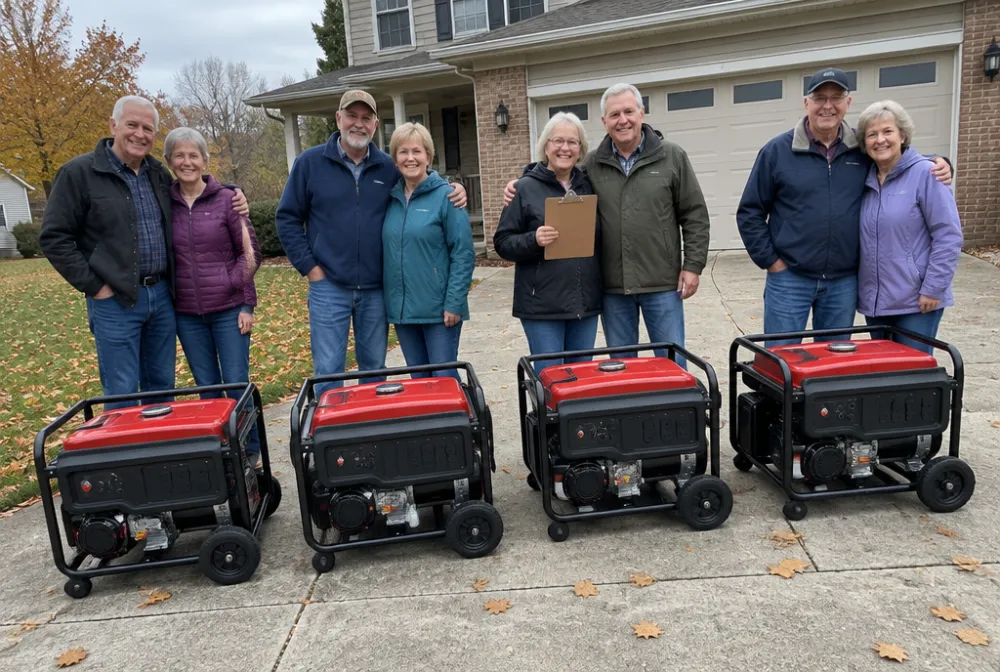
Bill Whitfield, Tom Archer and 41 others18 comments
Stories · Home & Winter
Eight months after my husband died, the whole street got ready for winter without me. This is what I did instead, and what my neighbor saw on day two of the ice storm.
For seven years, the four couples on our street talked about going in together on generators for the winter. Ray and me included.
Eight months after Ray died, I open Facebook and there they are.
Our street is finally ready for winter! Four houses, four generators, one fuel schedule. Proud of these guys.
Four couples in Bill and Sharon's driveway, four new generators lined up on the concrete. Sharon in the middle, holding the fuel schedule.
I called her right away. She used that voice. The patient one you use with a child.
"Oh Janet, we just didn't think it made sense. It's the husbands' project now. They take turns."
And honestly, she said, there's the whole practical side of it. A generator isn't a plug. It's oil, it's fuel, it's a cord you pull at two in the morning in the ice.
"Your well pump. Your pipes. Ray always handled all that for you. We just didn't think you could handle it on your own."
Translation. Without a man in the house, you'll freeze.
It's better this way, she said. She said I'd end up calling my son at three in the morning.
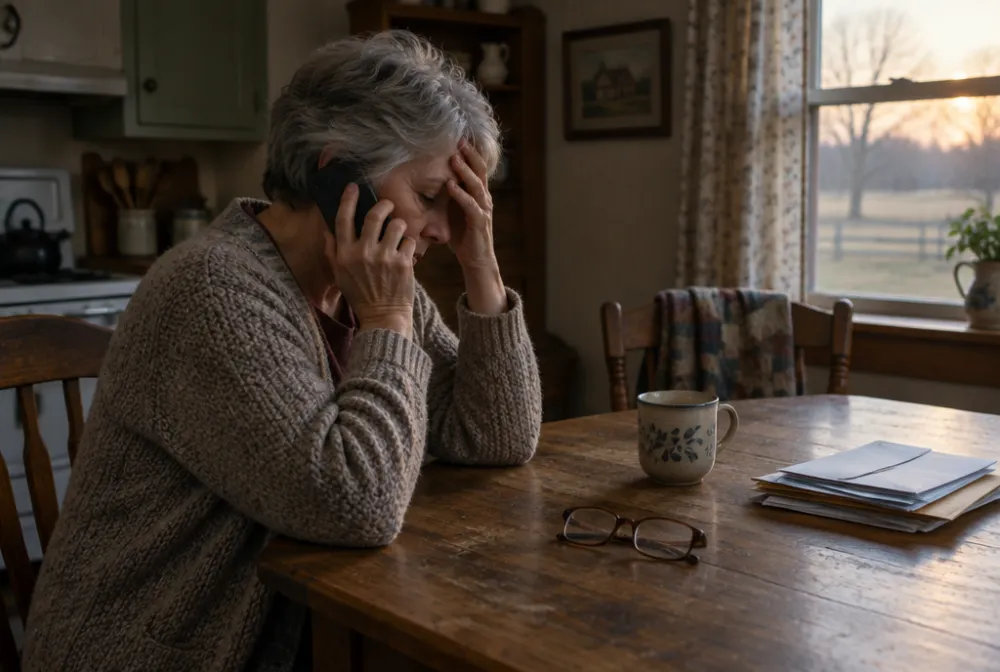
I sat there for about an hour. She wasn't calling me a widow. She was calling me incapable.
Ray taught me to change a tire. He didn't teach me to be useless.
So I decided to get the house ready myself. Same winter. Same street.
And then I sat down at the kitchen table and realized I had no idea what I was doing. I want to be honest about this part, because it's the part nobody tells you.
I downloaded four free PDFs. Every one of them had the same list. Water, flashlight, canned food, batteries.
I watched eleven hours of YouTube and came away knowing exactly what a solar panel looks like, and nothing about what my house needed first.
I joined a Facebook group and asked where a woman my age should start. Somebody told me to just buy a generator like everybody else. Thirty people liked it.
So I bought one. The biggest one at the store.
I bought a nine dollar ebook off an ad. It had a chapter about pulling drinking water out of the air with a machine that runs on electricity, and a photograph of a cabin that doesn't exist. Nobody wrote that book. Something generated it.
So I built my own spreadsheet. Two hundred and forty rows, pulled off blogs, color coded.
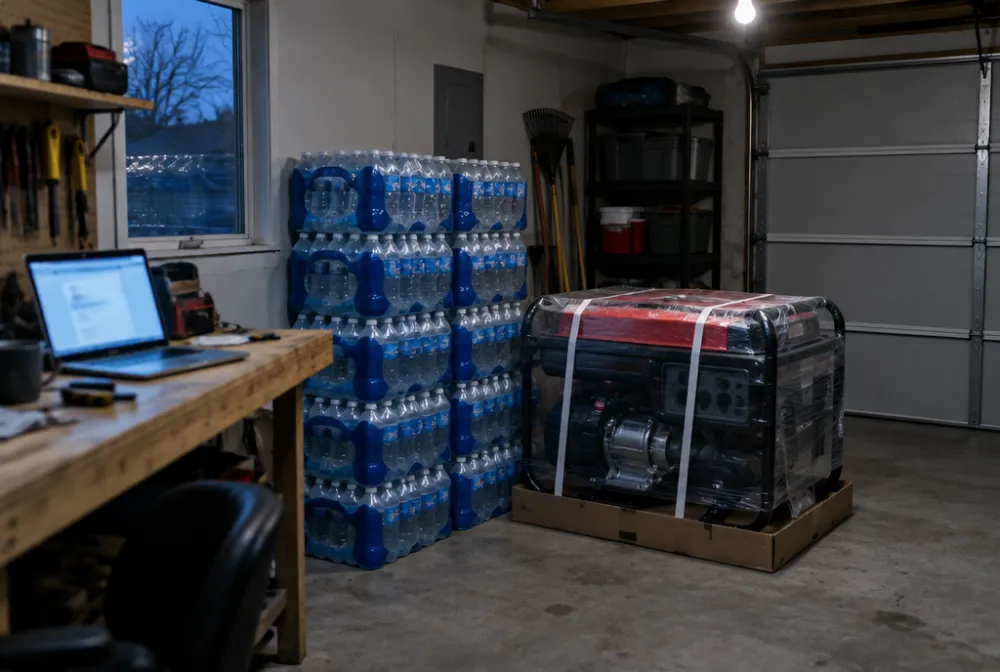
I stacked twelve cases of water in the garage and felt prepared. That lasted until October.
The first windstorm of the fall took the power out on a Friday afternoon.
Hour one, I opened the freezer three times looking for the flashlight I'd put in row nine.
Hour three, I turned on the kitchen faucet and it coughed and stopped. The well pump runs on the same power as the lights. Not one of those blogs said so. I hadn't filled a single pot.
Second night. Nine forty. Forty-eight degrees in the kitchen. Phone at six percent. And row one hundred seventeen of my spreadsheet says: start the generator.
I pulled that cord until something in my shoulder said no. It never turned over.
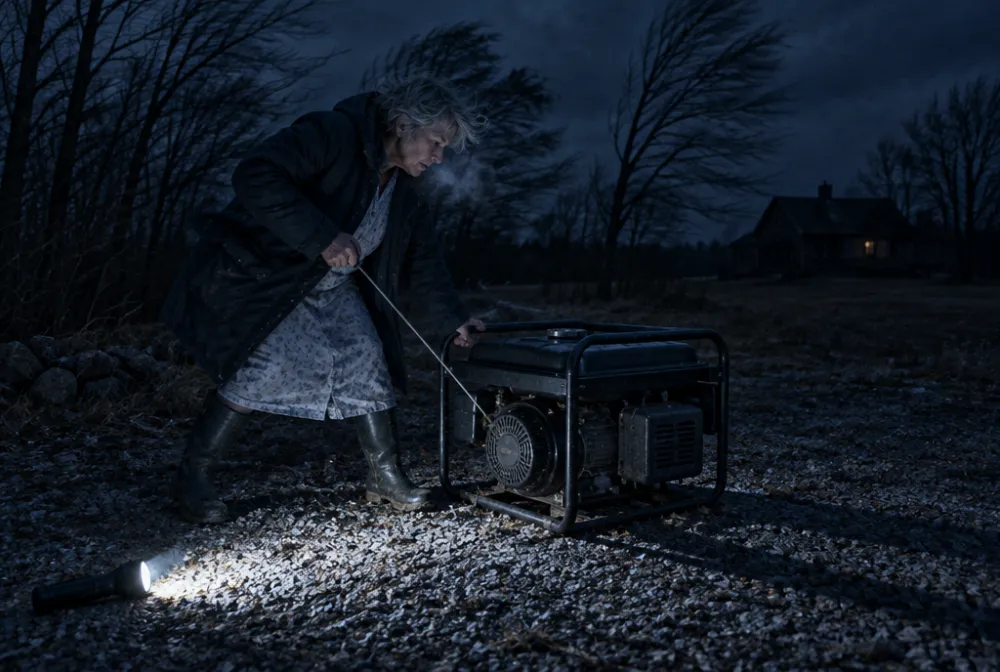
I went and sat in the car with the doors locked so I could charge my phone, and I cried. I need you to understand it wasn't about the generator.
It was that Sharon was right.
I drove out to the hardware store on the highway because it was the only lit thing for miles. It was running on its own generator. There was a line of men out the door buying the last ones.
And there was a woman out in the lot loading cinder blocks into a truck. Seventy, maybe. Sun on one arm. She asked if I was okay, which tells you how I looked.
I told her the whole thing. The street, the spreadsheet, the cord.
She walked to her truck and came back with a book. Thick, beat to hell, a rubber band around it holding the whole thing shut. Sticky notes coming out the top edge.
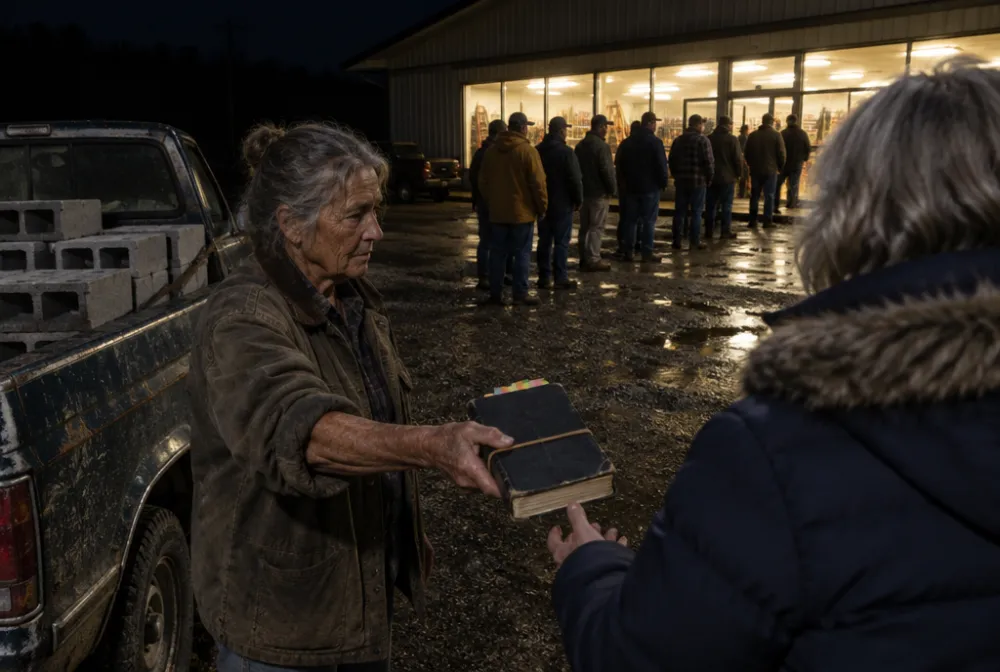
She opened it to the water chapter and turned it toward me. Every project on that page had the cost, the time and how hard it was printed right at the top. And a photograph for every single step, somebody's hands in every one.
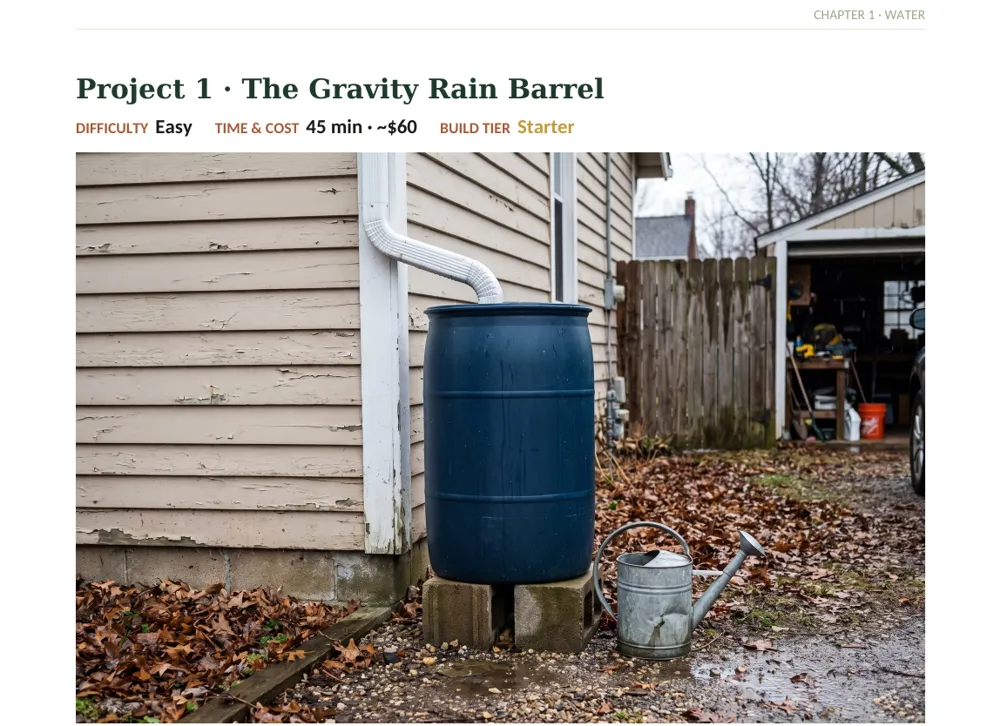
She put her finger on one. "That's the first one I built," she said. "My husband passed in twenty nineteen. I'd never held a drill."
"A Navy SEAL built every one of these with his own hands before he wrote a word of it. Somebody actually built this. That's the whole difference."
The Off-Grid Handbook. It's a real book, on paper, so it works when the lights don't.
I ordered it standing in that parking lot. This is the book she handed me, if you want to see it →
When it showed up on my porch, it was heavier than I expected.
Project one. A barrel under the downspout, two concrete blocks, one spigot. No pump, nothing to switch on.
Forty-five minutes, it said. About sixty dollars. It took me an hour and ten, because I read every step twice.
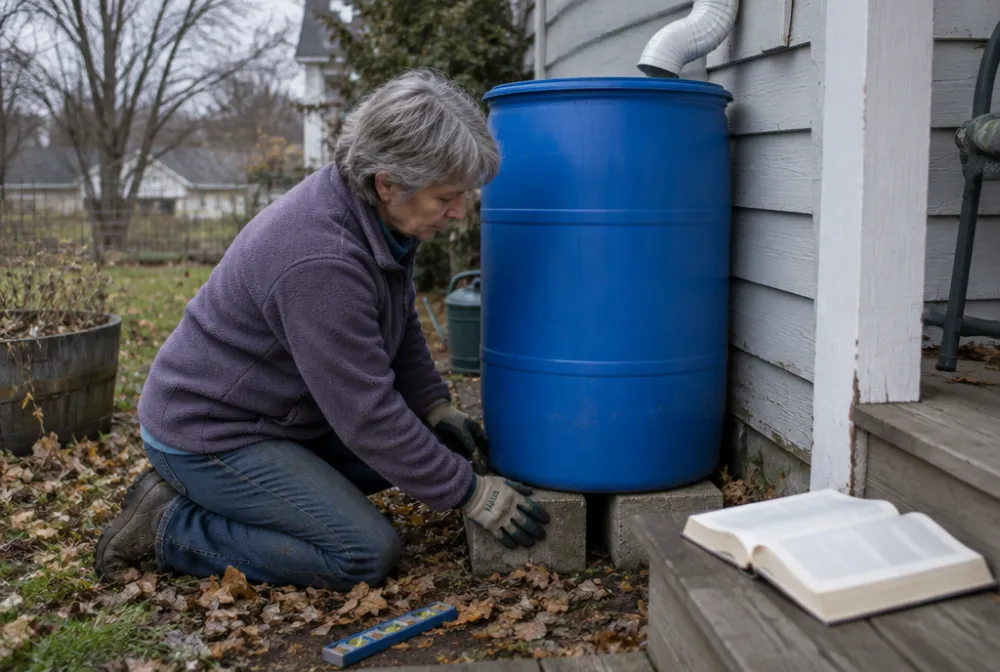
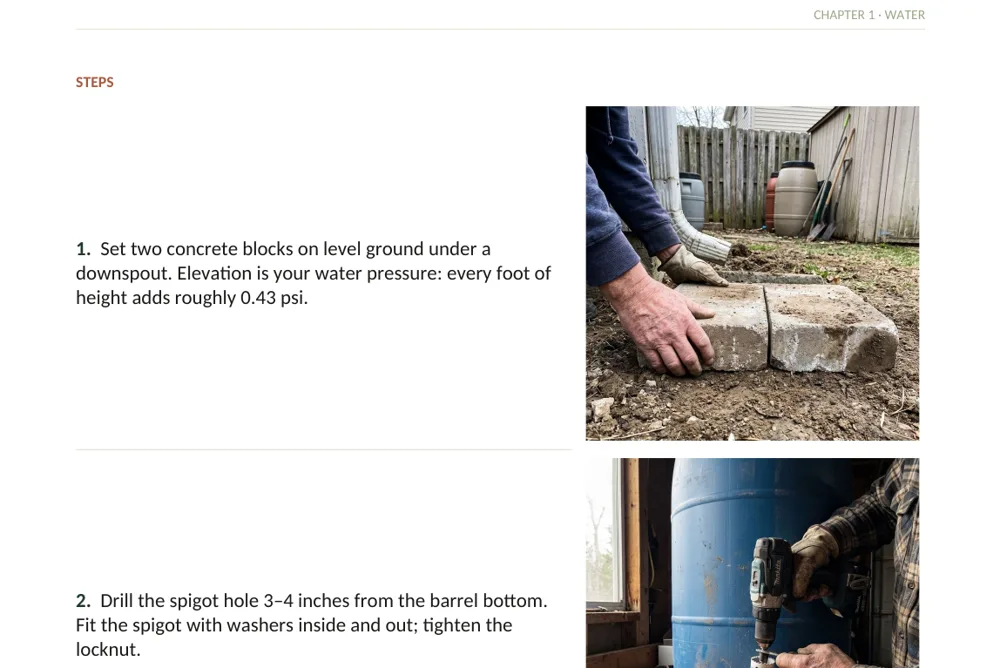
Everything after that is just the house working. By the third weekend I stopped guessing.
It told me which builds were a Saturday morning, and which ones were a whole weekend pretending to be a morning. It gave me three ways to do the same system, depending on what I felt like spending.
It told me the mistake most first builds make, before I made it. Don't put the barrel on the ground.

It told me to sleeve the pipes in the garage in the fall, not the night they freeze.
I built the lights that turn themselves on when the power dies. I built a battery box that keeps the lights, the radio and the phones going for one to three days. I picked one room and got it ready to be the warm one.
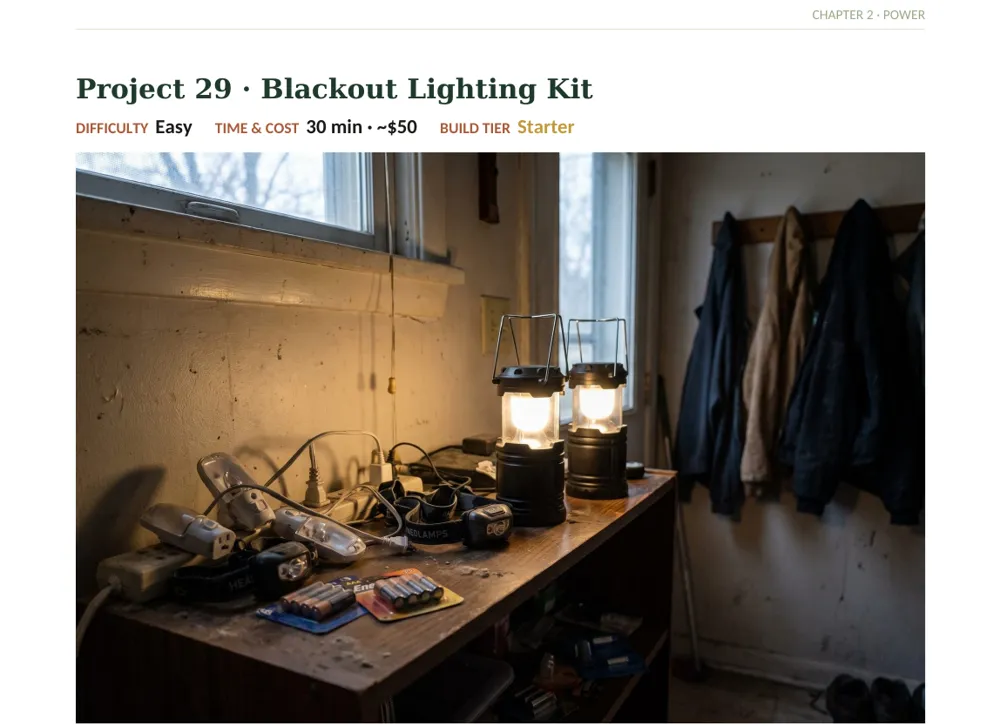
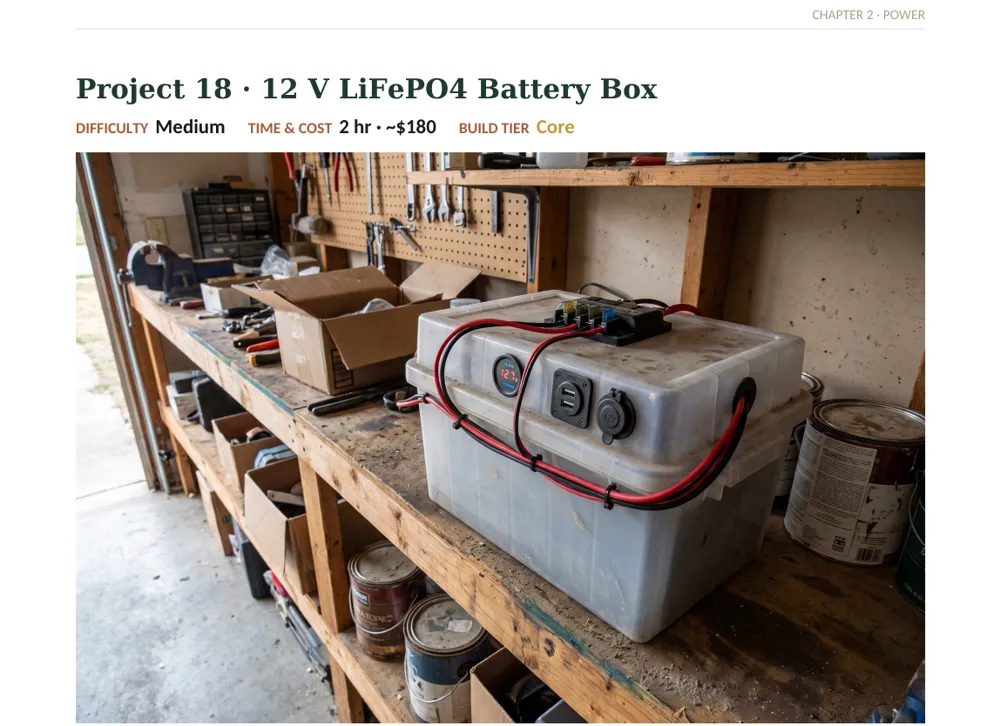
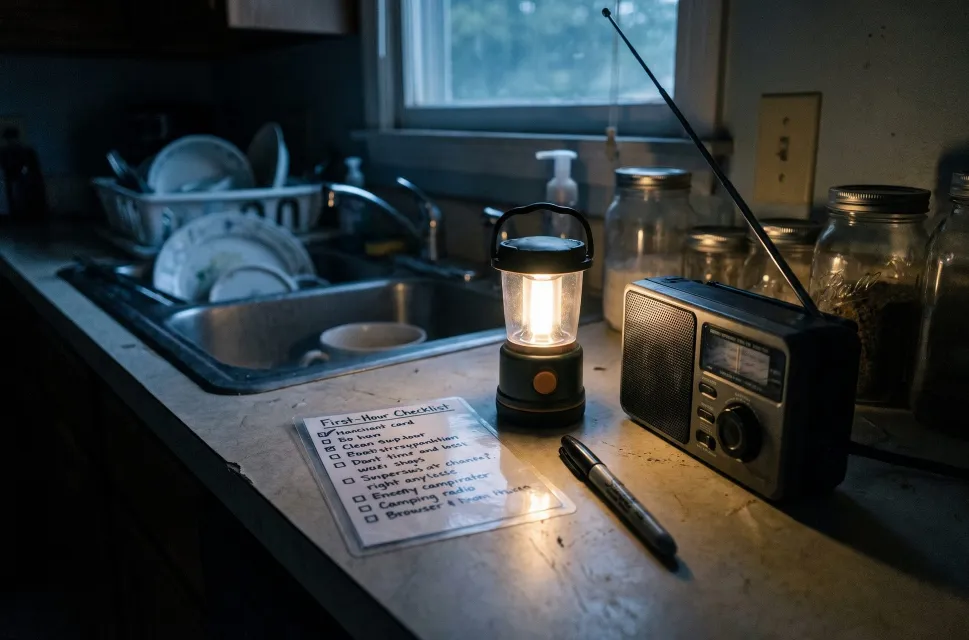
I wrote the first-hour checklist and stuck it on the fridge.
Eight weekends, and I never once called my son to ask how. See every project inside the Handbook →
The ice took out the whole county for four days.
Minute ten, I was filling the bathtub. The water pressure that fills a bathtub in minute ten is gone by hour three. I only knew that because page nine said so.
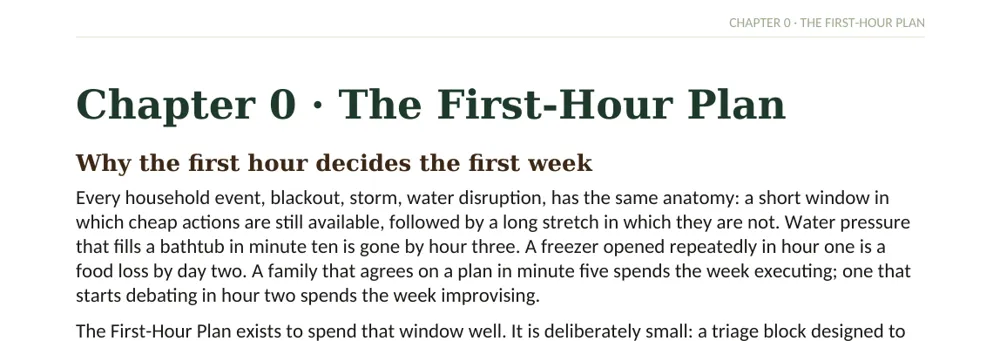
The night lights came on by themselves. The warm room was warm.
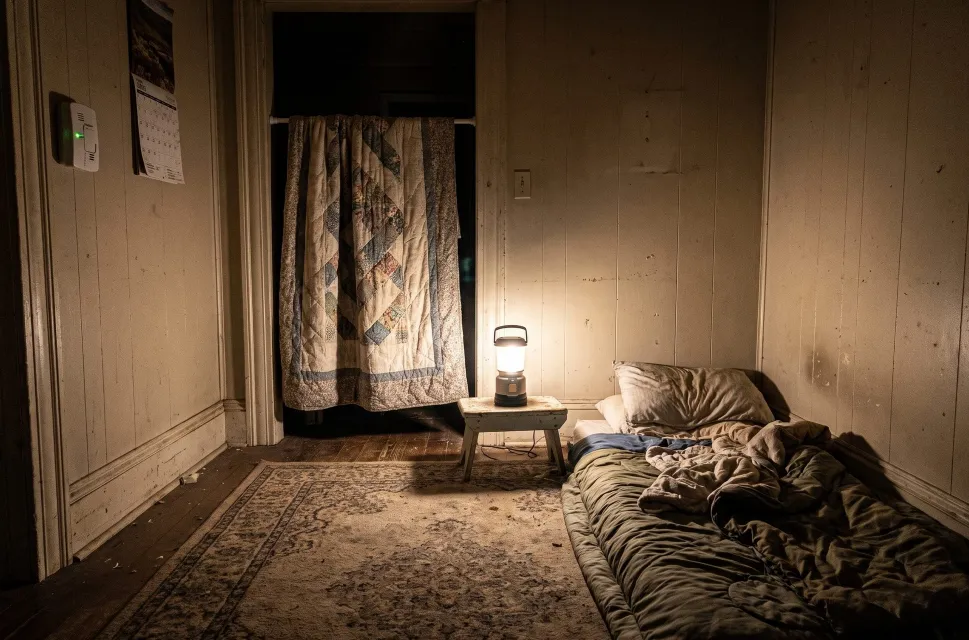
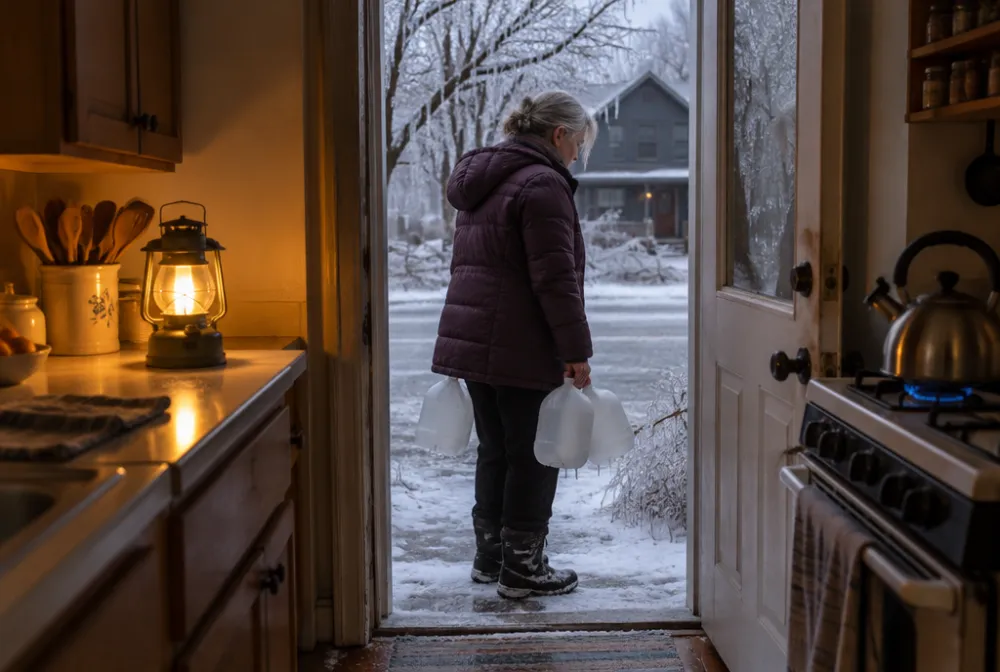
Second day, there's a knock at the back door. Sharon. Holding two empty jugs.
Their well pump died with the power, same as mine. Their generator ran dry the first night, and Bill had been in line for gasoline since six in the morning.
She sees the lantern, the warm room, the kettle going, and she stops. "Janet? You're okay?"
"Fine. Same storm as you."
She looks at the book on the counter. She laughs. "That's what you've been using? A book? Where's your generator?"
"In the garage," I said. "It's all in here, Sharon."
"That's not possible." She says it loud enough for the whole kitchen to hear. "You clearly didn't think this through. Ray would've had the generator running by now."
And then there's a second knock. Volunteer fire department, doing welfare checks on everybody over sixty-five on the road. Big guy, reflective vest, radio on his shoulder.
"Ma'am, we're just checking on..." He stops in the doorway. He's looking at the book. "Sorry. Is that the Off-Grid Handbook?"
I look up. It is. Sharon says, "What, what is it." He ignores her completely.
"My wife's been after me to get the printed one since last winter." He asks if he can look. I turn it around and he goes through it standing up.
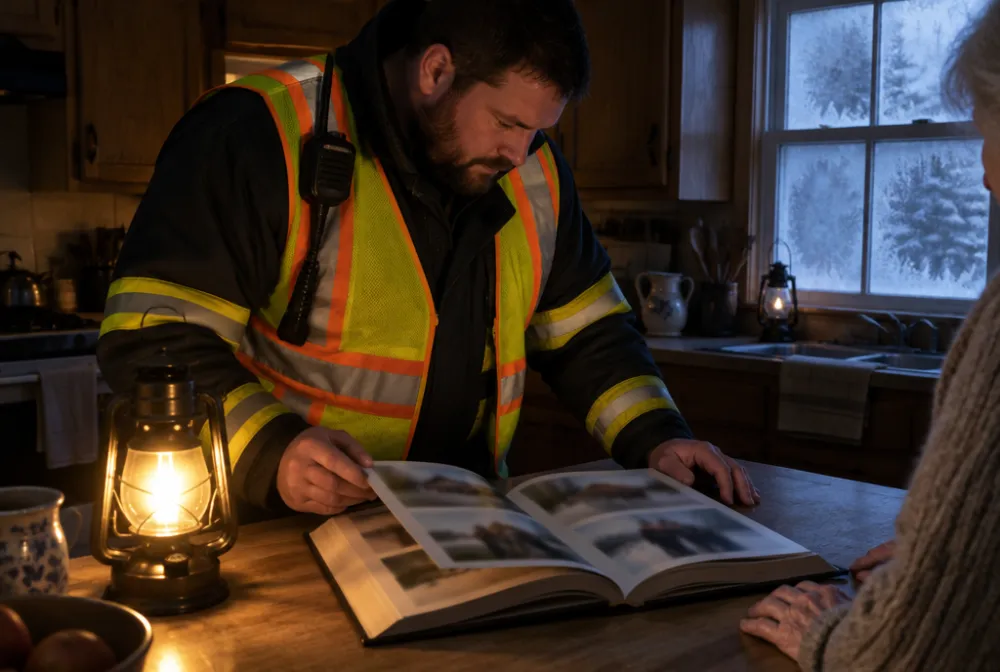
He stops on the page about frozen pipes and reads it out loud.
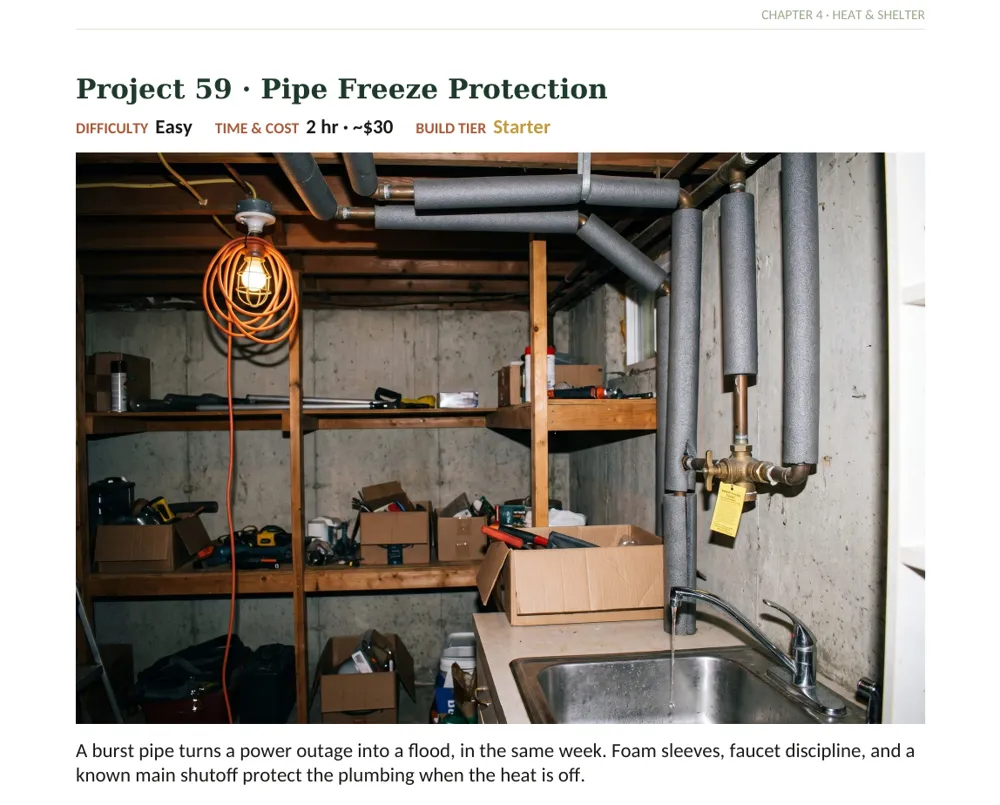
"A burst pipe turns a power outage into a flood, in the same week."
"Fourteen years I've been doing these checks," he says, "and that's what ruins people's houses. I've never seen a book put the cost on the page before you buy a thing."
He takes a picture of the cover. "Half my calls tonight are going to be somebody who can't get a generator started."
Behind him, Kayla from the end of the road comes in to charge her phone off my battery box. She runs the county Storm Watch group on Facebook. About forty thousand members.
She sees the book. "Oh my God, is that the Off-Grid Handbook? Everybody in the group asks me what they should actually build first. I've been trying to get the printed copy since the summer."
The firefighter laughs. "Right?" She asks if she can photograph it and takes ten shots from every angle. "I'm posting this tonight," she says.
Sharon is still standing there. Her house across the street is dark. The pipes in their garage froze the second night. She's been calling the power company every morning on a phone with no bars.
"Were you saying something about how I couldn't handle the house without Ray?"
She went red and didn't answer. I filled her jugs from the barrel anyway. For the toilet.
The power came back Thursday. Bill texted me first.
I haven't decided. Then this morning, a message from Sharon.
I took a screenshot and sent it to the woman from the hardware store. We've been texting since October.
Then I answered Sharon. They print it in small runs. Check the site. She hasn't written back.
Here's what I actually learned, and it isn't what you think.
They didn't count me out because I'm a widow. They counted me out because they assumed I couldn't handle a house without Ray. And for one night in October, they were right.
Not because I'm not capable. Because I was getting ready off free PDFs, YouTube and a spreadsheet I built out of blog posts, and not one line of it had ever been built by anybody.
What I was missing was never a husband. It was one person who'd actually built it and photographed every step.
The book didn't make me capable. It stopped me from being sabotaged by people who never picked up a drill.
Sharon watched me come through four days of ice warm, lit and with water, while her husband stood in line for gasoline. She watched a firefighter and the woman who runs the Storm Watch group both ask me where I got it. A few days later she texted me asking the exact same thing.
She spent the storm waiting on the power company. I spent mine at home.
Mine came in January. Yours might come in November, or with the next windstorm on a Friday afternoon.
Project one is forty-five minutes and about sixty dollars. Start there.
Go build it before it does. You can do anything you set your mind to.
Get the printed HandbookP.S. If you're thinking "I'm not handy," neither was I. Neither was the woman in the parking lot. Every project tells you how hard it is before you start, and the first ones use tools you already own.
P.P.S. It's a real printed book, and they print it in small runs. When a run sells out, you wait for the next one. See if this run is still available.
P.P.P.S. You're covered for 30 days. Build a tier-one project, and if it doesn't come together the way the photos show, send the book back for a full refund. Order with the guarantee.