Can you use a pressure cooker for canning? Why a cooker is not a canner
A pressure cooker and a pressure canner look like cousins. For canning low-acid food, the difference is the whole safety margin.
In this article
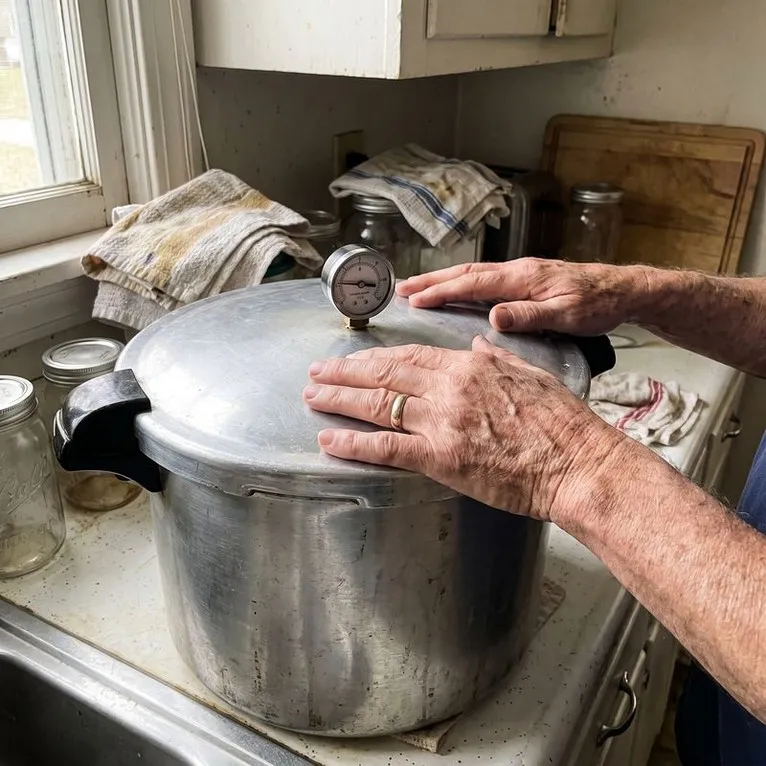
Can you use a pressure cooker for canning? No, not with USDA canning processes. Those processes were developed for stovetop pressure canners large enough to hold at least four quart jars standing upright. The National Center for Home Food Preservation (NCHFP) recommends against small stovetop pressure cookers, and it does not support canning in electric multi-cookers, even ones with a "canning" button. The Off-Grid Handbook puts it in one line in the tool list for Project 32: a pressure cooker is not a canner.
Here is why the size and type of pot matter so much, and what to use instead.
Pressure cooker vs pressure canner
Both lock their lids and build steam pressure. They are built for different jobs:
| Pressure canner | Pressure cooker | |
|---|---|---|
| Purpose | Processing sealed jars for shelf storage | Cooking food to eat now |
| Size | Holds at least 4 quart jars upright, with the lid on | Usually smaller, less metal, less water |
| Gauge | Dial gauge or weighted gauge you can read or hear | Often a simple valve, or electronic sensors |
| Tested USDA canning processes | Yes | No |
The CDC gives the same rule in its botulism prevention advice: use a recommended pressure canner that holds at least four 1-quart jars sitting upright on the rack.
Why size matters: heat-up and cool-down count
It seems logical that 10 pounds of pressure is 10 pounds of pressure in any pot. The NCHFP explains why it isn't that simple. Pressure cookers have less metal, a smaller diameter and less water than canners, so they heat up faster and cool down faster.
That matters because the time a canner spends coming up to pressure, and especially the time it spends cooling back down, is part of the total heat the food receives. The USDA processing times assume the slower heat-up and cool-down of a full-size canner. In a small cooker, jars spend less total time at killing temperatures, and the published time may not be enough.
The USDA published its recommendation against pressure saucepans for canning in the late 1980s, and the NCHFP still holds that position. If a manufacturer offers its own directions for a small cooker, the NCHFP says to take those questions to the manufacturer, because they are not USDA processes.
Instant Pot canning and other electric multi-cookers
Electric multi-cookers are the most common version of this question. In its 2019 statement, the NCHFP said it does not support using USDA canning processes in electric multi-cooker appliances, including those with canning or steam canning buttons, even when the maker supplies instructions. Its reasons:
- No USDA thermal process work has been done with jars inside an electric pressure cooker, tracking the actual temperature inside the jars.
- Temperature matters, not pressure. A pressure reading on the appliance does not prove the food in the center of a jar got hot enough for long enough.
- Power can vary. The NCHFP questions whether surges or dips could drop the temperature during processing.
- The cool-down is part of the process, and a small electric pot can't reproduce the cool-down of a stovetop canner.
- Altitude. Pressure readings need adjusting at higher elevations, which these appliances don't reliably handle.
The statement makes an exception for appliances that are dedicated canners rather than multi-cookers: a non-pressurized electric boiling water canner, and an electric canner for acid foods only that has had its own thermal process development. If you own a dedicated electric canner, follow its instructions exactly and ask your county Extension office about it.
What goes wrong with low-acid food
This is not a matter of quality. Low-acid foods, which the CDC lists as all fresh vegetables, meats, poultry, fish, seafood, figs and some tomatoes, can carry Clostridium botulinum. The CDC says low-acid foods are the most common source of botulism linked to home canning. The USDA explains that its spores need 240 to 250°F to be destroyed in a reasonable time, which only a working pressure canner reaches.
Project 32's safety box is blunt: pressure canning is the only safe home method for low-acid foods, and that is USDA doctrine, not preference. Under-processed jars can look and smell normal. Never taste food from a jar you have doubts about. The CDC lists botulism symptoms as double or blurry vision, drooping eyelids, slurred speech, difficulty swallowing or breathing, and muscle weakness. If anyone shows these signs, see a doctor or go to the emergency room immediately; call 911 for trouble breathing. The handling steps for suspect jars are in signs of botulism in canned food.
Choosing a pressure canner
Project 32 of the Handbook prices a pressure canning setup at about $120 and a half day, and its field note says that half day is the learning curve, not the labor. Look for:
- Capacity of at least four quart jars upright on the rack with the lid closed.
- A dial gauge or a weighted gauge. A dial gauge needs testing every year, which county Extension offices commonly do. A weighted gauge needs no testing but adjusts in bigger steps. Compare them in dial gauge vs weighted gauge.
- The manual and the NCHFP process tables. The book's first step is to read the canner manual end to end once.
The CDC adds: keep the gauge accurate, clean lid gaskets as the manufacturer directs, vent before pressurizing, follow the cooling steps, and replace old processing times with current ones. The full method is in pressure canning for beginners, and the altitude tables are in canning at high altitude.
What your pressure cooker is good for
Keep the cooker. It is still useful for food that goes straight to the table, the refrigerator or the freezer:
- Cooking dried beans, stock and tough cuts quickly, then refrigerating or freezing the leftovers in containers.
- Making batches for the freezer, which needs no canning process at all.
For high-acid foods such as jams, fruit and pickles, you don't need any pressure equipment. Project 31 uses a deep stock pot with a rack as a water-bath canner. See pressure canning vs water bath to sort which foods go where, and water bath canning for beginners to start.
Frequently asked questions
Can you use an Instant Pot for canning?
The National Center for Home Food Preservation does not support using USDA canning processes in electric multi-cookers, even models with a canning button. No USDA testing has tracked jar temperatures inside them, and pressure readings alone don't prove the food got hot enough.
What is the difference between a pressure cooker and a pressure canner?
A pressure canner is large enough to hold at least four quart jars upright and has a dial or weighted gauge, and USDA processing times were developed for it. A pressure cooker is smaller, with less metal and water, so it heats and cools faster and the USDA times don't apply.
Can I water bath can in a pressure cooker?
You don't need one. High-acid foods such as jams, fruit and pickles can be processed in any pot deep enough to hold a rack and cover the jars with at least an inch of boiling water. Electric multi-cookers are not supported by the NCHFP for USDA canning processes.
Why can't you can vegetables in a pressure cooker?
Low-acid foods such as vegetables, meats and beans can carry botulism spores that need 240 to 250°F to be destroyed. USDA processes reach that safely only in a full-size pressure canner, whose slower heat-up and cool-down are part of the tested time.
Sources
- The Off-Grid Handbook, Garrett Dalton, Project 32
- NCHFP: Canning in Electric Multi-Cookers
- NCHFP: Canning in Pressure Cookers
- CDC: Home-Canned Foods and Botulism Prevention
- CDC: Botulism Signs and Symptoms
- USDA Complete Guide to Home Canning, Guide 1: Principles of Home Canning (PDF)
- National Center for Home Food Preservation: Using Pressure Canners
Safety guidance changes. Check the agency pages above for the current version, and follow your local code and manufacturer instructions.