A 30-day food supply list built from meals your family already eats
Ordinary groceries, in the amounts your household needs, bought a little at a time on normal shopping trips.
In this article
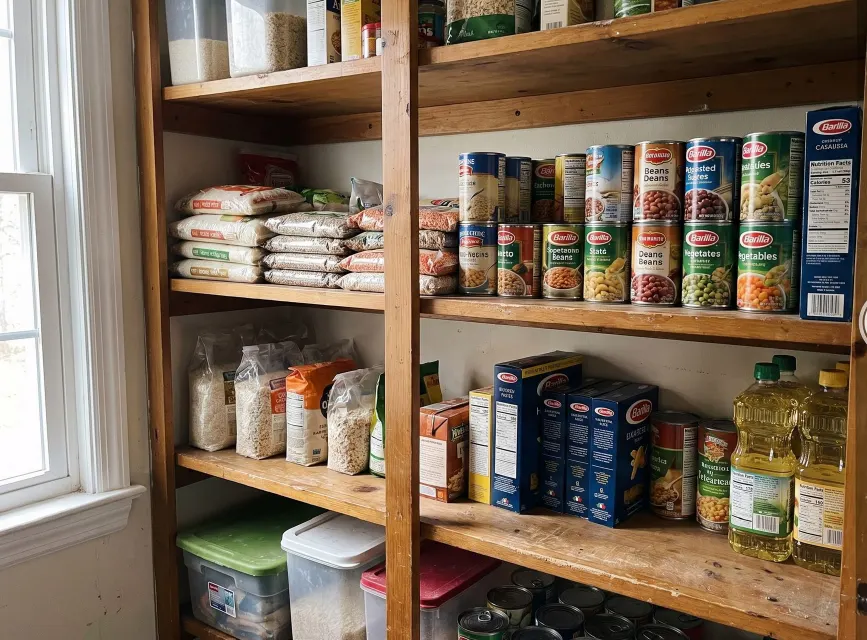
A 30-day food supply for one adult comes to roughly 10 pounds of rice, 8 pounds of beans, 5 pounds of pasta, 5 pounds of oats, 12 to 15 cans of protein, 20 or more cans of vegetables and fruit, 2 quarts of oil and 2 pounds of salt. Multiply by the number of people in the house and round up. The list works best when it comes from a 7-day menu your family already likes, repeated four times, at about 2,000 calories per adult per day.
Those quantities are the staple core from Project 37 of The Off-Grid Handbook. Below is the full list, how to scale it, and how to buy it without a single panic purchase.
The 30 day food supply list, per adult
The book calls these numbers approximate and menu-adjusted. Treat them as the backbone and adjust them to the meals you actually cook.
| Staple | Per adult, 30 days | Household of 4 |
|---|---|---|
| Rice | 10 lb | 40 lb |
| Dry beans and legumes | 8 lb | 32 lb |
| Pasta | 5 lb | 20 lb |
| Oats | 5 lb | 20 lb |
| Canned protein (tuna, chicken, beans, meat) | 12 to 15 cans | 48 to 60 cans |
| Canned vegetables and fruit | 20+ cans | 80+ cans |
| Cooking oil | 2 qt | 8 qt (2 gal) |
| Salt | 2 lb | 8 lb |
Sugar, coffee, spices and condiments fill in around the core, in whatever amounts your menu calls for. Add a manual can opener, which Ready.gov lists with any emergency food supply.
Start with a menu, not a shopping list
Most emergency food ends up expired in the back of a closet because nobody in the house wants to eat it. The book builds the pantry the other way around, and the field note sums it up: store what you eat, eat what you store.
- Write a 7-day menu of meals your household already likes that need only shelf goods and water. Repeat it four times and you have the 30-day plan.
- Turn the menu into a quantity list. Count the calories once, so the list is grounded in numbers rather than in how full the shelf looks.
- Buy on normal grocery runs. Each trip, add duplicates of two or three items on the list until you reach the target.
- Shelve it so the oldest gets used first, and eat from it normally. The reserve stays fresh because it is simply your pantry, deeper.
- Cross-check your water. Cooking this menu adds water on top of drinking water.
What a shelf-only week can look like
The menu is yours, but it helps to see the shape of one. Every meal below uses only staples from the list and water.
- Breakfast: oatmeal with sugar or dried fruit, and coffee
- Lunch: rice and beans with canned vegetables and a little oil and salt
- Dinner: pasta with canned tomatoes and canned tuna or chicken
- Side or snack: canned fruit
Swap in the dishes your family already asks for, and the list changes to match. The book calls the plan budget-scaled, so a household can build it slowly, and as your own canning and drying grow, home-preserved jars take over some of the store-bought lines.
How many calories per person per day in an emergency?
The book uses about 2,000 calories per adult per day as its rule of thumb. That matches the middle of the federal Dietary Guidelines, which estimate adult needs at 1,600 to 2,400 calories a day for women and 2,000 to 3,000 for men, depending on age and activity.
Older and less active adults sit at the low end. Anyone hauling water, splitting wood or clearing storm damage will burn more, so round up if your plan involves hard physical work.
30 day food supply for a family of 4
For a household of four, multiply every line of the per-adult list by four and round up, as the book does. Counting children as adults gives you a margin rather than a shortfall, and teenagers often eat like adults anyway.
Water is where a 30-day plan gets serious. Ready.gov says to store at least one gallon per person per day for drinking and sanitation, and the book adds roughly half a gallon per person per day for cooking rice, beans and pasta. For four people over 30 days, that is about 180 gallons.
Few households store that much at once, which is why the water plan matters as much as the food. Start with how much water per person per day, and run your own household through the emergency supply calculator.
Emergency food storage list: what keeps, and for how long
The USDA gives these shelf-life ranges for unopened food stored on a pantry shelf:
- Rice and dried pasta: 2 years
- Low-acid canned goods (meat, poultry, stews, most vegetables, beans): 2 to 5 years
- High-acid canned goods (tomatoes, fruit, juices, pickles): 12 to 18 months
- Home-canned foods: 12 months
Heat shortens all of it. The USDA recommends a cool, dry spot below 85°F, and never above the stove, under the sink or in a damp garage. Skip any can that is bulging, leaking, rusted through or deeply dented.
Rotation is what keeps a deep pantry from turning into a museum. A DIY can rotation rack loads at the back and serves from the front, so the oldest can always comes out first. As your own preserving grows, water bath canning adds jars of fruit and tomatoes to the same shelves.
Cooking it when the power is out
Rice, beans and oats need heat, water and time. Keep part of the supply ready-to-eat: canned meats, fruits, vegetables, peanut butter and dried fruit can be eaten without cooking, which Ready.gov specifically recommends.
For the rest, plan a safe way to cook. Charcoal grills and camp stoves are outdoor-only appliances, never used inside the house or garage. The options are covered in how to cook without electricity.
Frequently asked questions
How much food do I need for 30 days?
For one adult, a practical core is about 10 pounds of rice, 8 pounds of dry beans, 5 pounds each of pasta and oats, 12 to 15 cans of protein, 20 or more cans of vegetables and fruit, 2 quarts of oil and 2 pounds of salt. That is sized to roughly 2,000 calories a day and should be adjusted to the meals you actually eat.
What is a 30 day food supply for a family of 4?
Multiply the per-adult list by four and round up: about 40 pounds of rice, 32 pounds of beans, 20 pounds each of pasta and oats, 48 to 60 cans of protein, 80 or more cans of vegetables and fruit, 2 gallons of oil and 8 pounds of salt. Plan water separately, at least one gallon per person per day plus cooking water.
How many calories per person per day in an emergency?
A common planning figure is about 2,000 calories per adult per day. The Dietary Guidelines for Americans estimate adult needs at 1,600 to 2,400 calories for women and 2,000 to 3,000 for men, depending on age and activity. Plan higher if the emergency involves hard physical work like hauling water or clearing debris.
How long does emergency food storage last?
According to the USDA, rice and dried pasta keep about 2 years, low-acid canned goods 2 to 5 years, high-acid canned goods such as tomatoes and fruit 12 to 18 months, and home-canned food about 12 months. Store everything in a cool, dry place below 85°F and rotate it so the oldest food is eaten first.
Sources
- The Off-Grid Handbook, Garrett Dalton, Project 37
- Ready.gov: Food
- Ready.gov: Water
- USDA FSIS: Shelf-Stable Food Safety
- Dietary Guidelines for Americans, 2020-2025
Safety guidance changes. Check the agency pages above for the current version, and follow your local code and manufacturer instructions.