How much food and water to store for an emergency: a calculator for people, pets and days
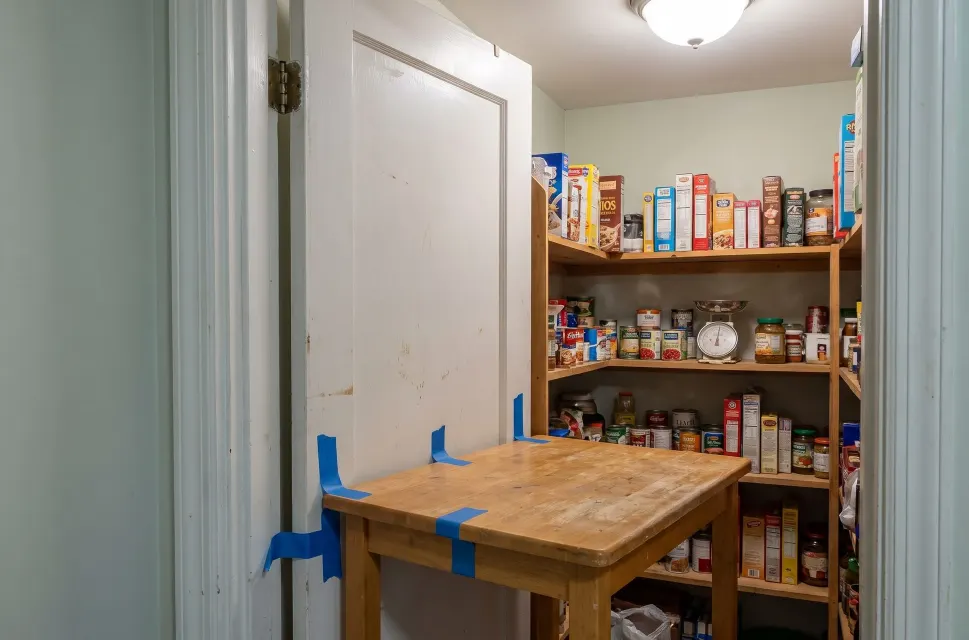
Every number below comes from one stocking table that fits inside a pantry door. Put in your household and the math is done.
In this article
Store 1 gallon of water per person per day and about 2,000 calories of food per person per day, for at least three days and ideally two weeks. A household of four needs 12 gallons and 24,000 calories for three days, or 56 gallons and 112,000 calories for two weeks. Add half a gallon to a gallon of water a day for each dog, and more for hot weather or anyone sick, pregnant or nursing.
The calculator above does that math for any household. Enter people, pets and days, and it returns gallons of water, total calories and a basic pantry list. The rest of this page explains where each number comes from, so you can adjust it for your own house.
How much water to store per person
The baseline is one gallon per person per day, for drinking and sanitation. That is the Ready.gov figure, and Project 5 of The Off-Grid Handbook builds its storage table on it.
Ready.gov asks for that gallon "for several days." The American Red Cross is more specific: a 3-day supply if you have to leave, a 2-week supply at home, which is why the calculator starts at 14 days.
Some people need more. Ready.gov notes that children, nursing mothers and sick people may need extra, and that in very hot temperatures water needs can double. Cooking dry staples like rice and beans adds roughly half a gallon per person per day, per the book's pantry plan.
For containers, rotation and well water, see how much water per person per day. If stored water runs out, how to purify water with bleach gives the ratio.
How many calories per person per day?
The calculator uses 2,000 kcal per person per day, the book's rule-of-thumb energy target for an adult. It is also the figure the FDA uses as a general guide on the Nutrition Facts label, while noting that real needs vary with age, sex, height, weight and activity.
Counting calories once keeps a food reserve honest. A shelf can look full and still hold only a week of energy, because volume says little about what a family can live on.
Treat the total as a planning number. A household with small children will need less than the calculator shows, and one doing hard physical work in the cold will need more.
Emergency food calculator: what the pantry estimate means
Calories alone don't tell you what to buy. The pantry estimate takes the book's 30-day staple core for one adult, scales it to your household and number of days, and rounds up.
| Staple | Per adult, 30 days |
|---|---|
| Rice | 10 lb |
| Beans and legumes | 8 lb |
| Pasta | 5 lb |
| Oats | 5 lb |
| Canned protein | 12 to 15 cans |
| Canned vegetables and fruit | 20 or more cans |
| Cooking oil | 2 qt |
| Salt | 2 lb |
For four people over 14 days, that works out to about 19 lb of rice, 15 lb of beans, 10 lb each of pasta and oats, 23 to 28 cans of protein and at least 38 cans of vegetables and fruit. The book calls these numbers approximate and menu-adjusted: write a 7-day menu your household already eats, then buy toward the list a few items per grocery trip. The 30-day food supply list walks through the menu method.
Adding pets to the math
Project 74 of the book puts animals on the same table as people. Its rule of thumb: a dog drinks roughly half a gallon to one gallon a day, and livestock far more, so their water is the first thing to plan.
University of Georgia Extension gives the same half-to-one-gallon range per pet per day. The calculator counts each pet at 1 gallon, the top of the range, so the total errs on the side of water left over; if your animals are small, the low end is closer to reality.
Pet food is counted by each animal's normal daily ration, not calories. The book's pet module holds two weeks of food per animal, plus medications, a leash or carrier, vaccination copies and a photo of each animal with the family, covered in pet emergency preparedness.
How long will my supplies last?
Run the math backward. Divide the gallons you have by the gallons your household uses per day, and divide your stored calories by 2,000 times the number of people.
Example: 30 gallons of water for two adults and one dog lasts 10 days, at 3 gallons a day. A pantry holding 60,000 calories feeds the same two adults for 15 days, and the shorter of the two numbers is how long you can stay home.
For the three-day version packed into two tubs, see the 72-hour kit checklist.
The two-week threshold table
Project 65, Threshold Tables, gathers every standing number into one page posted inside the pantry door. Here is its two-week base by household size.
| Item | 2 people | 4 people | 6 people |
|---|---|---|---|
| Water | 28 gal | 56 gal | 84 gal |
| Staple calories | about 56,000 kcal | about 112,000 kcal | about 168,000 kcal |
| Cooking fuel, 20 lb propane equivalents | 1 | 1 to 2 | 2 |
| Lighting | 1 headlamp each, 2 lanterns | 1 headlamp each, 3 lanterns | 1 headlamp each, 3 lanterns |
| Prescriptions | A 2-week margin per person, where prescribers allow | ||
Propane stoves and grills are for outdoor cooking only, never inside the house or garage.
The table works because of the par rule: when an item touches its threshold, it goes on the next normal shopping trip. Audit once, honestly, weighing and counting, and the gap between the table and your shelves becomes the shopping list.
The book's field note says households fail at maintenance, not acquisition. Review the table every quarter and re-scale it when someone moves in or out.
Frequently asked questions
How much water should I store for an emergency?
Store at least one gallon per person per day, for drinking and sanitation. The American Red Cross recommends a 3-day supply for evacuation and a 2-week supply at home, which is 56 gallons for a family of four. Store more for hot climates, children, nursing mothers and anyone sick, and add water for pets.
How many calories do you need per day in an emergency?
A common planning number is about 2,000 calories per adult per day, the rule of thumb The Off-Grid Handbook uses and the general guide on the FDA's Nutrition Facts label. Real needs vary with age, size and activity, so small children need less and people doing hard physical work need more. For two weeks, plan about 28,000 calories per adult.
How much water does a dog need in an emergency?
Plan on roughly half a gallon to one gallon of water per dog per day, the range used by The Off-Grid Handbook and University of Georgia Extension. Small dogs and cats sit at the low end. Store it with the household water and count it in your totals, along with two weeks of your pet's usual food.
How long will my emergency supplies last?
Divide your stored water by your daily use: one gallon per person plus up to a gallon per pet. Then divide your stored calories by 2,000 times the number of people. Two adults and a dog with 30 gallons have 10 days of water; with 60,000 calories they have 15 days of food. The shorter number is your limit.
Should I store 3 days or 2 weeks of supplies?
Both, for different jobs. Three days of water and food is the kit you can carry if you must leave, and two weeks is the reserve for riding out a longer event at home, as the American Red Cross recommends. Start with three days, then build toward two weeks a few items per grocery trip.
Sources
- The Off-Grid Handbook, Garrett Dalton, Project 65, with the numbers from Projects 5, 37 and 74
- Ready.gov: Water
- American Red Cross: Survival Kit Supplies
- FDA: How to Understand and Use the Nutrition Facts Label
- University of Georgia Extension: Emergency Preparedness
- Ready.gov: Pets and Animals
Safety guidance changes. Check the agency pages above for the current version, and follow your local code and manufacturer instructions.