72-hour kit checklist: what goes in a three-day emergency kit at home
Most of a three-day kit is already in your house. The work is pulling it into two labeled tubs and leaving it alone.
In this article
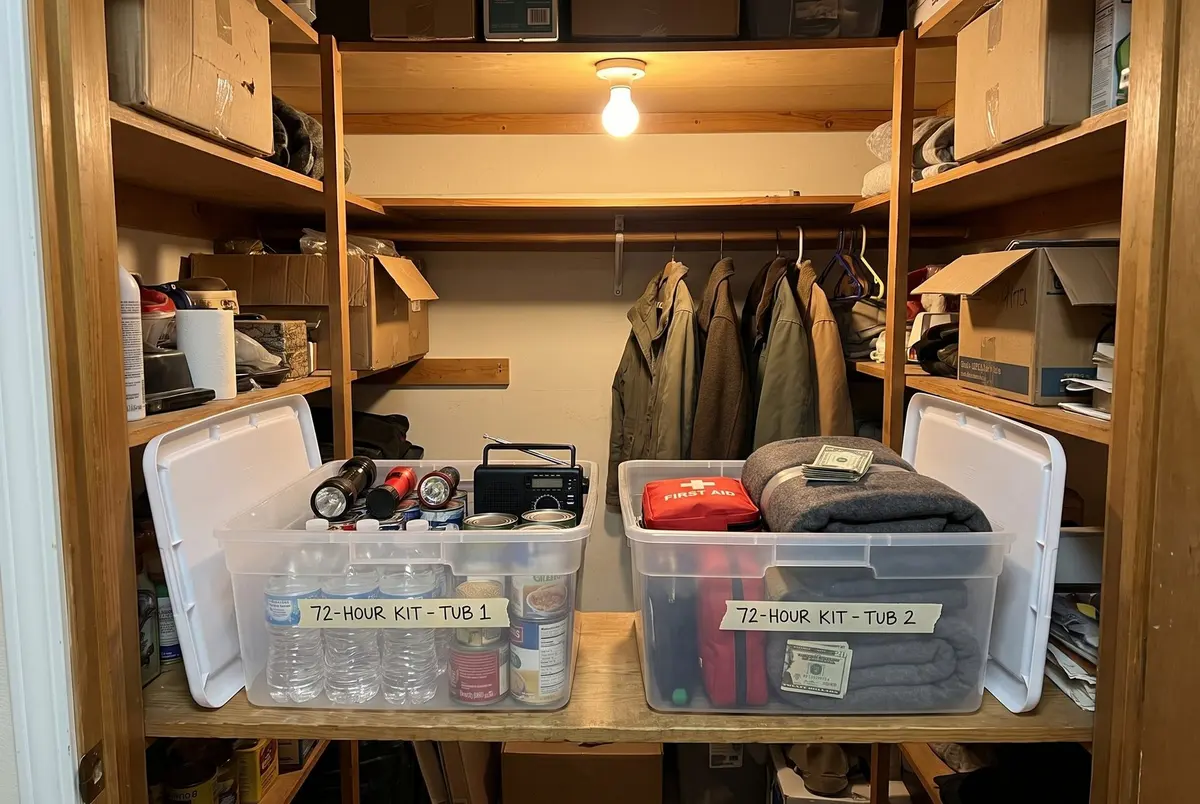
A 72-hour kit holds what your household needs for three days without power, running water or stores: 3 gallons of water per person, three days of food that needs no cooking, light, a battery or hand-crank radio, a first aid kit, medications, warmth, hygiene supplies, document copies and small-bill cash. Pack it in two labeled tubs in one closet everyone knows. Most of it you already own.
Stay kit vs. go bag
The Off-Grid Handbook's position is to stay put: for most realistic events, a prepared home is the strongest place to be. So Project 68 builds a 72-hour stay kit that makes the first three days smooth at home, and doubles as the grab-load in the rarer case that leaving is right.
The difference is size. The stay kit is everything in the tubs, and the go bag is the smaller set you carry out the door, listed in advance on the tub lid.
The American Red Cross draws the same line: a 3-day supply of water and food for evacuation, a 2-week supply for home. The 72-hour kit is the first step toward the larger reserve.
72-hour kit checklist
| Item | How much | Notes |
|---|---|---|
| Water | 3 gallons per person | 1 gallon per person per day; more in heat |
| Food | 3 days per person | No-cook: canned meals, nut butter, crackers, food bars; a manual can opener |
| Light | 1 headlamp or flashlight per person | Spare batteries; no candles |
| Radio | 1 | Battery-powered or hand-crank, with NOAA Weather Radio |
| Phone power | 1 charged power bank | Plus cables for every phone |
| First aid kit | 1 | Checked and restocked every quarter |
| Medications | Extra supply | The Red Cross suggests 7 days |
| Warmth | Blankets | Emergency blankets pack small |
| Hygiene | 3 days | Wipes, hand sanitizer, garbage bags, feminine supplies |
| Tools | 1 set | Whistle, wrench or pliers, dust masks, duct tape |
| Documents | Copies | Or a note saying where the go-binder is |
| Cash | Small bills | ATMs and card readers may be down |
The water line matters most. One gallon per person per day is the Ready.gov and Red Cross baseline, so a family of four needs 12 gallons for three days, and the emergency supply calculator scales it for your household and pets.
Fill the water from your regular stored supply rather than buying new. The book's storage rules apply: food-grade containers, labeled with the fill date, kept cool and dark and off bare concrete, and rotated every six months.
The radio is the piece that tells you when the event is over. A hand-crank emergency radio keeps working after the batteries run down.
The comfort layer people forget
A kit can tick every box and still fail in the middle of the night. The book lists what households tend to leave out:
- A margin of every prescription, where your prescriber allows
- Spare glasses or contacts, and hearing aid batteries
- Children's items: formula, diapers, a favorite book or game
- A three-day set for each pet: food, water, medications, leash or carrier
Pets need their own planning, because many public shelters can't take them. Pet emergency preparedness covers the pet module in full.
Medical and mobility needs
For older adults and anyone with a disability, FEMA's preparedness guide adds a few lines to the kit. Pack assistive devices such as hearing aids and mobility aids with spare batteries, a written list of your support network with their numbers, and food and supplies for any service animal.
If someone in the house depends on a powered medical device or refrigerated medicine, Ready.gov's advice is to talk to the medical provider about a power outage plan before you need one. Note the plan on a card in the kit, with the provider's number.
Keep a printed medication list in the kit too, with doses. If you have to see a new doctor or pharmacist during an event, it is the first thing they will ask for.
What goes in the go bag if you must leave
If the household has to relocate, there is no time to sort. Decide now what goes, and write the list on the tub lid.
- Documents: the emergency binder or its USB copy
- Medications and glasses
- Water
- Food bars
- Warmth: a blanket or jacket per person
- Cash
- Phones, chargers and the power bank
Keep a smaller version in each vehicle. The car emergency kit list covers what belongs in the trunk.
How to build a 3-day emergency kit in two hours
The book prices the kit at about $100 in materials, mostly because it consolidates instead of buying new. Work in this order:
- Get two clear plastic tubs, or one tub and a duffel, and label them.
- Pull water from your stored supply, three gallons per person.
- Pull three days of no-cook food from the pantry.
- Add the spare lighting set, a second radio or a power bank, and a first aid kit.
- Add blankets, hygiene basics, small-bill cash and the binder note.
- Add the comfort layer, then write the go-bag list on the lid.
- Date everything that expires.
Where to keep it, and how to keep it ready
The kit lives in one place, usually the closet of the room you would shelter in, and everyone in the house knows where. The book's rule: it is never quietly raided for camping.
Check dates and rotate food, water and batteries every three months. The book's field note sums up the point of the whole kit: it is 72 hours of not making decisions.
Frequently asked questions
What should be in a 72-hour kit?
At minimum: one gallon of water per person per day for three days, three days of food that needs no cooking, a manual can opener, a flashlight or headlamp for each person with spare batteries, a battery or hand-crank radio, a first aid kit, extra medications, blankets, hygiene supplies, a whistle, basic tools, document copies, small-bill cash and a charged power bank.
How much water do you need for a 72-hour kit?
Three gallons per person, based on the standard of one gallon per person per day for drinking and sanitation. A family of four needs 12 gallons. Add more for hot weather, for anyone sick, pregnant or nursing, and for pets, which need roughly half a gallon to one gallon each per day. Rotate stored water on a regular schedule.
What is the difference between a stay kit and a go bag?
A stay kit holds everything you need to get through three days at home without power or stores. A go bag is the smaller set you carry if you have to leave: documents, medications, glasses, water, food bars, warmth, cash and phones. Many households keep the stay kit in two tubs and write the go-bag list on the lid.
How often should you check a 3-day emergency kit?
Every three months is a good rhythm. Check the dates on food, water, medications and batteries, replace anything used or expired, and update the kit when your household changes, such as a new baby, a new pet or a new prescription. Keep it in one known place and do not borrow from it for camping trips.
Sources
- The Off-Grid Handbook, Garrett Dalton, Project 68
- Ready.gov: Build a Kit
- American Red Cross: Survival Kit Supplies
- FEMA: Disaster Preparedness Guide for Older Adults
- Ready.gov: Power Outages
- Ready.gov: Pets and Animals
Safety guidance changes. Check the agency pages above for the current version, and follow your local code and manufacturer instructions.