Hand crank emergency radio: what to buy, how to test it, and what the crank can't do
Some power tools are bought, not built. The crank radio is one of them, and it works best as part of a small kit that is tested and staged.
In this article
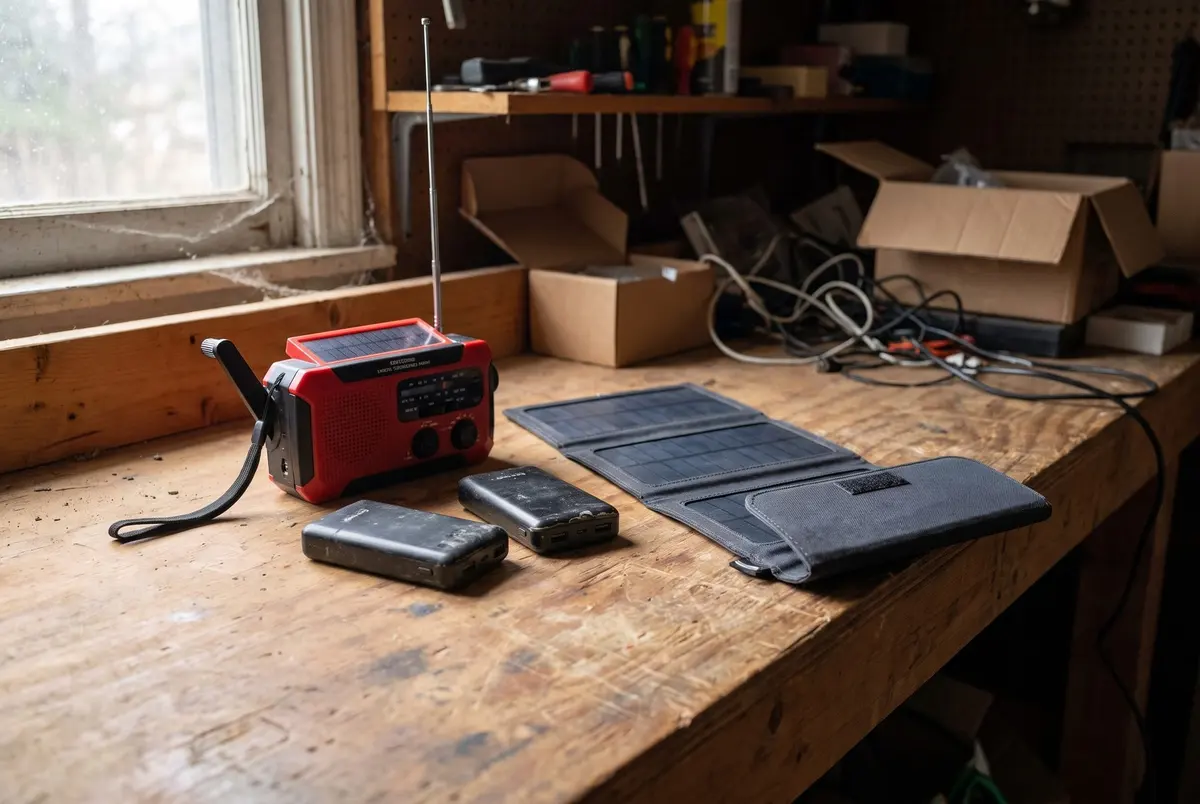
A hand crank emergency radio is a battery radio you can recharge by turning a handle or from its small built-in solar panel. The one worth owning receives the NOAA Weather Radio band, has a real USB output for charging a phone, and costs about $35, per The Off-Grid Handbook. Treat the crank as the backup's backup: two minutes of hard cranking buys a few minutes of radio and a sliver of phone charge.
Ready.gov's basic disaster kit lists exactly this: a battery-powered or hand crank radio and a NOAA Weather Radio with tone alert. Project 23 of the book assembles it into a small buy-side kit, tested on arrival and staged where you will reach for it.
What to look for in a hand crank emergency radio
The book's Gear Guide says to buy this one rather than build it, because the weather band matters and no homemade version comes close on price. Check these features before you buy.
- NOAA weather band. This is the main reason to own the radio.
- An alert or tone feature, so the radio can sound when a warning is issued.
- Crank plus solar charging, so you have two ways to refill it.
- Replaceable cells or LiFePO4 cells preferred, so a worn battery does not end the radio's life.
- Real USB output, tested on arrival, not just a port on the case.
- A built-in crank flashlight is a bonus, not a substitute for a headlamp.
What is a NOAA weather radio?
NOAA Weather Radio All Hazards is a network run by the National Weather Service. It broadcasts official warnings, watches and forecasts 24 hours a day, 7 days a week, from more than 1,000 transmitters covering all 50 states.
It needs a receiver built for it, which is why the band matters when you buy. Broadcasts sit on seven VHF frequencies between 162.400 and 162.550 MHz.
Many weather radios also support SAME, a coding system that lets you program your county so the radio alerts only for warnings that apply to you. The National Weather Service publishes the codes for every county.
If your radio supports it, program the code the day it arrives and write it on a label on the back of the radio. Reprogramming after a battery swap or a reset then takes a minute instead of a search.
How much power does cranking really make?
Less than the box suggests. The book's field note is blunt: two minutes of hard cranking buys a few minutes of radio and a sliver of phone charge.
That is enough to hear a forecast or a warning, and it is a real backup when everything else is empty. It is not a way to charge a phone, which is why the book pairs the radio with power banks and a solar charger.
The rest of the kit: emergency power banks and a solar charger
| Item | What the book specifies | What it is for |
|---|---|---|
| Crank radio | Hand-crank and solar, NOAA band, USB out, about $35 | Weather alerts and news |
| Power banks | Two, 10,000 mAh class | Phone charges for days |
| Solar charger | 10 W folding USB panel | Refilling banks and the radio in daylight |
| Cables | Short cable set in a labeled pouch | Never hunting for the right plug |
A 10,000 mAh bank stores about 37 watt-hours at its internal 3.7 volts. Using the book's own yardstick of roughly 12 watt-hours per phone charge, that works out to about two or three phone charges once conversion losses are counted.
Keep the cables with the banks, in a labeled pouch, so the kit never depends on finding the right plug in a dark house. The folding panel keeps the banks in play during a long outage. For a household that needs more, the book's DIY solar charging station returns hundreds of watt-hours a day.
How to test and stage your kit
- Buy to the criteria above: NOAA band, replaceable or LiFePO4 cells, real USB output.
- Test everything on arrival. Crank for two minutes and confirm that both the radio and the charge output work.
- Charge the power banks and put a quarterly top-up on the calendar. All lithium banks lose charge sitting in a drawer.
- Stage the radio and one bank at your first-hour station, and put the second bank in the vehicle kit described in our car emergency kit list.
- Log purchase dates. Retire a power bank at the first sign of swelling or fast self-drain.
Crank flashlight or headlamp?
Many crank radios include a small flashlight, and some sell crank flashlights on their own. They are useful as a last resort, but they share the crank's limit: a short burst of effort buys a short burst of light.
For real lighting, the book relies on headlamps at each bedside and LED lanterns in the shared rooms, covered in our guide to the best lighting for a power outage. Keep the crank flashlight as a spare in the kit, not as the plan.
Using the radio during an outage
In the book's first-hour plan, the battery radio goes on in the first twenty minutes, alongside the lighting stations, with phones switched to low-power mode. Our guide on what to do when the power goes out lays out that whole sequence.
After the first hour, the plan becomes a rhythm: radio on at the top of the hour and off between, to save batteries. The American Red Cross recommends having communication devices that work without home power, including a crank or battery radio.
A radio tells you what is happening, but it cannot tell your family where you are. Pair it with a family emergency communication plan, and pack a small radio in the 72-hour kit if you may need to leave home.
Frequently asked questions
Are hand crank radios worth it?
Yes, as a backup that never runs out. A crank radio with the NOAA weather band lets you hear official warnings when phones and power are down. Keep expectations realistic: The Off-Grid Handbook notes that two minutes of hard cranking buys only a few minutes of radio, so pair it with charged power banks and a small solar charger.
What is the difference between a NOAA weather radio and a regular radio?
A NOAA weather radio receives the National Weather Service's own network, which broadcasts warnings, watches and forecasts around the clock on seven VHF frequencies from 162.400 to 162.550 MHz. A regular AM/FM radio does not receive those frequencies. Many weather radios can also sound an alert when a warning is issued.
Can a hand crank radio charge a phone?
Only a little. Most crank radios have a USB port, but cranking produces a small amount of power: a couple of minutes of hard cranking gives a sliver of phone charge. For real phone charging, the book recommends two 10,000 mAh power banks and a 10-watt folding solar charger alongside the radio.
How often should I charge an emergency power bank?
Top them up every three months. All lithium power banks lose charge while stored, so The Off-Grid Handbook calls for a quarterly top-up on the calendar. Log the purchase date, and retire any power bank at the first sign of swelling or if it drains noticeably faster than it used to.
Sources
- The Off-Grid Handbook, Garrett Dalton, Project 23
- Ready.gov: Build a Kit
- National Weather Service: NOAA Weather Radio All Hazards
- National Weather Service: NWR Specific Area Message Encoding (SAME)
- American Red Cross: Power Outage Safety
Safety guidance changes. Check the agency pages above for the current version, and follow your local code and manufacturer instructions.