What size solar generator do I need? Start with a one-hour watt-hour audit
Before you compare boxes, spend one honest hour with a plug-in meter and find the number every backup power decision starts with.
In this article
Size a solar generator from your critical daily load in watt-hours, not from the size of the box. Add up the watt-hours your must-run devices use in a day, then buy a unit whose usable capacity covers one to two days of that load. For most households that skip the refrigerator, the critical load is 150 to 400 watt-hours a day, and carrying a modern fridge adds 1,000 to 1,500 more.
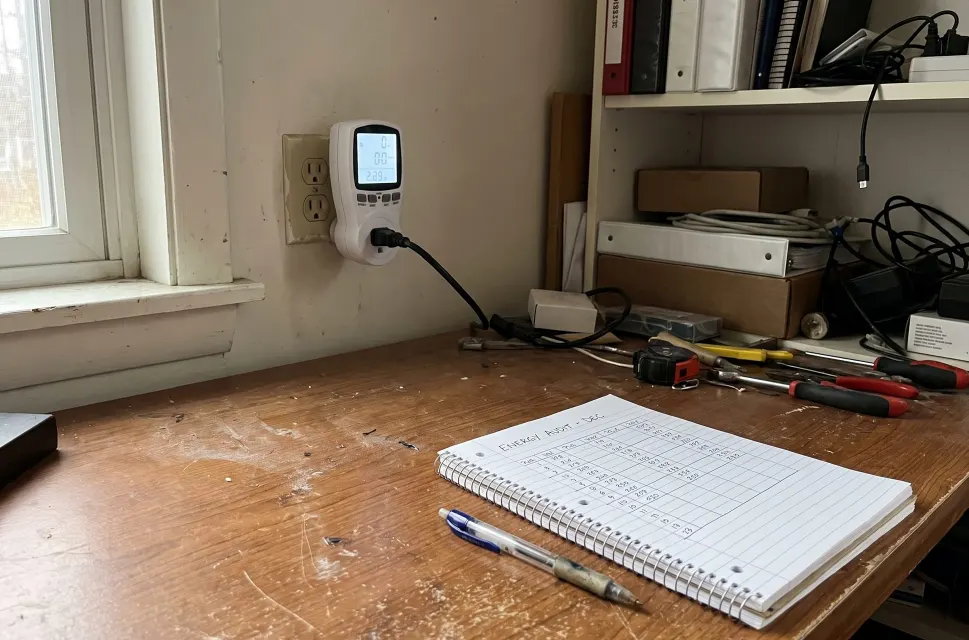
Those numbers come from The Off-Grid Handbook, which opens its power chapter with a one-hour measurement called the watt-hour audit (Project 17) and then uses it to choose a power station honestly (Project 27). Here is the method, the math and the four specs that matter.
What is a watt-hour audit?
A watt-hour is one watt used for one hour. The audit lists the devices that keep a household functioning in an outage and measures how much energy each one uses in a day.
The book is strict about the list: only critical loads. That means phones, a radio, lighting, medical devices, a fan, and the refrigerator only if you intend to carry it.
The audit usually brings good news, the book notes. People expect to need a whole-house solution, and the loads that keep a family functioning usually fit in a box you can carry.
Watt-hours calculator: how to do the math
For each device, multiply its watts by the hours it runs per day. Virginia Cooperative Extension uses the same formula, then divides by 1,000 to get kilowatt-hours.
- Plug each device into a plug-in energy meter (about $20, per the book), or read the wattage on its nameplate.
- Estimate honest hours of use per day during an outage, not on a normal day.
- Multiply: watts × hours = watt-hours per day for that device. A 10-watt lamp used for 5 hours is 50 Wh.
- Add the list. The total is your critical daily load.
- Write the number in your household binder and on the battery box, and redo the audit when your devices change.
Two details change the math. Refrigerators cycle on and off, so the nameplate wattage overstates daily use; the extension service suggests dividing plugged-in time by three as a rough guide, but a 24-hour reading on the meter is better. Motors also draw about three times their running current for a moment at startup, which matters for the inverter rating rather than the battery size.
How big a solar generator for home backup?
The book gives thresholds for the critical load without a fridge. Pair them with its rule that usable capacity should cover one to two days, and the size falls out.
| Household | Critical load per day (no fridge) | Usable capacity for 1 to 2 days |
|---|---|---|
| 2 people | 200 to 300 Wh | 200 to 600 Wh |
| 4 people | 300 to 450 Wh | 300 to 900 Wh |
| 6 people | 450 to 600 Wh | 450 to 1,200 Wh |
| Any size, plus fridge | Add the fridge's measured 24-hour figure, often 1,000 to 1,500 Wh | Add 1,000 to 3,000 Wh |
The fridge is the decision that changes everything else. Ready.gov says a closed refrigerator keeps food cold for about four hours and a freezer holds its temperature for about 48, which is why our guide to how long food lasts in the fridge without power is worth reading before you size the system around one.
The four numbers on the spec sheet that matter
Commercial power stations, usually sold as solar generators, put a battery, inverter, charge controller and outlets in one sealed box. The book calls them a legitimate shortcut and says to buy on four numbers only, since marketing names carry none of them.
- Usable watt-hours. At least one to two days of your audited critical load.
- Continuous inverter watts. Enough for your largest AC load plus 25%, with surge headroom for anything with a motor. See what size inverter you need.
- Solar input watts, along with the input voltage window. Your existing panels must fall inside that window before you connect them.
- Chemistry. The book prefers LiFePO4 (lithium iron phosphate).
Watch the word usable. LiFePO4 delivers 80 to 100% of its label, the book says, while lead-acid gives about half before you shorten its life, which matches the University of Arizona Extension's advice not to discharge a deep-cycle lead-acid battery beyond 50%.
How fast will solar panels refill it?
The book's rule of thumb: a 100-watt panel in decent sun returns 300 to 500 watt-hours a day. A household of four with a 400 Wh critical load comes close to breaking even on one panel in good weather, and a second panel gives a cushion for cloudy days.
If you would rather build than buy, the book's DIY solar charging station pairs one 100 W panel with a controller and a small battery, and its 12 V LiFePO4 battery box stores about 600 usable watt-hours. At small scale, the book admits, a good power station often beats the parts bin.
Give it one job and keep it charged
Project 27 assigns each box a role: a whole station for the fridge, or a portable node for the medical device and communications. One box, one job, so a tablet never drains the battery a medical device depends on.
When it arrives, cycle it fully once. After that, store it at the manufacturer's recommended charge level and top it up every quarter.
If anyone in the house relies on powered medical equipment or refrigerated medicine, Ready.gov advises talking with your medical provider about a power outage plan. That conversation also tells you which device belongs at the top of your audit.
A battery power station has one more advantage over a gas generator: it makes no exhaust, so it can sit inside where you need it. A fuel generator never can, as our guide to running a generator in the garage explains.
Frequently asked questions
What size solar generator do I need for a power outage?
Measure your critical daily load in watt-hours first. Households that skip the refrigerator usually land between 150 and 400 Wh a day, so a unit with roughly 300 to 900 usable watt-hours covers one to two days. Carrying a modern fridge adds 1,000 to 1,500 Wh a day and changes the size completely.
How do I calculate watt-hours?
Multiply a device's watts by the hours it runs per day. A 10-watt lamp used for 5 hours uses 50 watt-hours. Add every critical device to get your daily total. A plug-in energy meter is more accurate than the nameplate, especially for refrigerators, which cycle on and off instead of drawing full power all day.
Can a solar generator run a refrigerator?
Yes, if it is sized for it. A modern fridge typically adds 1,000 to 1,500 watt-hours a day, so the station needs that much usable capacity for each day of backup, plus an inverter with enough surge capacity for the compressor's startup. Measure your own fridge for 24 hours before you buy.
What does usable watt-hours mean?
It is the energy you can actually draw without harming the battery. Lithium iron phosphate gives 80 to 100% of its rated capacity, while a deep-cycle lead-acid battery should not be discharged beyond about 50%. Two batteries with the same label can deliver very different amounts of usable energy.
Sources
- The Off-Grid Handbook, Garrett Dalton, Projects 17 and 27, The Watt-Hour Audit and Power Station Integration
- Virginia Cooperative Extension: Estimating Appliance and Home Electronic Energy Use
- Ready.gov: Power Outages
- University of Arizona Cooperative Extension: Stand Alone Photovoltaic (PV) Systems (AZ1983)
Safety guidance changes. Check the agency pages above for the current version, and follow your local code and manufacturer instructions.