How long does food last in the fridge without power? Four hours, and here is what comes after
Four hours for the fridge, two days for a full freezer, and a plan for every hour after that.
In this article
- How long does food last in the fridge without power?
- How long does food last in the freezer without power?
- What to throw out after a power outage
- The first hour: doors shut, time on the door
- How to keep food cold without electricity: the ice bank
- Zeer pot: cold storage for produce, not for meat
- Running the fridge on backup power
- Frequently asked questions
A refrigerator keeps food safe for about 4 hours without power, as long as the door stays closed. A full freezer holds its temperature for about 48 hours, and a half-full one for about 24. After that, any perishable food that has been above 40°F for 2 hours or more goes in the trash, according to the USDA.
Those numbers only hold if nobody opens the doors. The rest of this article covers what to keep, what to throw out, and how to keep food cold without electricity once the clock runs out.
How long does food last in the fridge without power?
Four hours is the USDA figure for a closed refrigerator. Every time the door opens, warm kitchen air rushes in and the clock speeds up. An appliance thermometer inside the fridge turns the question into a reading: 40°F or below is safe, above 40°F for 2 hours is not.
| Where the food is | How long it stays safe (doors closed) |
|---|---|
| Refrigerator | About 4 hours |
| Full freezer | About 48 hours |
| Half-full freezer | About 24 hours |
| Cooler with enough ice | As long as it holds 40°F or below |
If the outage will run past four hours, move the perishables into a cooler with ice or frozen gel packs before the fridge warms up. Keep a thermometer in the cooler too, and add ice as it melts.
How long does food last in the freezer without power?
A packed freezer is a block of ice that protects itself. That is why the USDA gives a full freezer about 48 hours and a half-full one only about 24. Group frozen items together, and expect thin packages and anything in the door to thaw first.
For a long outage, dry ice or block ice buys time. The USDA says 50 pounds of dry ice should hold an 18-cubic-foot freezer for 2 days. Handle it with heavy gloves and never let it touch food directly.
Frozen food that has thawed can be refrozen if it still has ice crystals or has stayed at 40°F or below. The quality may suffer, but it is safe.
What to throw out after a power outage
If the fridge has been without power for more than 4 hours, the USDA says to discard these:
- Raw or cooked meat, poultry, fish, eggs, lunch meat and hot dogs
- Milk, cream, yogurt, sour cream and soft cheeses
- Leftovers, casseroles, soups, stews and pizza
- Cut fresh fruits and vegetables, cooked vegetables and opened juices
- Creamy dressings, batters, doughs, custard and cream-filled pastries
Some foods ride out an outage fine: hard cheeses, butter, whole fresh fruits and vegetables, bread, jams, mustard, ketchup and pickles. Opened mayonnaise is the odd one, and it goes if it sat above 50°F for over 8 hours.
Never taste food to decide. No taste test exists for the bacteria that matter, so when in doubt, throw it out.
The first hour: doors shut, time on the door
Chapter 0 of The Off-Grid Handbook makes the point plainly: a freezer opened repeatedly in hour one is a food loss by day two. Cold is the fourth line of its 20-minute triage block. Shut the fridge and freezer, write the outage start time on the door in marker, and keep the doors closed.
That written time is what lets you apply the 4-hour and 48-hour numbers honestly later. The full first-hour sequence is laid out in what to do when the power goes out.
How to keep food cold without electricity: the ice bank
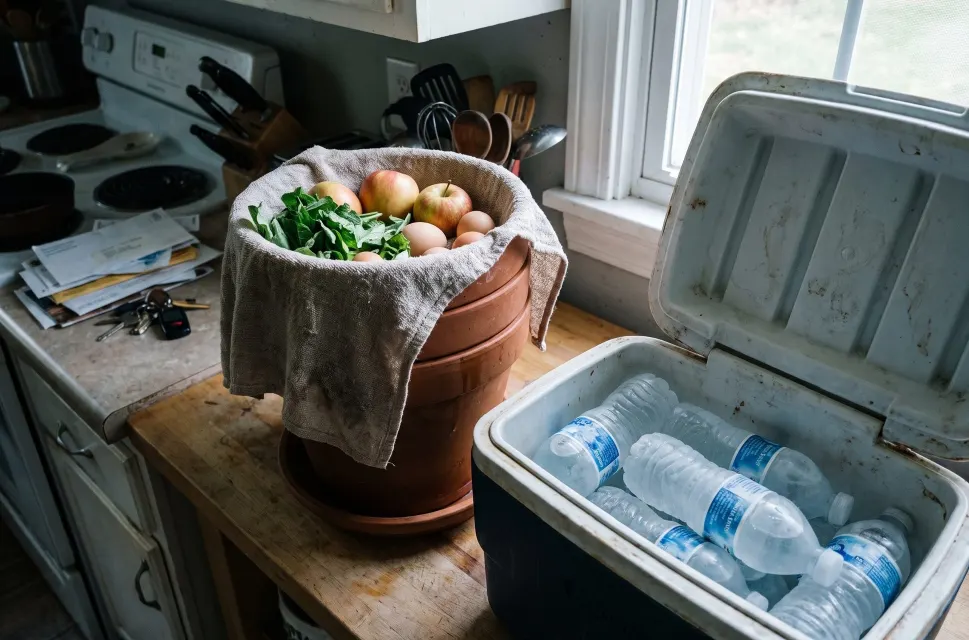
Project 43 of the book starts with a habit, not a build. Keep a stack of water bottles frozen flat in the freezer as standing policy. They add thermal mass to the freezer every day, and in an outage they move into a good cooler, which becomes your working fridge.
The cooler is now the only cold box you open. The fridge and freezer stay shut and coast on their own cold for as long as they can. When the bottles melt, they are clean drinking water, which counts toward how much water each person needs per day.
In winter, do not set food outside in the snow. The USDA warns that outdoor temperatures swing and animals get at it. Instead, fill buckets or jugs with water, let them freeze outside, and bring the ice in.
Zeer pot: cold storage for produce, not for meat
The zeer pot is the second half of Project 43, about an hour of work and around $25 in materials for both builds, per the book. It cools by evaporation, the same way sweat cools skin.
- Set a small unglazed terracotta pot inside a larger one.
- Fill the gap between them with clean sand.
- Pour water into the sand until it is soaked.
- Load whole produce into the inner pot and cover it with a wet cloth.
- Keep it in the shade with airflow and re-wet the sand once or twice a day.
The book puts the effect at 10 to 20°F below the outside air in dry weather. Field tests by MIT D-Lab found clay pot coolers averaged about 12°F of cooling when humidity was under 40%, and the effect shrinks as the air gets more humid.
That is not refrigerator cold. MIT D-Lab notes these coolers are not suitable for meat or dairy, so use the zeer pot for whole fruits and vegetables only. Eggs, milk and leftovers belong in the iced cooler, under the 40°F rule.
Running the fridge on backup power
A generator can keep a refrigerator going, but it has strict rules: outdoors only, at least 20 feet from the house, and never in a garage, even with the door open. The reasons are covered in why a generator never goes in the garage. If you have no backup power, plan meals that need no cold at all, using a 30-day shelf-stable food supply and the methods in how to cook without electricity.
Frequently asked questions
How long does food last in the fridge without power?
About 4 hours if the door stays closed, according to the USDA. After that, perishable foods such as meat, poultry, fish, eggs, milk, soft cheese and leftovers should be discarded if they have been above 40°F for 2 hours or more. A thermometer inside the fridge tells you the real temperature instead of guessing.
How long will a freezer stay frozen without power?
A full freezer holds its temperature for about 48 hours and a half-full freezer for about 24 hours, as long as the door stays closed. Keeping the freezer full with frozen water bottles helps. For longer outages, the USDA says 50 pounds of dry ice should hold an 18-cubic-foot freezer for about 2 days.
Can you refreeze food after a power outage?
Yes, if the food still contains ice crystals or has stayed at 40°F or below. The USDA says it is safe to refreeze, although texture and flavor may suffer. Food that has been above 40°F for 2 hours or more should be thrown out, and you should never taste food to decide whether it is safe.
Does a zeer pot keep food as cold as a refrigerator?
No. A zeer pot cools by evaporation, and field tests have measured around 12°F of cooling in dry air, less in humid weather. That keeps whole fruits and vegetables fresh longer, but it does not reach refrigerator temperature. Keep meat, dairy, eggs and leftovers in a cooler with ice at 40°F or below.
Sources
- The Off-Grid Handbook, Garrett Dalton, Project 43 and Chapter 0, The First-Hour Plan
- USDA FSIS: Keep Your Food Safe During Emergencies
- Ready.gov: Food
- MIT D-Lab: Evaporative Cooling Technologies for Improved Vegetable Storage in Mali
Safety guidance changes. Check the agency pages above for the current version, and follow your local code and manufacturer instructions.