What to do when the power goes out: the first 20 minutes, the first hour, the first days
Most of what decides an outage happens before anyone knows how long it will last. Here is the order to do things in.
In this article
When the power goes out, do six things in the first 20 minutes: account for everyone, check for hazards, fill water containers while you still have pressure, shut the fridge and freezer and write down the time, set up flashlights and a battery radio, and agree as a household on what happens next. Then spend the rest of the first hour on heat or cooling, safe backup power, the neighbors and one message to family. After that, an outage is a daily rhythm, not an emergency.
The order matters because every outage has the same shape. Chapter 0 of The Off-Grid Handbook describes a short window in which cheap actions still work, followed by a long stretch in which they don't. Water pressure that fills a bathtub in minute ten can be gone by hour three.
Power outage checklist: the first 20 minutes
This is the triage block. It needs nothing you have to build or buy first, and the book sets 20 minutes as the standard for finishing it.
- People. Everyone accounted for, everyone unhurt. Anyone who relies on a powered medical device or refrigerated medicine goes to the top of the list.
- Hazards. A fast walk through the house: gas smell, water where it shouldn't be, sparks, storm damage. Outside, stay well away from downed lines; the CDC's rule is never touch a fallen power line.
- Water. Fill the bathtub and every clean container while pressure lasts. On a well, the pump stopped with the lights; on city water, pressure is the resource most likely to quietly disappear.
- Cold. Fridge and freezer doors shut. Write the outage start time on the door in marker, and keep the doors closed.
- Light and information. Flashlights and lanterns out, battery or hand-crank radio on, phones switched to low-power mode.
- Agreement. Sixty seconds, everyone together: what you know, what you don't, and who does what next.
While you walk the house, turn off or unplug appliances and electronics. Ready.gov warns that power can come back with surges or spikes that damage equipment.
The first hour of a power outage
With triage done, the next 40 minutes go to the systems that keep the house livable. None of it is as urgent as the first block, but all of it is cheaper now than later.
- Temperature. In cold weather, pick one room to keep warm and close it off; see how to stay warm without power. In dangerous heat, the CDC advises going to an air-conditioned shelter rather than relying on fans.
- Backup power by the rules. A portable generator runs outdoors only, at least 20 feet from windows, doors and vents, and never in a garage, even with the door open. Read why the garage is never safe before the first storm, and keep a battery-powered or battery-backup CO alarm running inside.
- Neighbors. Knock on the doors of anyone elderly, alone, or dependent on medical equipment. A neighborhood emergency plan tells you in advance which doors those are.
- Family. Send one short text to your out-of-area contact. Texts often get through when calls don't, and a family emergency communication plan sets this up ahead of time.
The hour should end with the household in a defined state: watered, lit, informed, warm or cool enough, in contact, and with everyone knowing their next task.
How long will food last in the fridge without power?
The CDC's numbers: a closed refrigerator keeps food safe for up to 4 hours. A full freezer holds for about 48 hours, a half-full one about 24, as long as the door stays shut.
That is why the outage time goes on the door. When the power returns, Ready.gov's rule is to throw away food that has been at 40°F or warmer for two hours or more, or that has an unusual odor, color or texture. The full guide is in how long food lasts in the fridge without power.
Refrigerated medicine needs its own plan. CDC guidance is to discard medication that should be refrigerated once the power has been out for a day or more, unless the label says otherwise, so ask your pharmacist now what that means for yours.
What to do when the power is out for days
After the first hour, the plan becomes a rhythm instead of a sequence. The book gives five headers for the first 48 hours, and they hold for longer outages too.
| Area | What it means day to day |
|---|---|
| Water discipline | Use stored water on a budget of about 1 gallon per person per day, for drinking and sanitation |
| Meals from storage | Cook from a planned menu of shelf-stable food so the fridge and freezer stay shut |
| Power budget | Spend battery and generator capacity on phones, the radio, medical devices and light first |
| Information rhythm | Radio on the hour for news, off between to save batteries |
| Rest rotation | Adults take turns sleeping, because tired people make the expensive mistakes |
For light, the CDC recommends battery-powered flashlights and lanterns instead of candles, to cut the risk of fire. Never heat the house with a gas oven or range, and never bring a grill, camp stove or generator indoors: carbon monoxide builds up without any smell.
Stay off the roads unless you have to travel. Dead traffic signals and downed lines make driving riskier than staying put in a house that is already set up.
Put the plan on one card
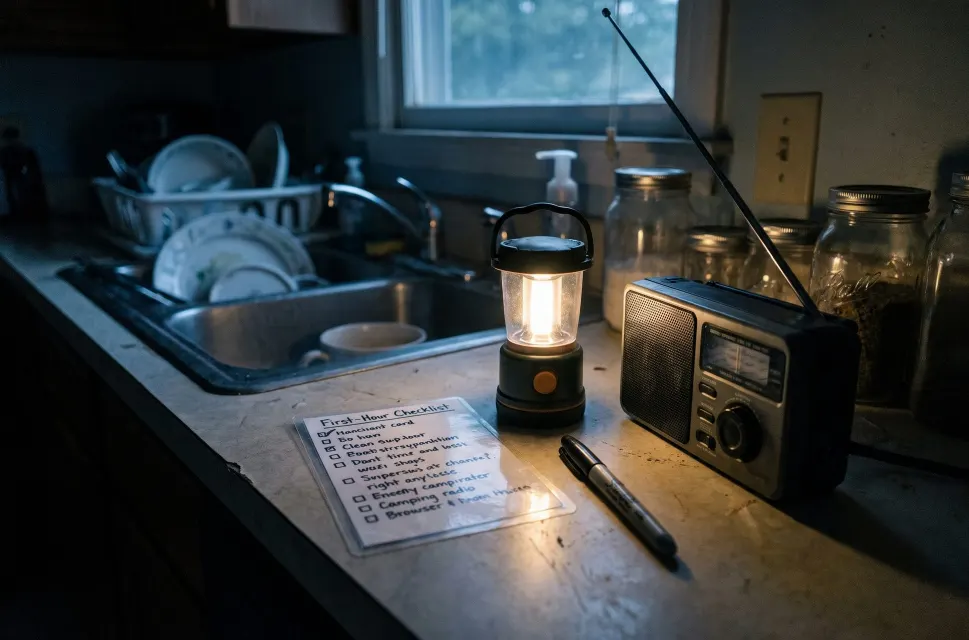
Project 61 of The Off-Grid Handbook turns all of this into a laminated First-Hour Checklist, with one copy per station: the kitchen, the warm room, each vehicle. Every line starts with a verb, fits on one line, can be read by flashlight, and has a person's name next to it.
Then run it once as a drill and time it. If the triage block takes 40 minutes, the book says the fix is shorter lines or better staging, not faster people, and households that drill it routinely finish in under fifteen.
Edit whatever stumbled, and keep the card where the next outage will find it: on the fridge, next to the flashlight.
If this is your first step toward being ready, the guide to off-grid living for beginners lays out what to build first, and in what order.
Frequently asked questions
What should you do first when the power goes out?
Account for everyone and make sure nobody is hurt, then walk the house for gas smells, water leaks, sparks or damage. Next, fill the bathtub and containers while water pressure lasts, shut the fridge and freezer and note the time, set up flashlights and a battery radio, and agree as a household on what happens next. Aim to finish all of it in about 20 minutes.
How long does food last in the fridge when the power goes out?
According to the CDC, a refrigerator keeps food safe for up to 4 hours if you keep the door closed. A full freezer holds for about 48 hours and a half-full one about 24. Throw away perishable food that has been at 40°F or warmer for two hours or more, or that has an unusual odor, color or texture.
Should you unplug appliances during a power outage?
Yes. Ready.gov recommends turning off or disconnecting appliances, equipment and electronics during an outage, because power can return with momentary surges or spikes that damage them. Unplug computers, televisions and anything with a motor or compressor, and plug things back in one at a time after the power has been stable for a while.
Is it safe to run a generator in the garage with the door open?
No. The CDC says never to run a generator inside a home, basement or garage, or less than 20 feet from any window, door or vent. An open garage door does not clear carbon monoxide fast enough. Run the generator outdoors, use a heavy-duty extension cord long enough to keep that distance, and keep a battery-powered CO alarm working inside.
What should you do when the power is out for days?
Switch from emergency mode to a routine: budget stored water at about a gallon per person per day, cook from shelf-stable food, spend battery and generator power on phones, the radio, medical devices and light, listen to the radio on the hour, and take turns sleeping. Check on elderly neighbors each day and keep family updated by text.
Sources
- The Off-Grid Handbook, Garrett Dalton, Chapter 0, The First-Hour Plan, and Project 61
- CDC: What to Do to Protect Yourself During a Power Outage
- Ready.gov: Power Outages
- Ready.gov: Water
Safety guidance changes. Check the agency pages above for the current version, and follow your local code and manufacturer instructions.