How to make a family emergency communication plan that works when the phones don't
In a regional emergency, the call across the country often connects when the call across town cannot. Plan around that.
In this article
A family emergency communication plan answers three questions before anything goes wrong: who everyone reports to, how they reach that person, and where the family meets if they can't get home. Pick one out-of-area contact, agree to text before calling, name your meeting places, and put it all on a paper card each person carries. It takes one evening.
Why local calls fail first
Networks fail locally. FEMA's planning guide notes that in a disaster it may be easier to make a long-distance call than to call across town, because local lines get jammed.
Phones also run out of battery, and most people no longer know a single number by heart. Project 63 of The Off-Grid Handbook puts it plainly: every number the household knows is stored in a device with a battery.
Choose an out-of-area contact
Pick a willing relative or friend in another region. Everyone in the family reports to that one person, and that person relays the news, so nobody has to reach everybody.
Tell your contact they have the job, and give them the list of names and numbers. FEMA also suggests telling your emergency contact about any medical issues, and saving at least one contact in every phone under "In Case of Emergency," or ICE.
A good out-of-area contact has three qualities:
- Distance. Far enough away that the same storm or outage is unlikely to hit them too.
- Reliability. Someone who answers texts and will stay calm while relaying news.
- Know-how. They can send and read texts, and they know the plan and the meeting places.
In an outage, the out-of-area contact gets the first short report within the hour. It is one of the steps in what to do when the power goes out.
Texting during emergencies: text first, call second
Ready.gov's planning guide puts it in three words: text is best. A text needs far less bandwidth than a call, so it may get through when a call won't, and it can wait and send itself once the network has room.
The book sets a simple order of attempts:
- Text the family group and the out-of-area contact.
- If that fails, reach the out-of-area contact by phone, briefly.
- Use voicemail as a message board: leave short updates others can pick up.
The FCC adds a few rules worth teaching everyone: keep calls short, limit calls that aren't urgent, and wait about 10 seconds before redialing a call that didn't connect. Call 911 only for emergencies, and make sure the out-of-area contact knows how to text too.
What to put in a check-in text
Short texts get through faster and say more. Agree on a format everyone uses: who you are, where you are, how you are, and when you'll check in next.
For example: "Mom, at home, all fine, power out, next text at 6." A message like that, sent to the family group and the out-of-area contact, answers every question before anyone has to ask.
Landlines and backup phones
Know what kind of home phone you have. The FCC explains that phone service over broadband, such as VoIP, stops working in a power outage unless it has a battery or other backup power.
A traditional copper landline may keep working, but often only with a corded phone, since many cordless handsets need house power. If anyone in the home is Deaf or hard of hearing, Ready.gov suggests keeping relay service details on the card and an analog device with battery backup.
Pick your meeting places
Write down where the family reunites, so nobody has to decide under stress:
- Home, the default.
- A neighborhood spot if the house is damaged or unsafe, such as a neighbor's porch you have agreed on in your neighborhood emergency plan.
- An out-of-neighborhood spot if you can't get back to the area. Ready.gov suggests a library, community center, house of worship or a family friend's home.
Add who picks up which child, and learn each school's own emergency and pickup plan. Ready.gov also suggests an out-of-town meeting place, such as a relative's home, in case your community is told to evacuate.
Make an emergency contact card for each person
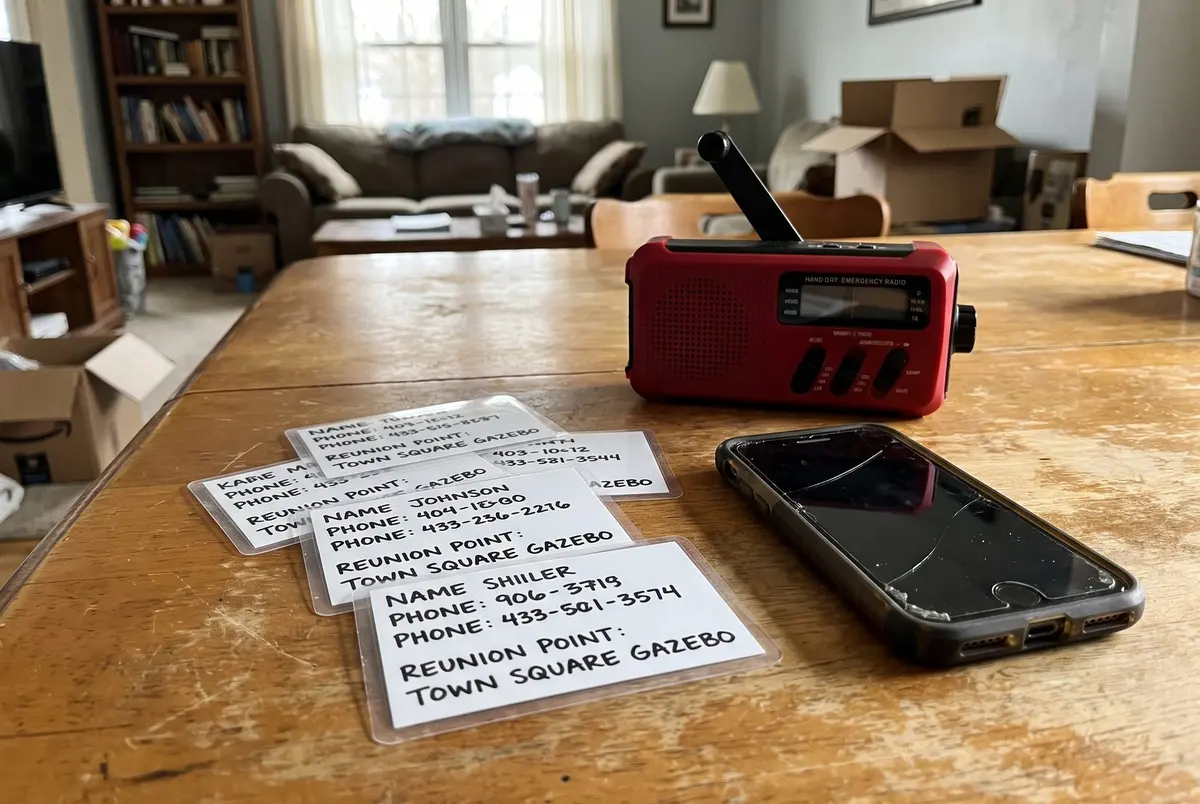
The book calls the wallet card the humble hero of the plan. Ready.gov recommends a copy for every member of the household to carry in a wallet, backpack or purse, plus one posted at home.
What goes on the card:
- Out-of-area contact: name, cell and home number
- Cell numbers for everyone in the household
- The meeting places, with addresses
- Schools, workplaces and caregivers
- Doctors, pharmacy, veterinarian, insurance and utilities
- Important medical information
Laminate the cards or slip them into clear sleeves, and keep a copy in each vehicle. One more copy belongs in your emergency binder with the household's documents.
Keep a way to receive news
A plan for sending messages needs a way to receive them. The book pairs the comms plan with a battery or hand-crank emergency radio, which keeps working when cell service and the internet don't.
If you charge phones in the car, run it only outdoors in open air, never in a closed garage, because of carbon monoxide. Using your car as a power source covers how to do it safely.
Sign every phone in the house up for local emergency alerts as well. Alerts come to you even when you're not thinking to check.
Practice the plan
Set a check-in rhythm for times when the family is split up, such as a text on the hour and on the half hour. Then practice: everyone sends a test text to the out-of-area contact and to the family group.
Ready.gov suggests reviewing the plan at least once a year, or whenever information changes. One of its exercises makes the point fast: ask everyone to recite the important numbers from memory, then picture doing it in an emergency.
Frequently asked questions
What is an out-of-area contact?
It is one relative or friend who lives in another region and agrees to be the family's central point of contact in an emergency. Everyone reports to that person, who passes the news along. It works because long-distance calls and texts often connect when local networks are jammed, and it means separated family members only need to reach one person.
Is it better to text or call during an emergency?
Text first. Ready.gov and the FCC both note that a text message may get through when a call will not, because it needs far less bandwidth and can send automatically once the network has capacity. If you do call, keep it brief, share only vital information, and wait about 10 seconds before redialing a call that failed.
What should be on an emergency contact card?
Include the out-of-area contact's name and numbers, cell numbers for everyone in the household, your meeting places with addresses, and the numbers for schools, workplaces, doctors, the pharmacy, the veterinarian, insurance and utilities. Add important medical information. Make one card for each person to carry, keep one in each car, and post one at home.
How often should a family communication plan be updated?
Review it at least once a year, and any time a phone number, school, job or address changes. A good habit is to practice it at the same time: have everyone send a test text to the out-of-area contact, walk to the neighborhood meeting place, and print fresh wallet cards if anything changed.
Sources
- The Off-Grid Handbook, Garrett Dalton, Project 63
- Ready.gov: Create Your Family Emergency Communication Plan (PDF)
- FCC/FEMA: Emergency Communications Tips
- Ready.gov: Make a Plan
Safety guidance changes. Check the agency pages above for the current version, and follow your local code and manufacturer instructions.