How to make a neighborhood emergency plan in one evening
The houses within a hundred yards of yours are the closest help you have in a long outage. Most people have never written down who lives in them.
In this article
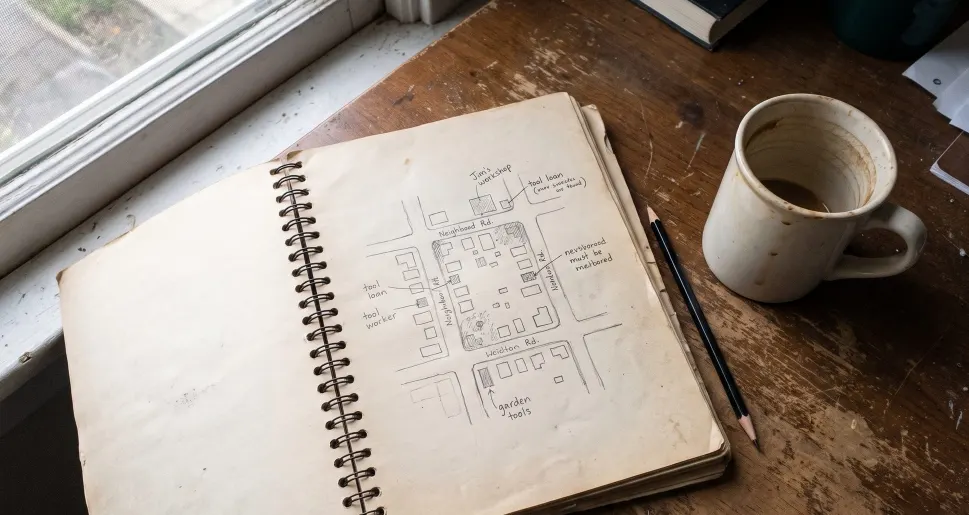
A neighborhood emergency plan is a written map of the households around you: who lives there, who needs checking on first, who has useful skills or equipment, and how to reach them. You can make one in an evening with a sketch of your block and a few short conversations. The whole agreement fits in one line: if the power goes out for a few days, we check on each other.
Why a neighborhood plan beats a bigger stockpile
In a multi-day event, outside help can be slow, and the closest people are the ones next door. Project 67 of The Off-Grid Handbook makes the case that a simple map of skills, needs and resources within a hundred yards outperforms any solo stockpile.
FEMA's preparedness guide for older adults makes the same point from the other side. It tells older adults to build a support network of family, friends, caregivers and neighbors, and to arrange for someone to check on them by phone or in person during a disaster.
For many people on your street, you are that someone. The plan just makes it official.
How to map your block, step by step
- Sketch it. A printed map or a hand drawing of the houses around you, roughly a hundred yards in each direction.
- Fill in what you already know. Who is home during the day, who has a generator, who is a nurse, who is elderly or lives alone.
- Have the low-key conversations. Over the next few weeks, introduce yourself and fill in the gaps.
- Mark the check-first houses. These get a knock in the first hour of any outage.
- List what can be shared. Include your own household's equipment.
- Keep it on paper. One page per household, in your binder.
What goes on each household page
- Names of everyone in the house, and the best phone number
- Who is home during the day, and who travels for work
- Medical needs that depend on power: oxygen, a CPAP, refrigerated insulin
- Skills: nurse, electrician, mechanic, someone who speaks a second language
- Equipment they are willing to share
- A relative or friend to call if you can't reach them
- Pets in the house, in case someone has to step in
The book prices the project at zero dollars. The only cost is a few evenings of knocking on doors.
What to say to your neighbors
Skip the doomsday talk. The book's script is one sentence: "If the power went out for a few days, we check on each other. Here's our number."
Most people are relieved someone asked. Ask for the best phone number, whether anyone in the house depends on medical equipment or refrigerated medicine, and whether there is a relative you should call if you can't reach them.
Write down what they offer, not what you guess. If someone would rather not be on the map, respect it, and still knock on their door when the lights go out.
How to check on elderly neighbors
The check-first houses are the elderly, the disabled, single parents and anyone who depends on a medical device. They come first because the early hours of an outage are when cold, heat, a dark staircase or a device without power does the most harm.
FEMA also suggests that at least one person in an older adult's support network has a spare key and knows where their emergency supplies are. If a neighbor asks you to be that person, put it on their page.
A useful check takes two minutes at the door:
- Is everyone in the house accounted for and unhurt?
- Do you have a working flashlight and a way to get news?
- Does any medicine or device need power or refrigeration?
- Is the house holding a safe temperature?
- Do you have water and food for a few days?
- Is anything running indoors that shouldn't be, like a grill or a generator?
That last question matters. The CDC says generators never run inside a home, basement or garage, or less than 20 feet from any window, door or vent; why a generator in the garage is never safe explains the carbon monoxide risk.
Mutual aid: what to share on your street
Mutual aid here means neighbors pooling what they already own. On each page, note the shareable assets, including yours: a chainsaw, a four-wheel drive, an extra freezer, a water filter, a charging station.
A house with a solar charging station can keep several neighbors' phones alive. A household with a hand-crank radio can pass along news to a house that has none.
Agree on the basics before you need them: who knocks on which doors, and where people gather if the phones are down. The first-hour routine in what to do when the power goes out includes that neighbor check.
Keep the map private, and keep it on paper
The map holds sensitive details: who lives alone, who is away during the day, who owns a generator. That is why the book says the map lives in your binder, not in a group chat.
Paper also works when phones are dead. Store it with your documents in an emergency binder, and add the key neighbors' numbers to your family's wallet cards.
Community preparedness beyond your block
If the map gets your street talking, the next step is formal training. FEMA's Community Emergency Response Team program, CERT, trains volunteers in fire safety, light search and rescue, team organization and disaster medical operations.
FEMA counts more than 3,200 local CERT programs across the country, and its free online course IS-317 is an introduction. A neighbor with that training is worth marking on the map.
The book's field note calls this the cheapest project in the book and possibly the most valuable. In its words, the neighborhoods that fare best are the connected ones, not the equipped ones.
Frequently asked questions
What is a neighborhood emergency plan?
It is a simple written map of the households around you, usually within about a hundred yards, showing who lives there, who needs checking on first, who has useful skills or equipment, and how to reach each other. Neighbors agree to check on each other if the power or phones go out for a few days. It costs nothing and takes an evening to start.
How do I check on elderly neighbors during a power outage?
Knock early, in the first hour. Ask whether everyone is unhurt, whether they have a flashlight and a way to get news, whether any medicine or device needs power or refrigeration, and whether the house is holding a safe temperature. Make sure nothing like a grill or generator is running indoors. Then agree on when you will check again.
What is mutual aid in an emergency?
Mutual aid means neighbors helping each other with what they already have, instead of each household facing an event alone. In practice it is a list: who has a chainsaw, a four-wheel drive, an extra freezer, a water filter or a charging station, and who needs help first. Writing it down before an emergency is what makes it work.
How do I start community preparedness in my neighborhood?
Start small with your own block. Sketch the houses around you, introduce yourself, and ask each household if they would like to check on each other during outages. Mark the elderly, disabled and medical-device-dependent homes for a first-hour check. If interest grows, look into FEMA's Community Emergency Response Team program, which trains volunteers locally.
Sources
- The Off-Grid Handbook, Garrett Dalton, Project 67
- FEMA: Disaster Preparedness Guide for Older Adults
- FEMA: Community Emergency Response Team (CERT)
- CDC: What to Do to Protect Yourself During a Power Outage
Safety guidance changes. Check the agency pages above for the current version, and follow your local code and manufacturer instructions.