How to build a DIY solar charging station that refills itself every sunny day
One panel, one controller and one small battery make the power project that keeps phones, radios and headlamps charged for as long as the sun comes up.
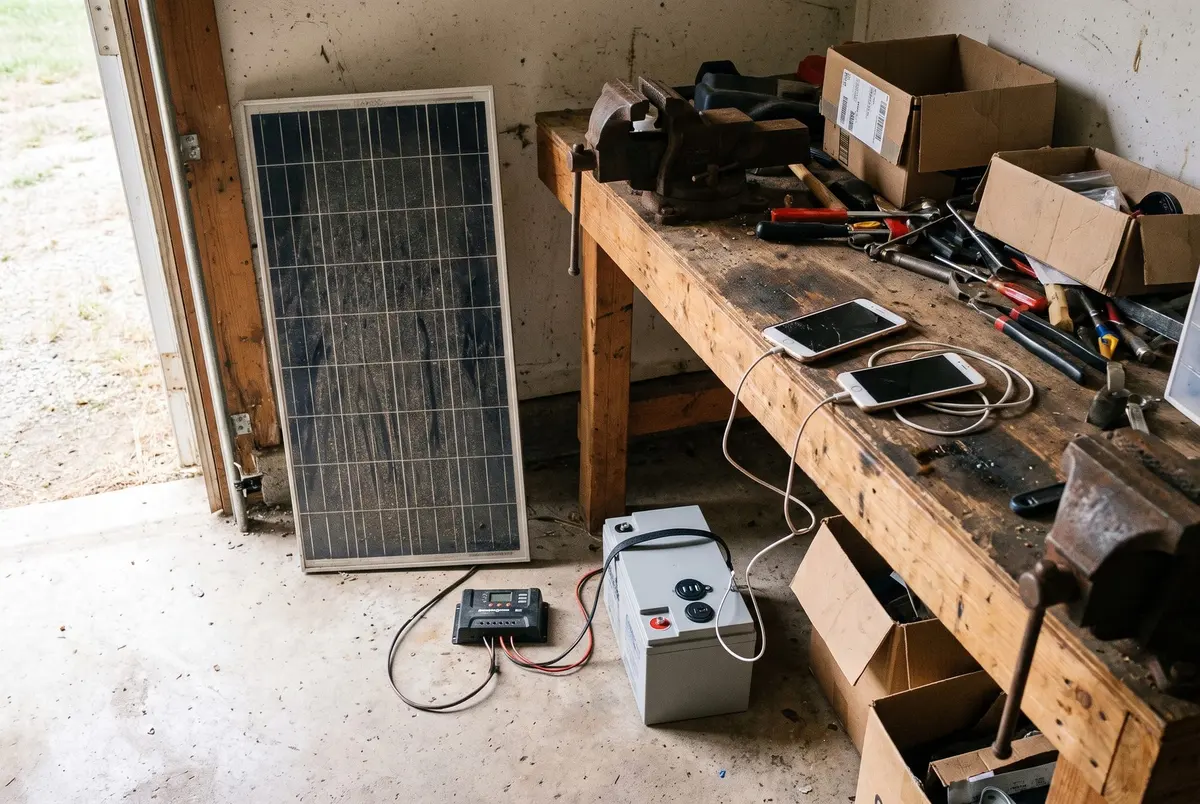
In this article
A DIY solar charging station is one solar panel, one charge controller and one 12-volt battery, wired so the panel refills the battery and the battery charges your devices through USB and 12 V outlets. A 100-watt panel, a 10-amp controller and a 20 to 30 amp-hour battery covers a household's phones, radio and headlamps. It takes an afternoon, costs about $120 in materials per the book, and returns roughly 300 to 500 watt-hours on a day of decent sun.
This is Project 16 of The Off-Grid Handbook, which calls it the single highest-value power project in the book. The reasoning is simple: a stack of charged power banks starts counting down the moment the grid fails, while a station that recharges itself never starts the countdown.
What you need: a small solar system for beginners
The parts list is short, and every piece is sold separately. That matters later, because you can repair or upgrade any one part without replacing the rest.
| Component | What to buy | Its job |
|---|---|---|
| Solar panel | 100 W, 12 V nominal | Harvests the day's energy |
| Charge controller | 10 A; PWM is adequate at this scale | Charges the battery safely and stops it from overcharging |
| Battery | 12 V, 20 to 30 Ah, LiFePO4 or sealed AGM | Stores the harvest for the evening |
| Outlet panel | USB ports plus a 12 V socket | Where the devices plug in |
| Wiring | 10 AWG leads, MC4 connectors, fused battery leads | Carries the current between parts |
The tools are ordinary: screwdrivers, wire strippers with a crimper, and a multimeter. If you have been pricing boxed solar panel battery charge controller kits, this is the same set of parts. The book's Gear Guide puts the built version at about $120 against $300 or more for packaged kits of similar capacity, and you can fix what you built.
PWM or MPPT for a single panel?
At 100 watts with a 12 V panel, a simple PWM controller does the job. The book's rule is that under about 200 watts PWM is fine, while larger arrays or high-voltage residential panels are where an MPPT controller pays for itself. The full comparison is in our guide to choosing between MPPT and PWM charge controllers.
One field note from the book is worth following: buy the controller one size up from today's need. A station that starts at 100 watts rarely stays at 100 watts.
How to wire a solar panel, charge controller and battery
The order of connections is the part people get wrong. Follow the book's sequence exactly.
- Battery to controller first, then panel to controller. Connecting in the reverse order can damage the controller.
- Fuse the battery lead within inches of the positive terminal. A 10 A fuse is right at this size.
- Mount the outlet panel (USB plus a 12 V socket) on the battery box, fed from the controller's load terminals.
- Set the controller's battery-type profile to match your battery chemistry.
- Aim the panel at true south (in the Northern Hemisphere), tilted at roughly your latitude, and confirm charging current on the controller display.
- Check the daily yield for a few days so you know what the station really delivers.
Even a 12-volt system can push burn-level current through a short circuit. The book's safety rules are part of the build: fuse every battery connection, keep terminals covered, and leave no exposed copper anywhere.
Where to put the panel
The federal Energy Information Administration notes that tilting a panel toward the south at an angle equal to your latitude maximizes its yearly exposure to direct sun. Shade matters even more than angle. Federal solar planning guidance warns that even a narrow strip of shade can limit the current of an entire array, so watch the spot across a full day before you commit.
A panel leaning on a wall rarely survives the first windstorm. The book's next build is a hinged A-frame that holds the angle and lets you change it with the seasons; see our guide to building a DIY solar panel ground mount.
How many phone charges does a 100-watt panel give?
Per the book, a 100 W panel in decent sun returns 300 to 500 watt-hours per day, enough for 25 to 40 phone charges. Cloudy days give less, and winter days give less than summer ones, which is why the battery sits in the middle of the system.
To see whether that covers your household, compare it with your critical load. The book's watt-hour audit puts a household of two at about 200 to 300 watt-hours a day without a refrigerator, and a household of four at about 300 to 450. A refrigerator adds 1,000 to 1,500 watt-hours a day, far beyond one panel; our guide on what size solar generator you need walks through the audit.
Which battery, and can it stay indoors?
A 12 V battery of 20 to 30 amp-hours holds roughly 240 to 360 watt-hours on its label. The book prefers LiFePO4, which delivers 80 to 100 percent of its rated capacity, where lead-acid gives about half before its life shortens.
For a battery kept in living space, the rule is firm: LiFePO4 or sealed AGM only, never flooded lead-acid, which gives off hydrogen. Never charge a LiFePO4 battery below freezing unless it has low-temperature protection, and follow the manufacturer's charge specifications. When the household outgrows the small battery, the book's step up is a fused 50 Ah unit, covered in our DIY LiFePO4 battery box guide.
Using it as your solar phone charger setup
Once it is running, treat the station as the household's daily charging point. Phones, headlamps, power banks and a weather radio all live on it, so nothing waits for the grid to come back.
- Charge power banks during the day and carry them to bedrooms at night.
- Keep the emergency radio and its power banks topped up from the USB ports.
- Run a few 12 V LED lights straight off the battery: four 4-watt lights burning five hours use about 80 watt-hours, a fraction of the daily harvest.
Ready.gov advises every household to plan batteries and alternative power sources, such as a power bank, for the things that rely on electricity. A station that refills itself is the version of that plan that does not run out.
Frequently asked questions
Can a 100 watt solar panel charge a phone?
Yes. A 100-watt panel in decent sun returns about 300 to 500 watt-hours a day, according to The Off-Grid Handbook, which is enough for roughly 25 to 40 phone charges. It works best charging a 12 V battery through a charge controller, so you can charge phones at night and on cloudy days from stored energy.
Do I need a charge controller for a small solar panel?
Yes, if the panel charges a battery. The controller sits between panel and battery, regulates the charge and keeps the battery from overcharging. For one 100-watt, 12-volt panel, a 10-amp PWM controller is adequate. Connect the battery to the controller first, then the panel, and set the controller to your battery chemistry.
What size battery do I need for a 100 watt solar panel?
The Off-Grid Handbook pairs a 100-watt panel with a 12-volt battery of 20 to 30 amp-hours, LiFePO4 or sealed AGM. That stores roughly 240 to 360 watt-hours on the label, close to one good day of solar harvest. A 50 amp-hour LiFePO4 battery stores about 600 usable watt-hours if you need more.
Is it safe to keep a solar battery inside the house?
It can be, with the right chemistry. Keep only LiFePO4 or sealed AGM batteries in living space, never flooded lead-acid, which gives off hydrogen. Fuse the positive lead within inches of the terminal, cover the terminals, and do not charge a LiFePO4 battery below freezing unless it has low-temperature protection.
Sources
- The Off-Grid Handbook, Garrett Dalton, Project 16
- U.S. Energy Information Administration: Solar panel tilt and latitude
- NREL / U.S. Department of Energy: Solar Ready Buildings Planning Guide
- Ready.gov: Power Outages
Safety guidance changes. Check the agency pages above for the current version, and follow your local code and manufacturer instructions.