A 12V LED lighting system for off-grid rooms: layout, wire gauge and fusing
Lighting straight off the battery, with no inverter and no conversion loss. A 12 V LED circuit lights the core of the house for a handful of watts.
In this article
A 12V LED lighting system for off-grid use runs LED strips or fixtures directly from a 12-volt battery, with no inverter in between. The Off-Grid Handbook's version uses three to five light points of 3 to 5 watts each, 16 AWG two-conductor wire, total runs under about 25 feet, and a 5-amp fuse, with a switch at each fixture. Four 4-watt lights burning five hours use about 80 watt-hours, a fraction of what one small solar panel makes in a day.
This is Project 21 in the book, a two-hour build for about $50 in materials. It is the step that turns a battery in the garage into lit rooms on the third night of an outage.
Why run DC lights instead of lamps on an inverter?
LED strips and fixtures built for 12 volts run on DC. Running them straight off the battery skips the inverter and its conversion losses, so more of the stored energy becomes light.
The Department of Energy notes that LEDs use up to 90 percent less energy and last up to 25 times longer than incandescent bulbs. On a battery, that efficiency is the difference between lights for an evening and lights for a week. The book's view is that phones, lights, radio and router are DC natives, and the inverter is for the one or two stubborn AC exceptions; our guide on what size inverter you need covers those.
Where to put 12V lights in a cabin or house
Plan three to five points, no more. The book's list is the kitchen surface, the main room, the bathroom and one hallway.
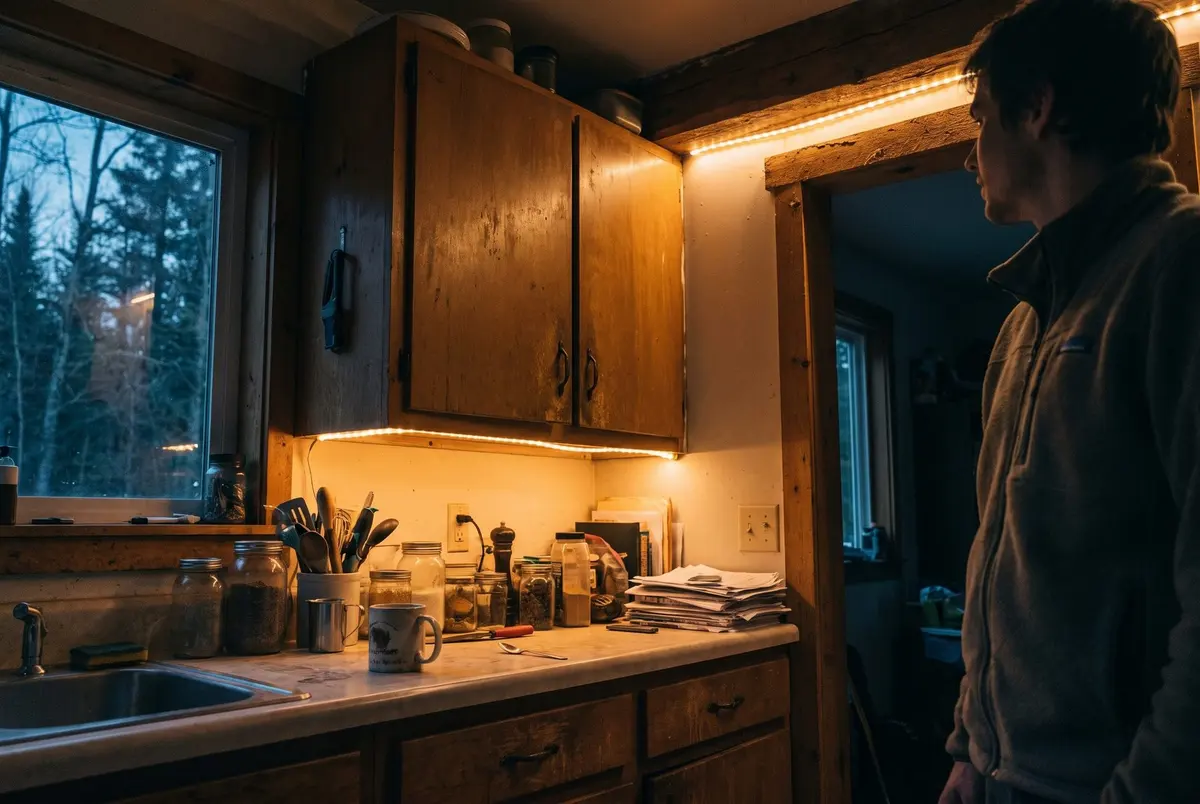
- Kitchen: a strip under the wall cabinets lights the counter where you cook.
- Main room: a strip above a doorway or along a beam lights the space without glare.
- Bathroom: one small fixture is enough.
- Hallway: one point lights the route between bedrooms and the bathroom at night.
Mount strips under cabinets and above doorways so the light bounces off walls and ceilings. The book's phrase is bounce light, not glare, and it is why a 4-watt strip can light a whole kitchen.
Choosing 12V LED strips and fixtures
The book specifies 3 to 5 watts per light point. Check that every strip and fixture is rated for 12 volts DC, since LED products also come in 24-volt and household-voltage versions.
The Department of Energy's lighting guide recommends reading the label for brightness in lumens and for light appearance, warm or cool. Both are printed on the package, so you can match the light to the room before you buy.
What wire gauge for 12V lights?
At 12 volts, wire size is about voltage drop, not just about current. Every foot of wire has resistance, and at low voltage the loss shows up quickly as dim lights at the far end.
A Michigan State University electrical tech note explains that the National Electrical Code recommends about 3 percent voltage drop on branch circuits and no more than 5 percent overall. On a 12-volt circuit, 3 percent is only 0.36 volts.
| Copper wire | Max one-way run, 16 W of lights | Max one-way run, 40 W of lights |
|---|---|---|
| 16 AWG | about 27 ft | about 11 ft |
| 14 AWG | about 43 ft | about 17 ft |
| 12 AWG | about 68 ft | about 27 ft |
The table is calculated at 12 volts for a 3 percent drop, using the copper resistance values in that tech note and counting both conductors. It shows why the book's rule works: 16 AWG under about 25 feet keeps four 4-watt lights within the drop limit, and longer runs or more lights call for a heavier gauge.
How to build the DC lighting circuit
The tools are a drill, a crimper, wire strippers and a staple gun with insulated staples. The materials are 12 V LED strips or fixtures, 16 AWG two-conductor wire, inline switches, a 5 A fuse and low-voltage wire clips.
- Plan three to five points: kitchen surface, main room, bathroom, one hallway.
- Run 16 AWG from the fuse block on the battery box. Keep total runs under about 25 feet at this gauge.
- Fuse the circuit at 5 A and put a switch at each fixture.
- Mount the strips under cabinets and above doorways for bounced light.
- Measure the finished draw with a multimeter and write the number in your binder.
The circuit runs from the battery box only. It never connects to the house wiring; work on household circuits belongs to a licensed electrician under your local code.
Is 12V lighting safe?
Low voltage is not no risk. The book's warning is specific: an unfused 12 V short against a 50 amp-hour battery will happily start a fire.
- Every circuit fused, close to the battery.
- Every splice in a proper connector, with no twist-and-tape joints.
- Insulated staples only, so a staple never cuts into the wire.
- Wire clipped along its run, not hanging where it can be pulled.
How much battery and solar does it take?
Very little. Four points at 4 watts burning five hours is 80 watt-hours, and the book's 100-watt DIY solar charging station returns 300 to 500 watt-hours on a day of decent sun.
A 50 amp-hour LiFePO4 battery, like the one in our DIY LiFePO4 battery box guide, stores about 600 usable watt-hours. That runs the lights alone for about a week of evenings with no sun at all, and the watt-hour audit shows how lighting fits with the rest of your critical load.
The book's field note explains why this project matters more than its wattage suggests: light is morale. For the portable side of the plan, headlamps and lanterns are covered in our guide to the best lighting for a power outage.
Frequently asked questions
What size wire do I need for 12V LED lights?
For a small circuit of three to five LED lights drawing 3 to 5 watts each, The Off-Grid Handbook uses 16 AWG two-conductor wire with total runs under about 25 feet. At 12 volts, voltage drop limits the run length, so longer runs or more lights call for 14 or 12 AWG. Fuse the circuit at 5 amps.
Can I run LED lights directly from a 12V battery?
Yes, if the lights are rated for 12 volts DC. Running them straight off the battery skips the inverter and its conversion losses. Put a fuse close to the battery, use a switch at each fixture, and make every splice in a proper connector. Four 4-watt lights for five hours use about 80 watt-hours.
How long will a 12V battery run LED lights?
Divide the battery's usable watt-hours by the lights' total watts. A 50 amp-hour LiFePO4 battery stores about 600 usable watt-hours, so four 4-watt lights drawing 16 watts in total would run for roughly 37 hours. At five hours a night, that covers about a week of evenings without recharging.
Do 12V LED lights need a fuse?
Yes. Low voltage still carries fire risk: an unfused short against a 12-volt battery can start a fire. The Off-Grid Handbook fuses the lighting circuit at 5 amps from the fuse block on the battery box. Every circuit gets its own fuse, and no splice is made by twisting wires and taping them.
Sources
- The Off-Grid Handbook, Garrett Dalton, Project 21
- Michigan State University, Biosystems & Agricultural Engineering: Sizing Conductors to Minimize Voltage Drop (Tech Note 227)
- U.S. Department of Energy: Consumer Guide to Energy-Efficient Lighting
Safety guidance changes. Check the agency pages above for the current version, and follow your local code and manufacturer instructions.