How to connect batteries in parallel without building in a weak link
Parallel banks add capacity; sloppy parallel banks add failure modes.
In this article
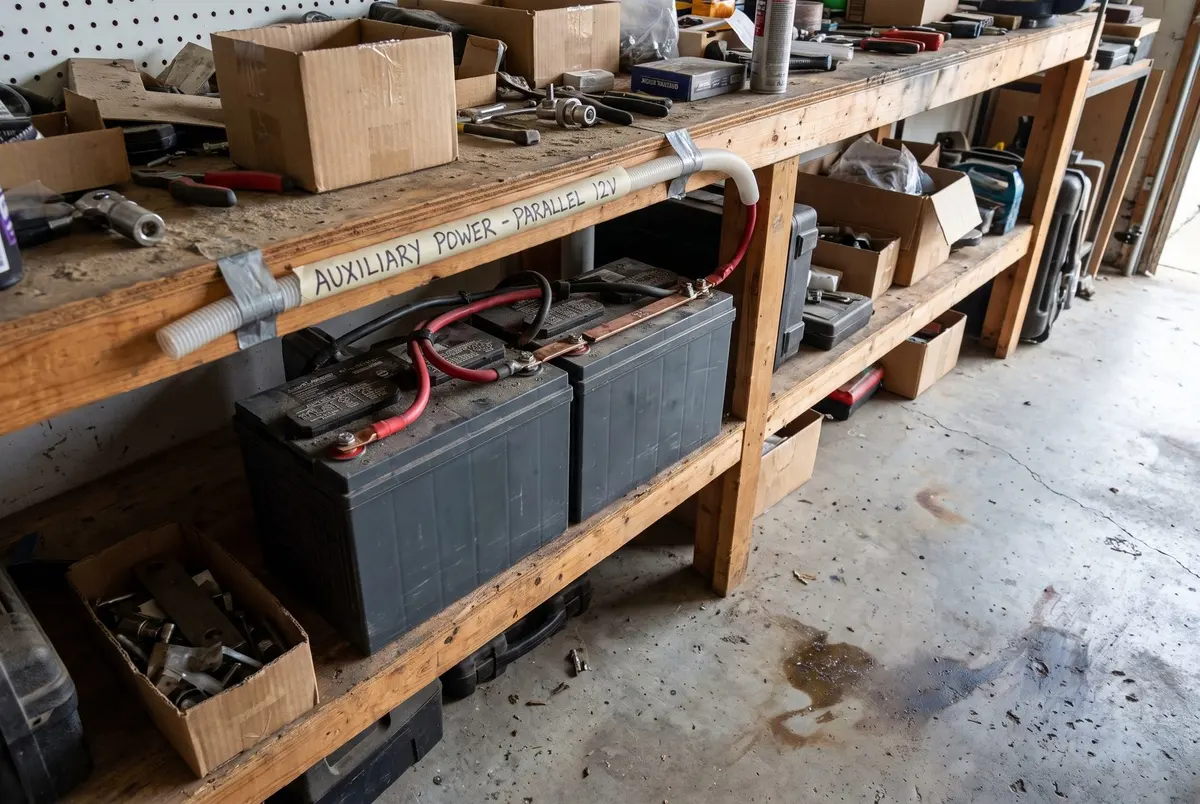
To connect batteries in parallel, join all the positive terminals to one conductor and all the negative terminals to another. Voltage stays the same and capacity adds up, so two 12 V 100 Ah batteries become one 12 V 200 Ah bank. Use matched batteries at the same charge, equal-length cables, and take the system's positive and negative from opposite ends of the bank.
The Off-Grid Handbook covers this in Project 24, Battery Bank Expansion, one of the few builds it rates Hard. Its rules line up with a battery design guide from the Florida Solar Energy Center (FSEC) at the University of Central Florida, cited throughout below.
Series vs parallel batteries
In series, the negative terminal of one battery connects to the positive of the next. The FSEC guide explains that voltages add while capacity stays the same as one battery.
| Two 12 V 100 Ah batteries | Series | Parallel |
|---|---|---|
| Connection | Negative to positive | Positive to positive, negative to negative |
| Bank voltage | 24 V | 12 V |
| Bank capacity | 100 Ah | 200 Ah |
| Stored energy | About 2,400 Wh nominal | About 2,400 Wh nominal |
| Typical reason | Moving a system to 24 V | More runtime on an existing 12 V system |
For a 12 V system you already own, parallel is how you add hours of runtime without changing the controller, the inverter or the loads. Series moves the whole system to a higher voltage, which means a different controller setting, inverter and wiring plan.
How to connect batteries in parallel, step by step
- Match everything: same chemistry, model, capacity and age.
- Charge each battery fully, on its own, before the first connection. Connect them only when a multimeter shows matched voltage.
- Use bus bars and equal-length cables so current shares evenly between the batteries.
- Take the system feeds diagonally: positive from the battery at one end, negative from the battery at the other end.
- Resize the master fuse and main cables for the new maximum draw.
- Label the bank with its total capacity, the install date and the new days-of-autonomy figure.
Why diagonal feeds and equal cables matter
Every cable and lug adds a little resistance. The FSEC guide explains that the batteries with the lowest-resistance path to the charging source get worked harder than the rest, which leads to unequal treatment within the bank.
Making the external connections from opposite sides of the bank, it says, improves the equalization of charge and discharge. That is the same diagonal layout the book specifies.
The guide also notes that battery manufacturers generally recommend as few parallel strings as possible. If you need a lot more capacity, a larger battery can be a better answer than a long row of small ones.
Check the bank after the first charge
Once the bank is connected, charge it fully, let it rest, and measure each battery's voltage at its own terminals with a multimeter. Matched batteries should read the same, or very nearly.
Repeat the check after a discharge. A battery that keeps reading differently from its partners is the weak link, and it is far better found on the bench than on the third day of an outage.
Can you mix old and new batteries?
Don't. The book's rule is blunt: mixing old and new batteries drags both to the worse one's behavior. The same goes for mixing chemistries, models or capacities.
With LiFePO4, each battery's BMS sets its own current limits. Respect the BMS limits of the weakest unit, because that battery decides what the whole bank can safely do.
Battery bank expansion: how much do you need?
The book's honest metric is days of autonomy: usable watt-hours ÷ audited daily load. Two 12 V 50 Ah LiFePO4 batteries hold about 1,200 usable watt-hours, so at 400 Wh a day, that is three days.
Fill in the formula before you buy anything. A bank that already covers three days of your measured load does not need a third battery; it needs the solar or charging capacity to refill what it has.
Three days covers the overwhelming majority of grid events, according to the book, which advises chasing more only after your water and food are equally deep. Run a watt-hour audit before you buy the second battery, so the bank matches a measured number.
Safety: a parallel bank stores enough energy to weld
That is the book's warning, and it is meant literally. The NFPA notes that there is essentially no way to place an operating battery into an electrically safe work condition, so working on a battery should always be treated as energized electrical work.
- Use insulated tools only.
- Remove rings and watches before you start.
- Cover terminals between steps, and never let a wrench bridge two terminals.
- Keep positive and negative cables well separated, with insulated covers on the terminals when you finish.
- Install the upgraded master fuse and cabling before the bank goes back into service.
Size the conductors for the new current, too. The FSEC guide recommends conductors that handle at least 125% of the maximum current, with particular attention to the high-current run between battery and inverter; our guide to sizing an inverter covers that run.
Built from matched batteries like the one in the book's LiFePO4 battery box, a parallel bank adds runtime without touching the rest of a 12 V system. A bigger bank takes longer to refill from the same panels, though, so it may be time to add a panel and recheck your charge controller size.
Frequently asked questions
Do batteries in parallel increase voltage or capacity?
Capacity. In parallel, the voltage stays the same as one battery and the amp-hours add up, so two 12 V 100 Ah batteries make a 12 V 200 Ah bank. In series, the voltages add and the capacity stays the same, so the same two batteries would make 24 V at 100 Ah.
Can you mix old and new batteries in parallel?
It is not recommended. The Off-Grid Handbook warns that mixing old and new batteries drags both down to the worse one's behavior. Use the same chemistry, model, capacity and age, charge each battery fully on its own first, and connect them only when their voltages match.
Where do you connect the cables on a parallel battery bank?
Take the positive feed from the battery at one end of the bank and the negative feed from the battery at the opposite end. The Florida Solar Energy Center notes that connecting from opposite sides improves how evenly the batteries charge and discharge. Use equal-length interconnect cables and bus bars as well.
Can you connect lithium and lead-acid batteries in parallel?
No. The book requires matching chemistry, model and age in a parallel bank. LiFePO4 and lead-acid use different charge profiles and offer different usable capacity, about 80 to 100% for LiFePO4 against roughly 50% for lead-acid, so one type would always be mistreated. Build the bank from identical batteries.
Sources
- The Off-Grid Handbook, Garrett Dalton, Project 24
- Florida Solar Energy Center (UCF): Batteries and Charge Control in Stand-Alone Photovoltaic Systems
- NFPA: Article 320 Safety Requirements Related to Batteries and Battery Rooms (NFPA 70E)
Safety guidance changes. Check the agency pages above for the current version, and follow your local code and manufacturer instructions.