What size inverter do I need? Your largest load plus 25%, in pure sine wave
Most households need a smaller inverter than they expect, mounted closer to the battery than they expect.
In this article
Size an inverter to the largest AC load you will run, plus 25%, not to the sum of everything you own. For most emergency setups that means a pure sine wave inverter in the 300 to 600 watt class. If the load has a motor, such as a refrigerator, also check that the inverter's surge rating covers the startup draw.
That rule comes from Project 22 of The Off-Grid Handbook, which says the inverter is for "the one or two stubborn AC exceptions." Phones, lights, a radio and a router are DC natives, so the list of things that truly need 120 V AC is usually short.
How to size an inverter in three steps
- Start from your audit. Find the wattage of each AC device you actually need during an outage, with a plug-in meter or from the nameplate. Our watt-hour audit guide walks through it.
- Take the largest single load and add 25%. If you plan to run two AC devices at the same time, add them together first.
- Check the surge rating. Motors pull a burst at startup. Virginia Cooperative Extension notes a motor draws about three times its running current as it starts, and the Red Cross gives the same up-to-three-times warning when sizing generators.
A quick example: a device that draws 400 watts needs at least a 500 W inverter, because 400 × 1.25 = 500. The continuous rating covers the running load, and the surge rating has to cover the startup moment of anything with a motor.
Oversizing has a cost of its own. A big inverter wants big cables, a big fuse and a battery that can feed it, so the honest audit number saves money all the way down the line.
Which devices actually need an inverter?
Most of what keeps a household running in an outage already works on low-voltage DC. The book's field note is that most "I need a big inverter" cases dissolve in the audit.
- Run on DC, no inverter needed: phones and battery banks over USB, LED lights, a 12 V radio, and the router, which the book counts among the DC natives.
- Usually need AC: devices with a standard household plug and no DC option, such as a refrigerator, some medical equipment, or a laptop charger without a 12 V version.
Every conversion from DC to AC loses some energy as heat, and an inverter that is switched on uses some power of its own. Running DC loads on DC, and switching the inverter off when nothing needs it, keeps more of the battery for the devices that have no other option.
Pure sine vs modified sine inverter
Buy pure sine wave. The book's reason is practical: electronics and anything with a motor dislike modified sine. The University of Arizona Extension makes the same point, noting that pure sine models are designed to handle electronic devices such as laptops and communication radios with minimal distortion.
| Pure sine wave | Modified sine wave | |
|---|---|---|
| Output | A smooth wave, like utility power | A stepped approximation |
| Electronics, chargers, radios | Designed for them | The book advises against it |
| Motors (fridge, fan, pump) | Preferred | Motors dislike it, per the book |
| Where it fits in an emergency kit | Everything on the AC list | Not recommended |
What size inverter to run a refrigerator?
Measure the fridge with a plug-in meter, or read its nameplate. The running watts set the continuous rating (plus 25%), and the startup spike, which can be around three times the running draw, sets the surge rating you need.
The bigger question is energy, not watts. A modern fridge uses roughly 1,000 to 1,500 watt-hours a day, per the book, while the book's 12 V 50 Ah battery box stores about 600 usable watt-hours. An inverter can only deliver what the battery behind it holds.
So a fridge on an inverter needs a larger battery bank, often built by connecting batteries in parallel, or a power station sized for it. Ready.gov notes that a closed fridge keeps food cold for about four hours, which gives you time to start the system calmly.
Does battery voltage matter?
At 12 V, current climbs fast. The arithmetic is simple: 600 watts ÷ 12 volts = 50 amps on the DC side before any conversion losses, which is why the book specifies short, thick cable, such as 4 AWG at 600 W.
The University of Arizona Extension suggests 12 V for systems using less than about 1 kWh a day, 24 V between 1 and 4 kWh, and 48 V above that. It also notes that a 2,000-watt inverter may come in a 24 V version while a 6,000-watt one requires 48 V, so a growing AC list eventually becomes a battery voltage decision.
The Florida Solar Energy Center at the University of Central Florida shows the same effect at small scale: a 120-watt load draws 10 amps from a 12 V battery but only 5 amps from a 24 V one. Lower current means smaller and cheaper conductors, fuses and disconnects.
Inverter wiring safety
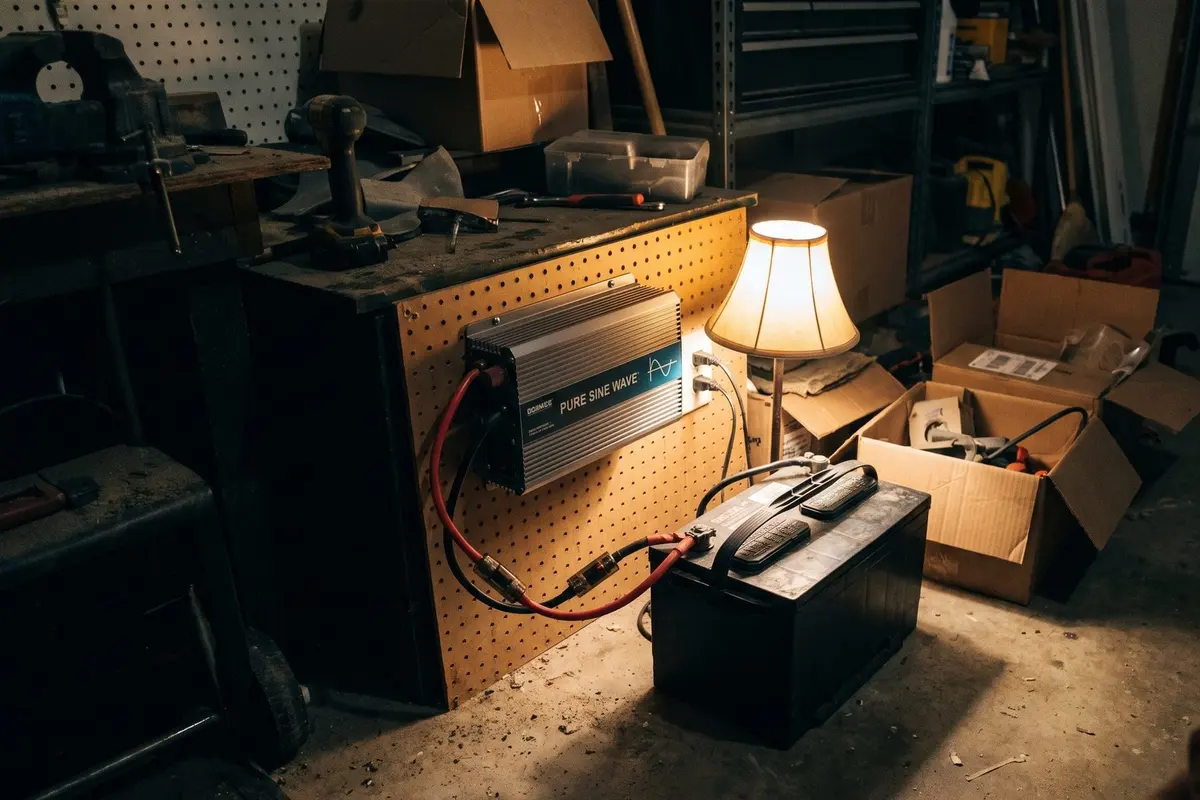
- Mount the inverter on a ventilated board within 3 to 6 feet of the battery, keeping cable runs short.
- Use cable sized per the inverter manual, short and thick.
- Put a Class T or ANL fuse sized to the inverter on the positive cable, within inches of the battery terminal.
- Torque the lugs. Loose high-current connections become heat sources.
- Load-test at half and then full rating, and feel the cables after ten minutes: warm is normal, hot is a fault.
Never wire inverter output into household wiring or an outlet. That is backfeeding, the same hazard as a generator plugged into a dryer outlet (see our generator safety guide), and the Red Cross warns it puts utility workers, neighbors and your own household at risk of electrocution. Loads plug into the inverter directly, and anything beyond plug-in use is work for a licensed electrician under the National Electrical Code.
Inverter output is real 120 V AC and can kill exactly like a wall outlet. Treat it with the same respect, and keep DC devices such as 12 V LED lighting on DC, where they need no inverter at all.
Frequently asked questions
What size inverter do I need for emergency power?
Start with the one or two devices that truly need AC, since phones, lights, a radio and a router can run on 12 V DC. Take the largest load you will run at once, add 25%, and check the surge rating if it has a motor. A 300 to 600 watt pure sine inverter covers most emergency setups.
Is a pure sine wave inverter worth it?
For an emergency setup, yes. Pure sine output closely matches utility power, and electronics and appliances with motors run best on it. Modified sine inverters are simpler, but The Off-Grid Handbook advises against them because electronics and motors dislike the stepped waveform. Pure sine is what the book specifies for its 300 to 600 watt inverter.
What size inverter do I need to run a refrigerator?
Measure the fridge's running watts with a plug-in meter, add 25% for the continuous rating, and make sure the surge rating covers the compressor's startup, which can be around three times the running draw. Then check the battery: a modern fridge can use 1,000 to 1,500 watt-hours a day.
Can I plug an inverter into a wall outlet to power my house?
No. Feeding inverter or generator power into household wiring through an outlet is backfeeding. It can energize utility lines and electrocute line workers, and it puts your own household at risk. Plug loads directly into the inverter. Powering house circuits takes equipment installed by a licensed electrician.
Sources
- The Off-Grid Handbook, Garrett Dalton, Project 22
- University of Arizona Cooperative Extension: Stand Alone Photovoltaic (PV) Systems (AZ1983)
- Virginia Cooperative Extension: Estimating Appliance and Home Electronic Energy Use
- American Red Cross: Safe Generator Use
- Ready.gov: Power Outages
- Florida Solar Energy Center (UCF): Batteries and Charge Control in Stand-Alone Photovoltaic Systems
Safety guidance changes. Check the agency pages above for the current version, and follow your local code and manufacturer instructions.