DIY LiFePO4 battery box: a 12 V power box you can build in an afternoon
The reservoir of a home backup power system, built in a sealed box with every circuit on its own fuse.
In this article
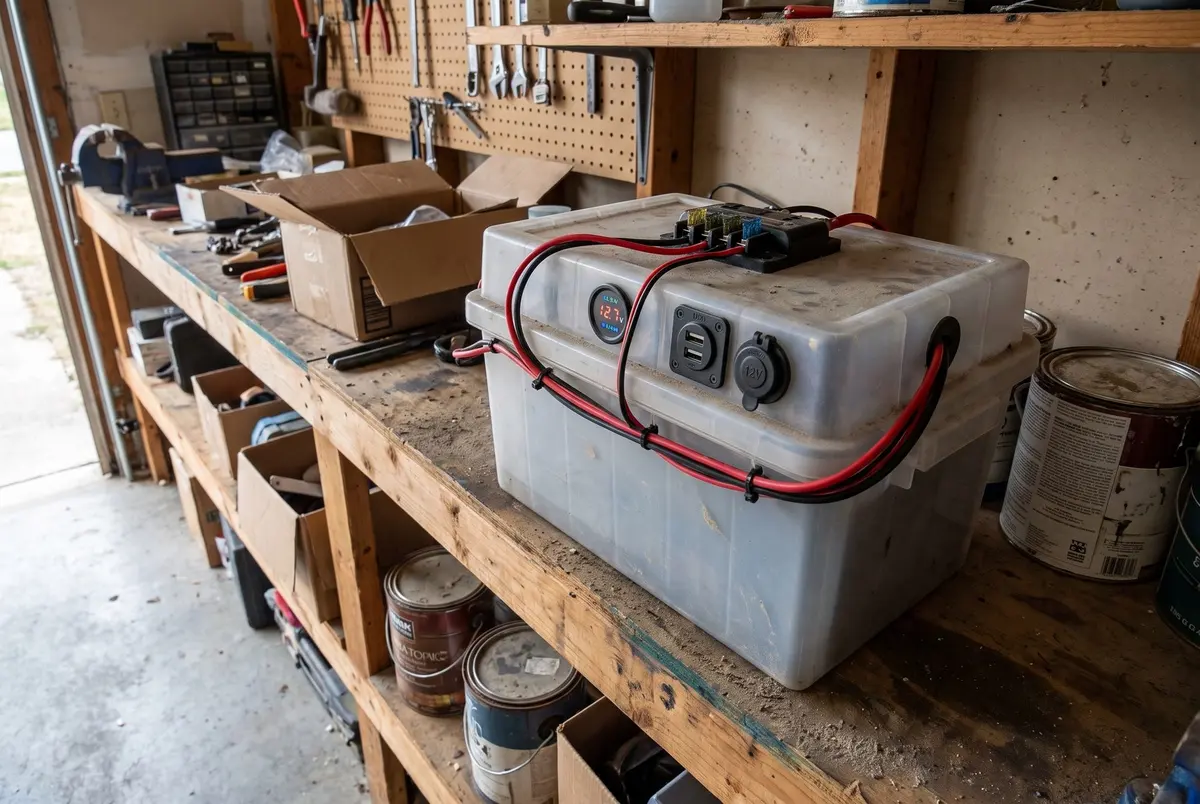
A DIY LiFePO4 battery box is a 12 V lithium iron phosphate battery with a built-in BMS, mounted in a sealed plastic box with a master fuse on the positive terminal, a fused outlet panel and a voltmeter. Built around a 50 Ah battery, it stores about 600 usable watt-hours, enough for one to three days of a typical critical load. The Off-Grid Handbook puts it at about two hours and $180 in materials.
Project 18 of the book calls the battery the reservoir of the power system. This guide follows that build and adds what the National Fire Protection Association says about living safely with lithium batteries.
Why LiFePO4 for a 12V battery box?
The book chooses lithium iron phosphate deliberately: stable, sealed, no acid and no hydrogen. That last point decides where a battery can live, and the book rules out flooded lead-acid in living space because of hydrogen off-gassing.
Usable energy is the other reason. LiFePO4 gives you 80 to 100% of its label, while lead-acid gives about 50% before you shorten its life, the same 50% limit the University of Arizona Extension sets for deep-cycle lead-acid batteries. As the book puts it, the cheaper battery usually is not.
Materials and tools checklist
- 12 V 50 Ah LiFePO4 battery with an internal BMS (battery management system)
- Sealed plastic battery box
- Fuse block and a 40 A master fuse
- Anderson-style connectors
- Panel-mount USB and 12 V outlets
- Battery voltage meter
- Marine-grade 10 AWG wire
- Tools: drill, step bit for the panel mounts, crimper, multimeter
Buy a battery that is listed by a nationally recognized testing laboratory and labeled accordingly, as the NFPA recommends. The internal BMS is what protects the cells, so read its specifications before you order.
How to build the battery box, step by step
- Mount the fuse block and outlets on the box, with the master fuse on the positive lead directly off the battery terminal.
- Wire every outlet through the fuse block. Each circuit gets its own fuse.
- Add the voltmeter where you can read it at a glance.
- Strain-relieve every cable that enters the box, so a tug on a cord never reaches a terminal.
- Charge it from a solar charging station or a mains LiFePO4 charger, and log one full cycle.
The book also asks you to write your audited daily load on the box. With that number on the lid, the voltmeter becomes a fuel gauge you can act on, and our guide to sizing backup power with a watt-hour audit shows how to find it.
Reading the voltmeter
For LiFePO4, the book's guidance is simple: about 13.0 V at rest is comfortable, and under 12.0 V means it is time to charge. Take the reading after the battery has rested, not while a heavy load is running, since a load pulls the number down.
Log the reading after the first full cycle. That gives you a baseline to compare against when the box has been sitting on a shelf for a season.
How much power is in a LiFePO4 battery, 12V 100Ah?
Capacity scales with amp-hours. If a 50 Ah battery gives about 600 usable watt-hours, a 12 V 100 Ah LiFePO4 gives roughly double, about 1,200 watt-hours, which is two to six days of a 200 to 600 Wh critical load.
A bigger battery can deliver more current, so the master fuse and the main wire must be sized for the new maximum draw and kept within the BMS limits, not copied from the 50 Ah build. You can also grow later by joining matched batteries; see how to connect batteries in parallel for the rules.
LiFePO4 safety rules
- Never bypass the BMS.
- Never charge below freezing unless the battery has low-temperature protection.
- Keep the master fuse in the circuit at all times.
- Follow the manufacturer's charge specifications exactly, with charging equipment compatible with the battery.
- Cover the terminals and leave no exposed copper. Even 12 V systems can deliver burn-level current through a short, the book warns.
- Stop using the battery if it shows an unusual odor, excessive heat, popping sounds, swelling or a change in color (NFPA).
- Do not store it in extremely hot or cold places, and do not modify the battery or its charger (NFPA).
Have repairs done by a qualified professional rather than opening the battery case, as the NFPA advises. If a lithium battery is ever damaged by floodwater, do not charge it; contact your fire department and the manufacturer.
Where to keep the battery box
The NFPA's advice for larger lithium batteries is not to store them in extremely hot or cold locations, or anywhere they block the only exit from a room. A shelf in a heated room, close to where you will use the power, meets both rules.
An unheated garage is a poor place to charge the box in winter unless the battery has low-temperature protection. Keep it dry, keep the lid closed, and keep tools and loose metal off the terminals.
Check it on a schedule. Every month or so, read the voltmeter at rest, recharge if it is under 12.0 V, and look the case over for swelling or heat.
A portable 12V power box for outages
Built this way, the box runs the things that matter most in an outage directly on DC, with no inverter: 12 V LED lighting, a radio and phone charging. Pair it with a DIY solar charging station and it refills every day the sun rises.
For the one or two devices that need household AC, the next step is a small pure sine inverter wired close to this battery. Our guide to what size inverter you need covers the sizing and the fuse.
Frequently asked questions
How long will a 12V 100Ah LiFePO4 battery last?
A 12 V 100 Ah LiFePO4 holds roughly 1,200 usable watt-hours. Divide that by your daily load: at 200 Wh a day it lasts about six days, at 600 Wh about two. A modern refrigerator alone can use 1,000 to 1,500 Wh a day, so with a fridge on it, plan on about one day.
Is it safe to keep a LiFePO4 battery indoors?
LiFePO4 is sealed, has no acid and does not give off hydrogen the way flooded lead-acid does, which is why The Off-Grid Handbook chooses it for indoor use. Keep the BMS intact, fuse the positive terminal, use compatible charging equipment, avoid extreme temperatures, and stop using any battery that swells, smells or overheats.
Can you charge LiFePO4 below freezing?
Not unless the battery has low-temperature protection. The book's rule is never to charge a LiFePO4 battery below freezing without it, and to follow the manufacturer's charge specifications exactly. Check the battery's datasheet for its charging temperature range before you leave the box in a cold garage or shed.
What size fuse do I need for a 12V battery box?
The book's 50 Ah build uses a 40 A master fuse on the positive lead, directly off the battery terminal, plus a separate fuse for every outlet circuit through a fuse block. With a larger battery or bigger loads, size the master fuse and cable to the new maximum draw and keep within the BMS limits.
Sources
- The Off-Grid Handbook, Garrett Dalton, Project 18
- NFPA: Lithium-Ion Battery Safety
- University of Arizona Cooperative Extension: Stand Alone Photovoltaic (PV) Systems (AZ1983)
Safety guidance changes. Check the agency pages above for the current version, and follow your local code and manufacturer instructions.