The best lighting for a power outage: headlamps, lanterns, and lights that turn themselves on
The first five minutes of any outage are decided by where the lights physically are. Stage them so nobody hunts in the dark, ever.
In this article
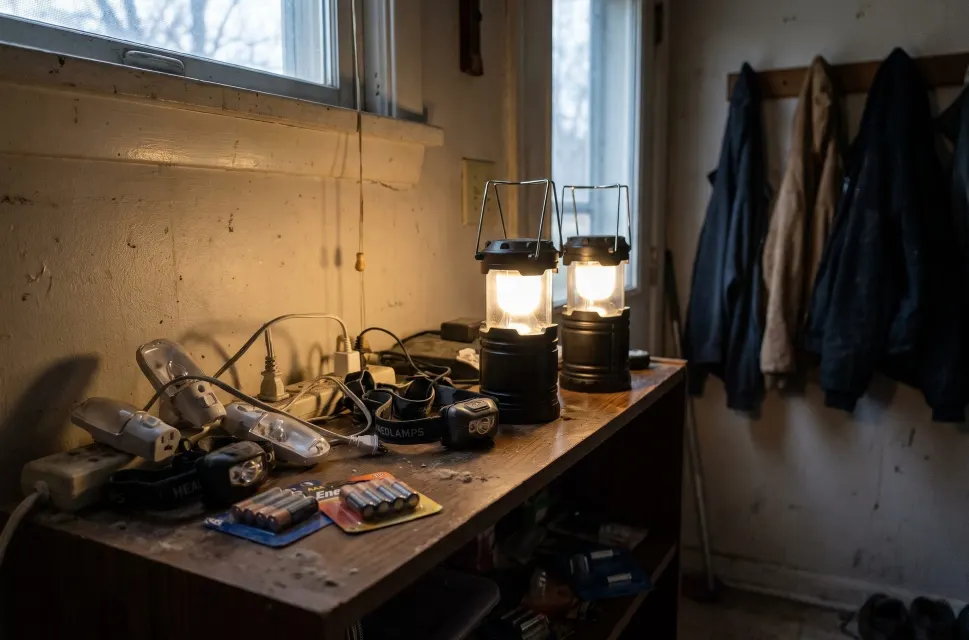
The best lighting for a power outage is battery LED light staged in fixed places: one headlamp per person, two or three LED lanterns of 300 lumens or more for the shared rooms, and plug-in power-failure night lights that switch on by themselves in hallways and stairs. Candles are not emergency lighting. The American Red Cross puts it in four words: use flashlights, not candles.
Most homes already own flashlights. The problem is that nobody knows which drawer they are in when it is dark, and that is the whole idea of Project 29 in The Off-Grid Handbook: stage the lights so nobody hunts in the dark, ever. The kit takes about 30 minutes to set up and about $50 in materials, per the book.
Headlamp vs. lantern: which do you need?
Both, because they do different jobs. A lantern lights a room for everyone in it, and a headlamp lights whatever the person wearing it is looking at.
| Light | Best for | Where it lives |
|---|---|---|
| Headlamp | Tasks, stairs, checking the breaker panel, cooking | At each bedside, one per person |
| LED lantern (300+ lumens) | Lighting a whole room for meals, games, conversation | One in the kitchen, one in the main room |
| Power-failure night light | Lighting escape routes the moment the grid drops | Hallway and stair outlets |
| Flashlight | A spare, or a beam for outside | The spares drawer |
The book makes headlamps the default over flashlights as a policy, for one reason: tasks need both hands. Carrying a child, holding a railing or lighting a stove is hard with a flashlight in one hand.
How bright should an emergency lantern be?
Shop by lumens, not watts. The Department of Energy explains that a watt measures electrical power while a lumen measures light, which is why LED packaging lists brightness in lumens.
The book sets the floor for lanterns at about 300 lumens, enough to light a kitchen counter or a table for a meal. Headlamps need less, since they light only what is in front of you.
Emergency lights for home: where to stage them
The book calls this station doctrine. Every light has a fixed home, and it is always the same home.
- One lantern in the kitchen.
- One lantern in the main room.
- A headlamp at each bedside, for every member of the household.
- Power-failure night lights in the hallway and stair outlets.
- Spare batteries in one drawer that everyone knows.
That matches Ready.gov's advice to have flashlights for every household member. The book's master supply table scales it by household size: one headlamp per person plus two lanterns for a household of two, and three lanterns for households of four or six.
Power failure night lights: the lights that turn themselves on
Plug-in power-failure night lights sit in an outlet like any night light. When the grid drops, they light up on their own, so the escape routes are lit before anyone gets out of bed.
Put them where a fall is most likely: the top and bottom of the stairs, the hallway between bedrooms and the bathroom, and the path to the exit you would use at night. They are the cheapest part of the kit and the one that works when nobody is awake to switch anything on.
Which batteries for the spares drawer?
The book specifies lithium primary batteries, the non-rechargeable kind, for the spares drawer. Per the book, they hold for about a decade on the shelf and work in the cold, which matters in a winter outage.
For longer outages, rechargeable lights pair well with a way to recharge them. A DIY solar charging station keeps headlamps and lanterns topped up every sunny day, and a 12 V LED lighting system wired to a battery gives you fixed light in the main rooms without any batteries to swap.
Blackout lighting kit checklist
Everything in the kit is bought, not built, and most of it is inexpensive. Use this list to set it up in one pass.
- One headlamp per household member, each with fresh batteries installed.
- Two or three LED lanterns in the 300-lumen class or brighter.
- Plug-in power-failure night lights for every hallway and stair outlet on the night route.
- Lithium primary spare batteries in the sizes your lights take, in one labeled drawer.
- A note inside the drawer listing which light takes which battery.
Buy the lights in matching battery sizes where you can. One size in the spares drawer is easier to keep stocked than four.
Write the date on each battery pack when it goes into the drawer. During the quarterly drill, the oldest packs are the ones to use first.
Why not candles?
Because they are an open flame in a dark, stressed house, often near curtains, children and pets. The book's field note is direct: candles are ambiance, not emergency lighting, and LEDs ended that trade-off.
The Red Cross lists flashlights instead of candles among its power outage safety steps. If a candle is ever lit anyway, keep a fire extinguisher where you can reach it.
The 90-second lighting drill
A kit only works if it is still where you left it. The book closes the project with a quarterly drill that takes about ninety seconds.
- Walk to every station: kitchen, main room, each bedside.
- Switch on every light and check it is bright, not dim.
- Unplug each power-failure night light, or press its test button if it has one, to confirm it lights.
- Count the spares drawer and replace what was used.
- Put the next drill on the calendar.
Lighting is the fifth line of the book's first-hour triage, right after people, hazards, water and cold. Our guide on what to do when the power goes out walks through the full sequence, and the 72-hour kit checklist covers the light you carry if you have to leave.
Frequently asked questions
What is the best light source during a power outage?
Battery LED lights are the best and safest choice. The Off-Grid Handbook recommends one headlamp per person, two or three LED lanterns of 300 lumens or more for shared rooms, and plug-in power-failure night lights in hallways and stairs. The American Red Cross advises using flashlights, not candles, during an outage.
Is a headlamp or a lantern better in a blackout?
You need both. A lantern lights a whole room for everyone, so it belongs in the kitchen and main room. A headlamp follows your eyes and leaves both hands free for stairs, cooking or carrying a child, which is why the book makes headlamps the default over flashlights and puts one at every bedside.
Do power failure night lights really work?
Yes. They plug into a wall outlet like a normal night light and switch on automatically when the power fails, so hallways and stairs are lit before anyone gets up. Test them during your quarterly drill by pressing the test button or unplugging them to confirm they light.
Is it safe to use candles during a power outage?
Candles are an open flame in a dark house, often near curtains, children and pets, so they are a poor choice. The American Red Cross recommends flashlights instead of candles during a power outage, and The Off-Grid Handbook treats candles as ambiance only. LED lanterns give more light without the fire risk.
Sources
- The Off-Grid Handbook, Garrett Dalton, Project 29
- American Red Cross: Power Outage Safety
- Ready.gov: Power Outages
- U.S. Department of Energy: Consumer Guide to Energy-Efficient Lighting
Safety guidance changes. Check the agency pages above for the current version, and follow your local code and manufacturer instructions.