Emergency binder checklist: the documents to copy before you need them
After the storm comes the paperwork. A binder of copies that leaves the house in ninety seconds turns weeks of rebuilding records into an afternoon.
In this article
An emergency binder holds copies of the papers you would need to prove who you are, what you own and what medical care you need: IDs and certificates, deed or lease, insurance pages, account numbers, prescription lists and a video inventory of your home. Keep the originals where they are safe, put copies in a water-resistant binder, and keep a second digital copy somewhere else. The whole job takes one evening.
What is a go binder?
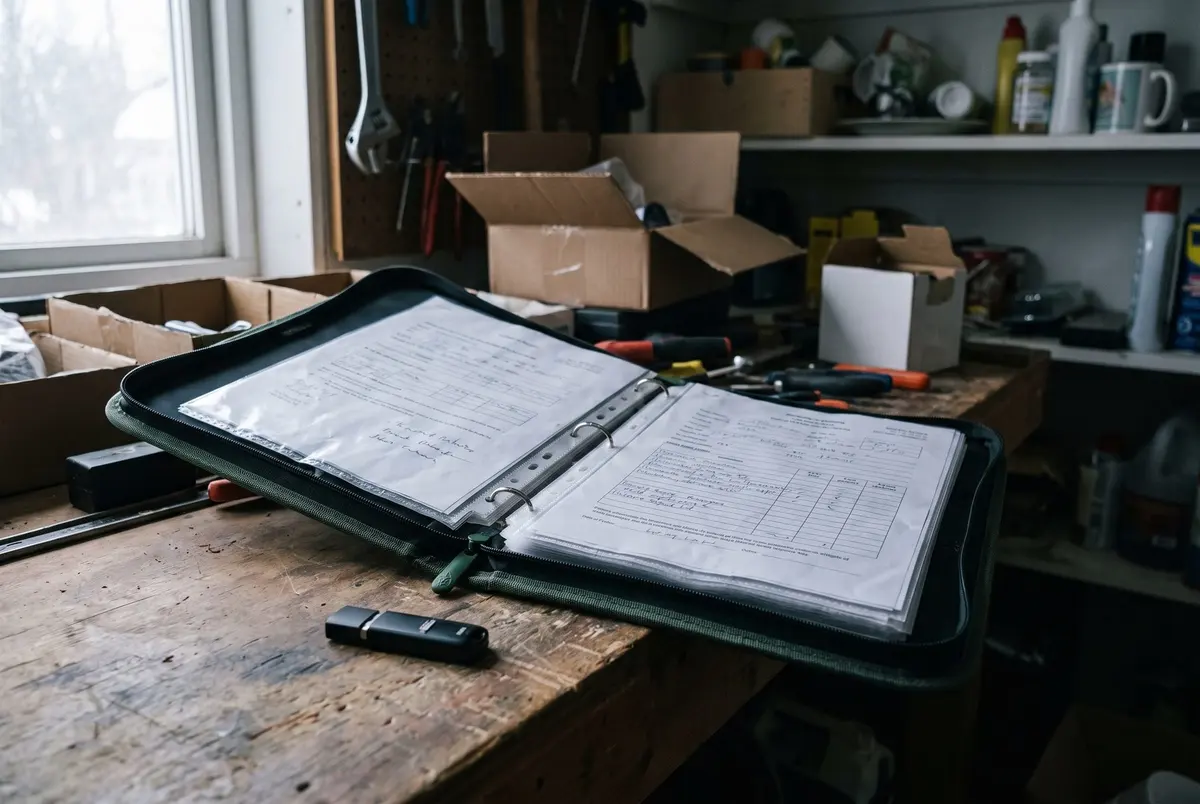
A go binder, or grab-and-go binder, is the working copy of your household paperwork, built to leave the house fast. Project 64 of The Off-Grid Handbook describes it as the binder that leaves in ninety seconds, with an encrypted USB drive as its twin.
It matters most after an event. Insurance claims, disaster aid and replacement documents all ask for papers that may be wet, burned or left behind, and Ready.gov notes, for example, that a Social Security card is used to apply for FEMA disaster assistance.
It also helps on an ordinary bad day. A prescription list with doses is what a new doctor, a pharmacist in another town or an emergency room will ask for first.
Important documents to keep in an emergency binder
Work through the house one category at a time. This list combines the book's three sets with Ready.gov's financial preparedness list and the American Red Cross kit list.
Identity
- Driver's licenses or photo IDs for every adult
- Passports
- Birth and marriage certificates
- Social Security cards
- Immigration papers
Home, money and insurance
- Deed, mortgage statement or lease, which also proves your address
- Vehicle titles
- Insurance declarations pages: home or renters, flood, auto, health, life
- A list of bank, credit card and policy numbers, with the phone number to call for each
- Recent tax statements and proof of income
Medical
- A prescription list with doses, for each person
- Allergies and medical conditions
- Vaccination records
- Doctor, dentist and pharmacy contacts
- Health insurance cards, front and back
- Pet vaccination records and a photo of each animal with the family
Household plans
- A copy of your family emergency communication plan and wallet cards
- Your neighborhood emergency plan map
- Utility account numbers and the phone numbers for outages
Add a photo inventory of your home
One item most binders miss is a video walk-through of the house. Take about ten minutes of phone video, room by room, opening every closet, and save it to the USB drive.
The book calls it the insurance claim you will be glad exists. Say out loud what the bigger items are as you film, so the video does the explaining later.
Don't stop at the living space. Film the garage, the basement, the shed, the yard and the outside walls and roof as they look today, because those are often the first things damaged in a storm.
Add a few close-ups of serial numbers and model labels on the expensive items: the furnace, the water heater, the appliances, the electronics. A still photo of each label takes seconds now and saves a long search later.
How to put the binder together
- Gather the originals on the kitchen table, one category at a time.
- Copy or scan each one; a phone scanner app works fine.
- Slip the paper copies into sheet protectors, grouped by section.
- Put everything in a water-resistant document pouch or zippered binder.
- Save the scans and the home video on an encrypted USB drive.
- Store the binder and the USB drive in different places.
The book puts the materials at about $25: the pouch or binder, sheet protectors and the USB drive. A printer helps, but a phone camera is enough.
Where to keep a grab-and-go binder
Keep the binder in the room where you would shelter, next to your shelter-in-place kit or your 72-hour kit, so it goes with you if you have to leave. Keep the USB drive somewhere else, or give it to your out-of-area contact.
Ready.gov suggests keeping document copies in a safe deposit box, on an external drive or in the cloud, so one fire or flood can't take everything. Originals stay wherever they live safely; the binder is the copy that travels.
Cash belongs nearby too, in small bills, because Ready.gov warns that ATMs and credit cards may not work during a disaster. How much cash to keep at home covers the amount.
Where each copy lives
| Copy | Where it lives | Why |
|---|---|---|
| Originals | A safe at home or a safe deposit box | They are hard to replace and rarely needed in the first days |
| Paper copies | The go-binder, in the shelter room | Readable with no power, ready to leave in ninety seconds |
| Digital twin | Encrypted USB, stored away from the binder | Survives if the binder is lost; holds the home video |
| Cloud copy | An account you can reach from any phone | Ready.gov lists it as an option for easy access during a disaster |
How often to update an emergency binder
Put an annual refresh on the calendar with tax season, when the paperwork is already out. Replace expired IDs, update prescriptions and insurance pages, and re-shoot the video if you've bought or sold anything big.
Encrypt the USB drive and keep the binder out of sight. It holds everything an identity thief would want, which is one more reason the originals don't belong in it.
Finally, make sure every adult in the house knows where the binder is and that it goes first if you leave. A binder only one person can find is half a plan.
Frequently asked questions
What documents should be in an emergency binder?
Copies of photo IDs, passports, birth and marriage certificates and Social Security cards; your deed or lease, vehicle titles, insurance declarations pages and a list of account and policy numbers; and medical records such as prescription lists, allergies, vaccination records and doctor contacts. Add pet records, your family communication plan, and a USB drive with scans and a video inventory of your home.
Should I keep originals or copies in a go binder?
Copies. The originals stay wherever they are safest, such as a fireproof safe or a safe deposit box. The go binder is the working copy that can leave the house in ninety seconds and be used for insurance claims and aid applications. Keep a second digital copy on an encrypted USB drive or in the cloud, stored somewhere other than the binder.
Where should I store my emergency binder?
Keep it where you would shelter during an emergency, next to your 72-hour kit, so everyone knows where it is and it can go with you if you leave. Store the digital copy somewhere else, such as with your out-of-area contact or in the cloud, so a single fire or flood cannot destroy both. Keep it out of sight.
How often should I update my emergency binder?
Once a year is enough for most households, and tax season is a good time because the paperwork is already out. Update it sooner when something changes: a new ID or passport, a new insurance policy, a move, a new prescription, or a large purchase that should be in your home video inventory.
Sources
- The Off-Grid Handbook, Garrett Dalton, Project 64
- Ready.gov: Financial Preparedness
- American Red Cross: Survival Kit Supplies
- Ready.gov: Pets and Animals
Safety guidance changes. Check the agency pages above for the current version, and follow your local code and manufacturer instructions.