How much cash to keep at home for emergencies, and why the bills should be small
When the power goes out, card readers, ATMs and payment apps go with it. A small envelope of cash is infrastructure, like stored water.
In this article
- How much cash should you keep at home for emergencies?
- Cash during a power outage: what stops working
- Why keep emergency cash in small bills?
- Where to keep it: split the stash three ways
- Put your financial facts on paper
- Emergency fund basics: the envelope and the deep reserve
- Keep the reserve fresh
- How to spend emergency cash when the cards are down
- Frequently asked questions
A common target is enough cash to cover one to two weeks of fuel, food and essentials, in small bills (twenties and smaller). Ready.gov recommends keeping a small amount of cash at home in a safe place, in small bills, because ATMs and credit cards may not work during a disaster. The exact amount is a personal decision, so build the number from your own weekly spending.
That is the approach in Project 73 of The Off-Grid Handbook, a one-evening project the book calls "self-scaled." The book frames it as general information about household logistics, not financial advice, and so does this article.
How much cash should you keep at home for emergencies?
Skip round numbers you heard somewhere and do the math for your household. List what you would actually need to buy in a week with no cards, then multiply by one or two.
| Category | What it covers | Your weekly amount |
|---|---|---|
| Fuel | Gas for the car, generator fuel, propane refills | $ |
| Food | Groceries and fresh items to top up the pantry | $ |
| Medicine | Prescription copays and pharmacy basics | $ |
| Essentials | Batteries, ice, water, hardware store repairs | $ |
| Pets | Food and supplies for each animal | $ |
| Transport | A motel night or a ride if you have to leave | $ |
Add the column, then decide between one week and two. Our emergency supply calculator helps size the food and water side, which tells you how much you would still need to buy.
Cash during a power outage: what stops working
A blackout does not only darken the house. Card readers, ATMs and payment apps all depend on power and a network, and the store down the road may be open with no way to take a card.
Ready.gov's basic disaster kit list includes cash for the same reason. Cash keeps working when the grid does not.
It buys gas from a station running on a generator, ice from a neighbor, or a repair from someone who only takes cash that week. Our guide on what to do when the power goes out covers the rest of the first hours.
Why keep emergency cash in small bills?
The book puts it plainly: a blackout is a bad time to need change for a hundred. A merchant working from a cash drawer with no bank run may not be able to break large bills, and you may end up overpaying for a small purchase.
Keep the reserve in twenties and smaller, with some fives and ones mixed in. A few rolls of quarters help too, for laundromats and vending machines.
Where to keep it: split the stash three ways
One envelope in one drawer is one point of failure. The book splits the reserve by where you might be when you need it.
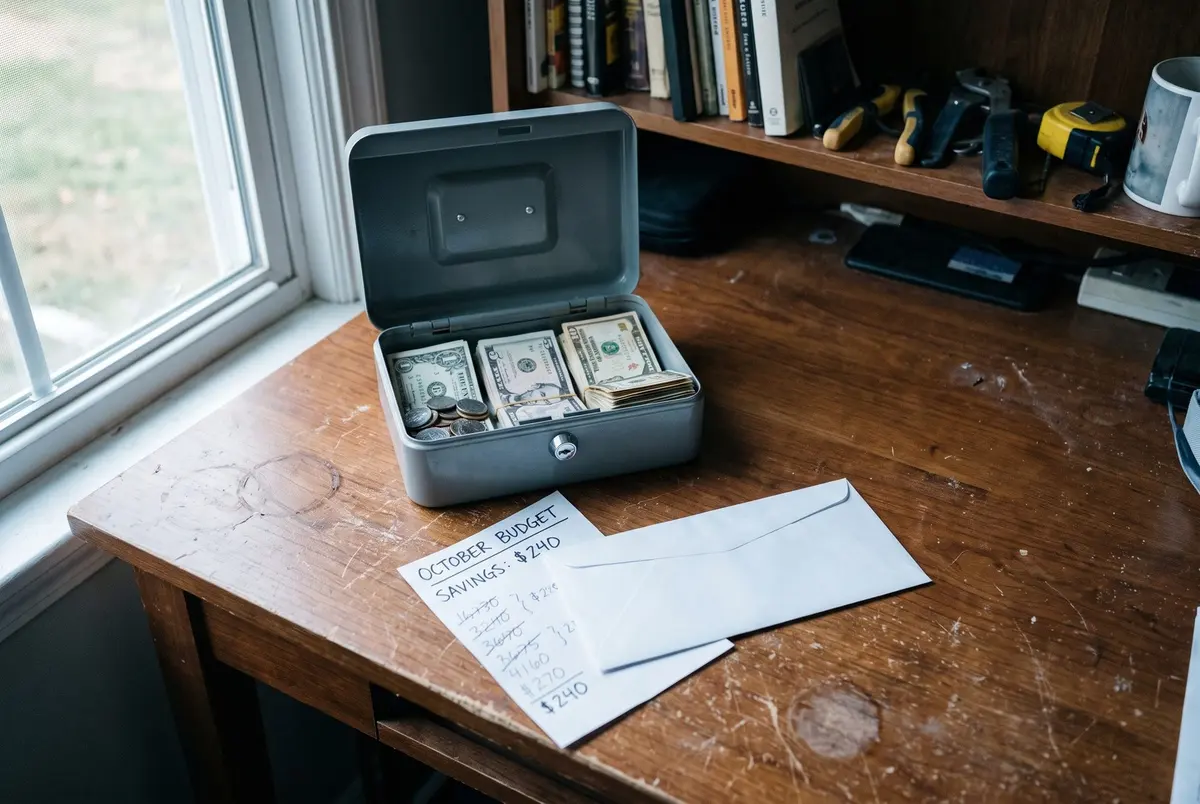
- Main reserve in a lockbox at home, in a spot only the adults know.
- A day's worth in the 72-hour kit, so it leaves with you in an evacuation. See our 72-hour kit checklist.
- A small fold in each vehicle kit, for fuel and tolls on the road. Our car emergency kit list shows where it goes.
Do not label the box or the envelope with what is inside. The fewer people who know where cash is kept, the safer it is.
Put your financial facts on paper
The second half of the project is the paper trail. If phones are dead and apps frozen, you still need to know which bank holds which account, your insurance policy numbers and who to call.
The book uses the account and policy list built for its document binder, so frozen apps do not mean frozen knowledge. Ready.gov lists the same categories: identification, financial and legal documents, medical information, insurance information and household contacts. Our emergency binder checklist walks through each page.
- Bank and credit card names, last four digits and customer service numbers.
- Insurance policies with policy numbers and claim lines.
- Recurring bills that may need a call if you are displaced.
- Copies of IDs for everyone in the household.
Emergency fund basics: the envelope and the deep reserve
The cash envelope is the first-week version of financial readiness. The deep version is the standard personal-finance advice of an emergency fund covering months of expenses, held in a savings account; Ready.gov also suggests an emergency savings account that could be used in any crisis.
The book's advice is to treat the larger fund as a goal, not a prerequisite. Build the envelope this week and grow the savings over time; a financial professional is the right person for the bigger questions.
Keep the reserve fresh
Cash is a stored supply like the pantry, and it needs the same care. The book gives it two rules.
- Rotate the bills once a year. Paper money mildews in damp storage, so spend the old bills and replace them.
- Treat it with par-level discipline. If you dip into the envelope, refill it on the next normal trip to the bank, just as you would restock a pantry shelf.
Store the lockbox somewhere dry, off the basement floor, and away from the water heater.
How to spend emergency cash when the cards are down
An outage that lasts a few days can drain an envelope faster than expected. Spend it in order of what keeps the household running.
- Fuel first: gas for the car and any fuel your plan depends on, while stations still have it.
- Medicine second: prescriptions and pharmacy basics.
- Water and food third, to top up what is already stored at home.
- Everything else last.
Keep a running note of what you spend on a slip of paper inside the lockbox. When the power is back, that note becomes the refill amount for the next trip to the bank.
Frequently asked questions
How much cash should I keep at home for emergencies?
There is no single official number. Ready.gov recommends a small amount in small bills in a safe place. A common target, used in The Off-Grid Handbook, is enough to cover one to two weeks of fuel, food and essentials. Add up what your household would spend in a week without cards, then keep one or two times that.
Why should emergency cash be in small bills?
Stores and neighbors working without power or bank deliveries may not be able to make change for large bills. Ready.gov specifically recommends small bills because ATMs and credit cards may not work during a disaster. Twenties and smaller, with some fives and ones, let you pay close to the exact amount.
Will ATMs and credit cards work during a power outage?
Often they will not. Card readers, ATMs and payment apps all need electricity and a working network, and Ready.gov warns that ATMs and credit cards may not work during a disaster. A small cash reserve at home, in the car and in your go-bag covers fuel, food and essentials until systems come back.
Is a cash envelope the same as an emergency fund?
No. The envelope covers the first week or two when cards and ATMs may be down. An emergency fund is a larger savings reserve, commonly suggested at several months of expenses, kept in a bank account. Build the envelope first and grow the fund over time, with a financial professional for the bigger decisions.
Sources
- The Off-Grid Handbook, Garrett Dalton, Project 73
- Ready.gov: Financial Preparedness
- Ready.gov: Build a Kit
Safety guidance changes. Check the agency pages above for the current version, and follow your local code and manufacturer instructions.