Shelter in place kit: how to stage a sealed room before you ever need it
Sealing a room against outside air is a ten-minute job, but only if the plastic was cut and labeled long before the siren.
In this article
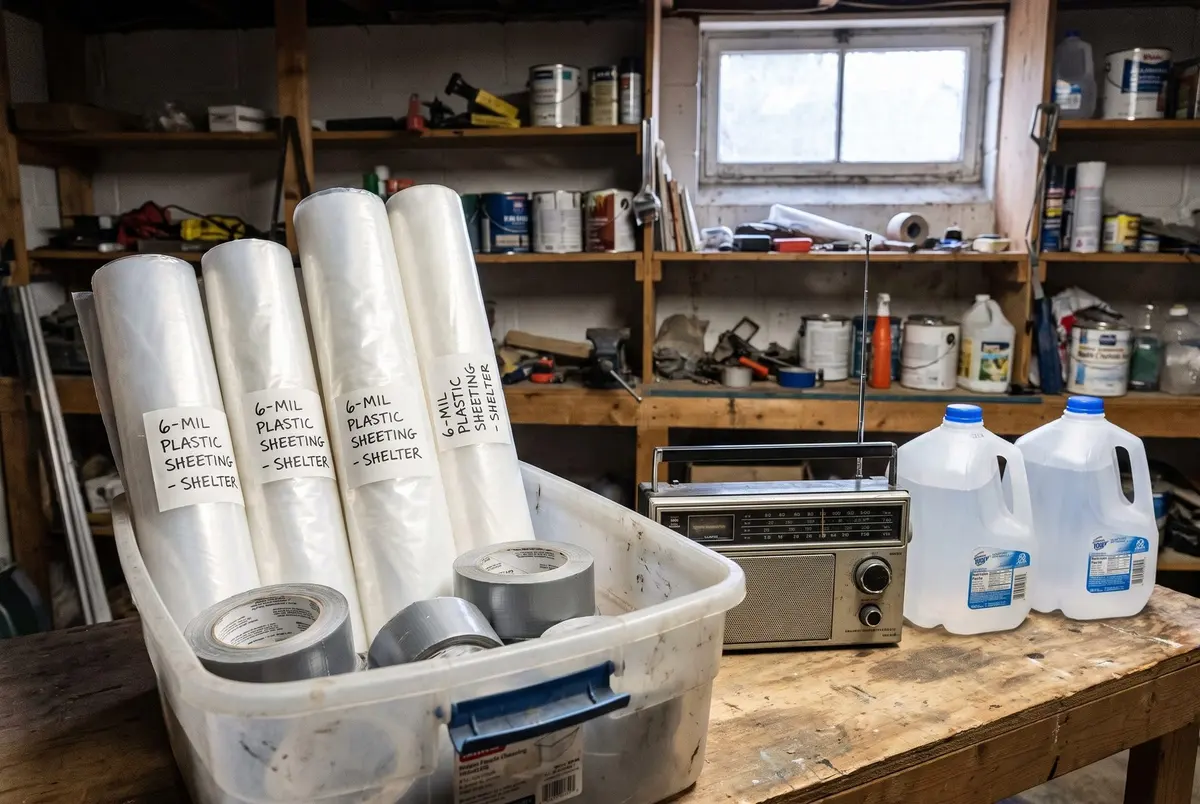
A shelter in place kit holds plastic sheeting pre-cut and labeled for every door, window and vent of one room, fresh duct tape, towels for the bottom of the door, a battery radio, water, snacks, battery lights and a first aid kit. Ready.gov's guidance is to go into an interior room with few windows, seal the windows, doors and vents with thick plastic sheeting and duct tape, and turn off fans and heating and cooling systems. You stay until officials say it is safe.
Project 60 of The Off-Grid Handbook stages all of it in about two hours, for roughly $60 in materials, per the book. The point is speed: sealing is a ten-minute job only if the cutting happened earlier.
What goes in a shelter in place kit?
Keep everything in one bin, in or right beside the room you picked. Here is the checklist.
- Plastic sheeting, pre-cut for each opening and labeled ("north window," "door," "vent"). The book uses 6-mil sheeting; Ready.gov asks for thick sheeting.
- Duct tape, in fresh rolls. The book warns that old tape fails, so replace it on a schedule.
- Scissors, for trimming on the day.
- Towels to block the gap at the base of the door.
- A battery-powered or hand-crank radio for official instructions. Our guide to the hand crank emergency radio covers which features matter.
- Water and snacks for everyone who will be in the room.
- Flashlights or battery lanterns, with spare batteries.
- The household first aid kit, staged in or beside the room. See our home first aid kit list.
- A charged phone and power bank, and any daily medications.
How to choose a shelter in place room
Ready.gov's rule is an interior room with few windows, if possible. The book adds a preference for a room above the ground floor for most hazards, and notes that the warm room many households set up for winter outages often already qualifies.
Size matters too. FEMA's rule of thumb is 10 square feet of floor space per person, which provides enough air to prevent carbon dioxide buildup for up to five hours. A family of four needs a room of at least 40 square feet; a small bedroom of 10 by 12 feet gives 120.
The right place depends on the kind of emergency, so follow the instructions officials broadcast. Here is how the main cases differ in federal guidance.
| Event | Where to shelter | Seal the room? | Typical duration |
|---|---|---|---|
| Chemical release | Interior room, few windows | Yes: plastic, tape, HVAC off | A few hours, until the all-clear |
| Radiation emergency | Basement or center of a large brick or concrete building | Follow official instructions | At least 24 hours unless told otherwise |
For a radiation emergency, Ready.gov says to stay in the most protective location for the first 24 hours unless an immediate hazard such as fire or a gas leak forces you out, or authorities say it is safe.
Plastic sheeting and duct tape: cut it now, not later
Measure every opening in the room: each window, the door, and every air vent and return. Cut a sheet for each one, larger than the opening so the tape lands on the frame or wall, and write its location on it with a marker.
Roll each sheet, then pack the rolls in the bin with the tape. On the day, Ready.gov's method is to tape the corners of each sheet first, then seal all the edges.
How to shelter in place, step by step
When officials issue a shelter-in-place order, run the drill the book lays out, with Ready.gov's additions.
- Get everyone inside, pets included. Close and lock exterior doors and windows, and close the fireplace damper.
- Turn off fans, air conditioning, forced-air heating and any fuel-burning appliances.
- Bring the kit, go into the room and close the door.
- Tape the pre-cut sheeting over the windows and vents, corners first, then the edges.
- Push a towel against the base of the door, and seal the door with its sheet.
- Turn on the radio and follow official instructions.
How long do you shelter in place?
For chemical releases, sheltering is usually a matter of hours, not days, because dangerous clouds tend to clear within a few hours. Do not leave the room, even to help someone outside, until authorities say it is safe.
When the all-clear comes, open the room and ventilate it fully, then air out the rest of the house. Ready.gov says to restore normal ventilation once you are cleared.
Safety: no flame in a sealed room
The book is absolute on this: a sealed room and any flame or fuel-burning device cannot go together. No candles, no camp stoves, no fuel heaters inside the sealed space. Use battery lights and a battery radio only, and keep a working CO alarm in the house as described in our guide to carbon monoxide detector placement.
If anyone shows signs of carbon monoxide poisoning or exposure, such as headache, dizziness, weakness, upset stomach or confusion, getting to fresh air and calling 911 comes before keeping the seal.
Practice the drill once a year
The book folds this kit into its yearly household drill, timed. The first run shows you what the kit is missing while there is still time to fix it.
- Pick a calm evening and announce the drill.
- Run the steps above with a timer: people and pets in, systems off, sheeting up, radio on.
- Note what slowed you down, such as a missing label, a sheet cut too small or a dead flashlight.
- Replace the duct tape if it has gone stiff or lost its grip, since the book warns that old tape fails, and recut any sheet that no longer fits.
The same room can do three jobs. The book uses it as the warm room in a winter outage, described in our guide on how to stay warm without power, as the sleeping room, and as the sealed room. Pets belong in it too, as covered in our guide to pet emergency preparedness.
Frequently asked questions
What do you need for a shelter in place kit?
Plastic sheeting pre-cut and labeled for each window, door and vent of one interior room, fresh rolls of duct tape, scissors, towels for the door base, a battery or hand-crank radio, water, snacks, flashlights with spare batteries, a first aid kit, and any daily medications. Ready.gov lists plastic sheeting, scissors and duct tape in its basic kit.
How do you shelter in place?
Bring everyone and pets inside, close and lock doors and windows, and turn off fans, air conditioning and forced-air heating. Go into an interior room with few windows, seal windows, doors and vents with plastic sheeting and duct tape, put a towel at the base of the door, and listen to the radio for instructions.
How long do you shelter in place?
For chemical releases it is usually a few hours, because the dangerous air tends to clear. FEMA says 10 square feet of floor space per person gives enough air to prevent carbon dioxide buildup for up to five hours. Radiation emergencies differ: Ready.gov advises staying in the most protective location for 24 hours unless told otherwise.
What is the best room to shelter in place?
Ready.gov recommends an interior room with few windows. Pick one large enough for at least 10 square feet per person, with as few openings to seal as possible, and stage the kit inside it. For a radiation emergency, the basement or the center of a large building is the recommended spot.
Sources
- The Off-Grid Handbook, Garrett Dalton, Project 60
- Ready.gov: Shelter
- Ready.gov: Hazardous Materials Incidents
- Ready.gov: Radiation Emergencies
- FEMA: How long to remain in a shelter-in-place room?
Safety guidance changes. Check the agency pages above for the current version, and follow your local code and manufacturer instructions.