Home first aid kit list: the Red Cross basics, what to add, and why the course matters more
A real household first-aid station is a well-stocked box, a few satellite kits, and at least two people who have taken a course.
In this article
- What should be in a home first aid kit?
- First aid kit supplies worth adding
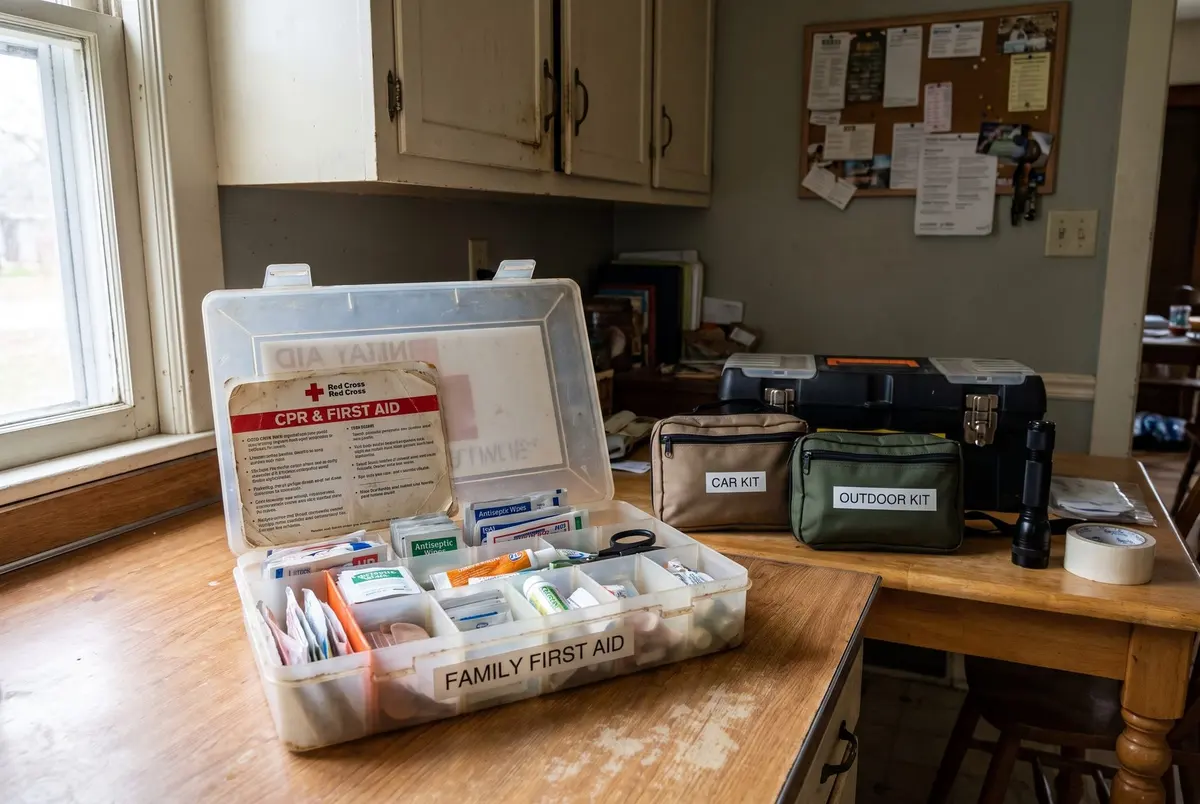
- Family first aid kit: one station, three satellites
- Adjusting the kit for the people in your house
- Prescriptions and the medical sheet
- Why CPR training matters more than the kit
- How to keep a first aid kit stocked and in date
- Frequently asked questions
The American Red Cross says a first aid kit for a family of four should include dressings and bandages, adhesive tape, antibiotic ointment, antiseptic wipes, gloves, a cold compress, a breathing barrier, an emergency blanket, a thermometer, tweezers and first aid instructions. The full list with quantities is below. Add your household's own medications and emergency numbers, and check expiration dates regularly.
Project 70 of The Off-Grid Handbook builds that kit into a household station, which takes about two hours and roughly $120 in materials, per the book. It is also clear about what matters most: "The training is the project; the kit is the accessory."
What should be in a home first aid kit?
This is the Red Cross list for a family of four, item for item. Many store-bought comprehensive kits cover most of it, so check yours against the table.
| Item | Quantity |
|---|---|
| Absorbent compress dressings, 5 x 9 inches | 2 |
| Adhesive bandages, assorted sizes | 25 |
| Adhesive cloth tape, 10 yards x 1 inch | 1 roll |
| Antibiotic ointment packets, about 1 gram | 5 |
| Antiseptic wipe packets | 5 |
| Aspirin packets, 81 mg each | 2 |
| Emergency blanket | 1 |
| Breathing barrier with one-way valve | 1 |
| Instant cold compress | 1 |
| Nonlatex gloves, size large | 2 pairs |
| Hydrocortisone ointment packets, about 1 gram | 2 |
| Gauze roller bandage, 3 inches wide | 1 |
| Roller bandage, 4 inches wide | 1 |
| Sterile gauze pads, 3 x 3 inches | 5 |
| Sterile gauze pads, 4 x 4 inches | 5 |
| Oral thermometer, non-mercury and nonglass | 1 |
| Triangular bandages | 2 |
| Tweezers | 1 |
| Emergency first aid instructions | 1 |
Ask your doctor or pharmacist before anyone in the house takes a medicine from the kit, aspirin included. Ready.gov's basic disaster kit lists a first aid kit alongside prescription medications, so the two belong together.
First aid kit supplies worth adding
The book treats the Red Cross list as the starting point, not the finish line. For the main home station it adds:
- Extra gauze, because it runs out first.
- Elastic bandages for sprains.
- More gloves.
- Trauma shears, which cut through clothing and tape.
- Oral rehydration salts.
- Your household's everyday over-the-counter basics.
Store the station in the room your household would shelter in. If you have set up a sealed room for chemical emergencies, our shelter in place kit guide explains why the first aid kit belongs right beside it.
Family first aid kit: one station, three satellites
Injuries happen where people are, not where the box is. The book adds small satellite kits in three places:
- The kitchen, scaled for burns and cuts.
- The car, as part of the trunk tub in our car emergency kit list.
- The 72-hour stay kit by the door, so first aid leaves with you in an evacuation. Our 72-hour kit checklist shows where it fits.
Label every kit, and keep an inventory card inside the lid with the expiry date of each item that has one. When you open the lid, you know what is missing in ten seconds.
Adjusting the kit for the people in your house
The Red Cross list is written for a generic family of four. Look at who actually lives with you and adjust, with your doctor's input where medicine is involved.
- Young children: child-sized bandages, and ask the pediatrician which medicines and doses are right before you stock any.
- Anyone with a serious allergy: prescribed emergency medicine stored as the pharmacist directs, with its expiry date on the inventory card.
- Anyone with a chronic condition: the testing supplies and equipment they use every day, plus a spare set where the doctor agrees.
- Older adults: spare reading glasses, a list of medications in large print, and supplies for any mobility aid.
- Pets: a few animal-specific items, covered in our guide to pet emergency preparedness.
Prescriptions and the medical sheet
The book's prescription plan is a two-week margin, coordinated with prescribers. Ask your pharmacist and doctors what margin is possible for each medicine; some can be refilled early and some cannot.
Tape a household medical sheet inside the station lid: each person's conditions, allergies, medications and doses, and doctors' numbers. A copy belongs in your emergency binder, and the emergency numbers go on a sheet posted beside the station and on everyone's wallet card, part of your family emergency communication plan.
Why CPR training matters more than the kit
A kit in untrained hands is a box of gauze. The book's second step is to book adult and pediatric first aid and CPR through the American Red Cross or an equivalent provider, for at least two people in the household.
Two people matter because the one who knows what to do may be the one who is hurt. The Red Cross offers first aid and CPR classes in the classroom and in a blended format (online lessons, then a skills check with an instructor). Online-only courses exist too, but they do not include a hands-on skills check.
The book states plainly that it is not medical advice and does not teach medicine. Its household rule: serious injury or illness means emergency services first, with first aid as the bridge until they arrive.
How to keep a first aid kit stocked and in date
Kits fail quietly, one used bandage at a time. The book keeps them current with two rules.
- Restock immediately after any use, even a single bandage.
- Audit expiry dates every quarter, on the same evening as the household drill.
- Replace anything with a cracked seal, a dried-out ointment or a dead thermometer battery.
- Re-check the medical sheet whenever a prescription changes.
The same schedule covers the satellite kits, so one evening every three months keeps every kit in the house and car honest.
Frequently asked questions
What are the most important items in a home first aid kit?
Start with the Red Cross basics for a family of four: assorted bandages, gauze pads and roller bandages, adhesive tape, antiseptic wipes, antibiotic ointment, nonlatex gloves, a cold compress, a breathing barrier, an emergency blanket, a thermometer, tweezers and first aid instructions. Then add your household's medications and emergency phone numbers.
How often should you check a first aid kit?
Check it regularly and restock after every use. The Red Cross advises checking expiration dates and replacing used or out-of-date items. The Off-Grid Handbook ties the audit to a quarterly household drill, so every kit in the house and car gets checked on the same evening every three months.
Who should take a CPR and first aid course?
At least two people in the household, so a trained person is still available if the other one is the patient. The book recommends adult and pediatric first aid and CPR through the American Red Cross or an equivalent provider. Courses are offered in person and in blended online formats.
Where should a home first aid kit be kept?
Keep the main kit in a known, easy-to-reach spot that everyone in the house can find, such as the room you would shelter in. Add smaller kits in the kitchen for burns and cuts, in the car, and in your 72-hour emergency kit, so first aid is close wherever an injury happens.
Sources
- The Off-Grid Handbook, Garrett Dalton, Project 70
- American Red Cross: Anatomy of a First Aid Kit
- American Red Cross: CPR Training
- Ready.gov: Build a Kit
Safety guidance changes. Check the agency pages above for the current version, and follow your local code and manufacturer instructions.