Car emergency kit list: what to keep in your car, and the two habits that matter more
One strapped-down tub in the trunk, a fuel habit and a paper map close the gap between your home systems and the car you spend hours in.
In this article
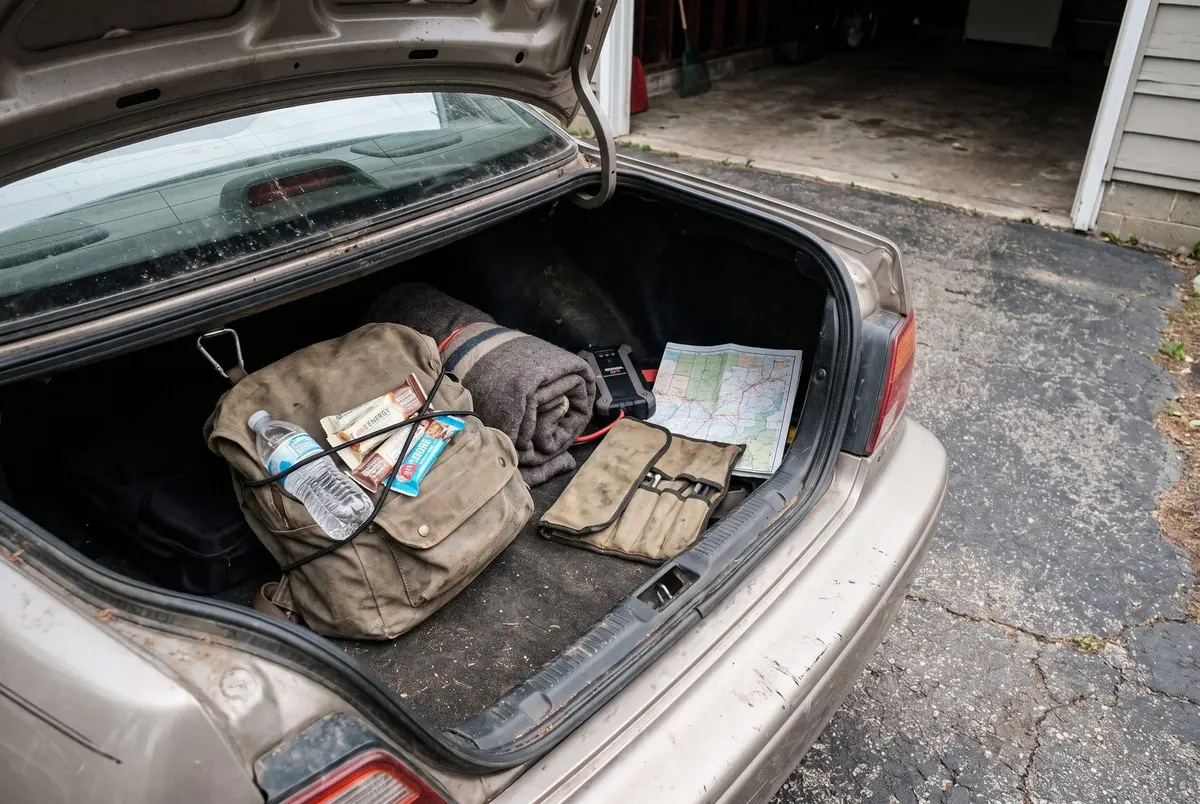
A car emergency kit should hold water, calorie bars, a blanket, first-aid basics, a flashlight, gloves, a phone power bank, a paper map, a small tool roll, a tow strap, and jumper cables or a jump pack. Add a winter module (ice scraper, traction aid, extra insulation) or a summer module (extra water, sunshade) as the seasons turn. Pack everything in one tub and strap it down in the trunk.
That is the list from Project 69 of The Off-Grid Handbook, which takes about an hour and roughly $80 in materials, per the book. Its argument is simple: you spend hours a day in a machine that can strand you thirty miles from every system you built at home.
What to keep in your car for emergencies
Here is the core kit, item by item. Ready.gov's car checklist adds flares or a reflective triangle and a car phone charger, so they are on it too.
- Water, rotated on a schedule (more on that below).
- Calorie bars or other no-cook, non-perishable snacks.
- A wool blanket or sleeping bag.
- First-aid basics: a small satellite kit, not the whole home station. See our home first aid kit list for what goes in each.
- Flashlight with spare batteries, and work gloves.
- Phone power bank, kept charged, plus a charging cable for the car.
- Paper road map of your region.
- Small tool roll: pliers, screwdrivers, a knife, tape.
- Tow strap and jumper cables, or a portable jump pack.
- Flares or a reflective triangle so other drivers see you.
- A small fold of cash in small bills. Card readers fail in outages, and our guide on how much cash to keep at home explains how the book splits the reserve.
Strap the tub in place. Loose gear becomes projectiles in a hard stop or a crash.
Winter car emergency kit: what to add in the cold months
The winter module swaps in gear for snow and ice. The National Weather Service's winter storm survival kit and Ready.gov's car list both point to the same items.
- Ice scraper and snow brush.
- A traction aid: sand or cat litter for under the tires (Ready.gov lists both), or traction mats.
- A compact shovel.
- Extra insulation: a second blanket, a hat, gloves and dry socks for everyone who rides with you.
- A bright cloth, red if possible, to tie to the antenna or door if you get stuck.
In summer, swap the cold-weather gear for extra water and a windshield sunshade. Heat is the summer version of the same risk.
The half tank rule
The first habit in the book is the half-tank rule: the fuel gauge never goes below half, as standing policy. A half tank gets you out of an evacuation zone, through a long traffic jam, or through a night of running the engine in short bursts for heat.
Official guidance goes further. Ready.gov says to keep the tank full in case of evacuation or power outages, and the National Weather Service says to keep it near full in winter to avoid ice in the tank and fuel lines. Treat half as the floor and fill up completely whenever a storm is in the forecast.
A fueled car is also a small power source at home. Our guide to using your car as a generator in a power outage covers how to charge devices from it safely, with the car outdoors and never in a garage.
Why keep a paper map in the car?
The second habit is the paper map. Your navigation lives in the same phone battery as your flashlight, your contacts and your news. When the cell network is overloaded or the battery is dying, a folded map still works.
Mark it ahead of time with two or three routes home and your family's meeting point. That ties the car into your family emergency communication plan.
What to do if you are stranded in the snow
The book's winter stranding doctrine matches the National Weather Service almost word for word. Follow it in this order.
- Stay with the vehicle. The National Weather Service warns that in wind-driven snow and cold you become disoriented quickly once you leave the car.
- Check the exhaust pipe before every engine run. Snow packed around the tailpipe pushes exhaust into the cabin, and carbon monoxide has no smell.
- Run the engine about 10 minutes each hour for heat, with a window cracked open a little for fresh air.
- Turn on the dome light at night while the engine runs, so you can be seen.
- Tie a bright cloth to the antenna or door. Once the snow stops falling, raise the hood to signal you need help.
- Wrap up in the blanket and extra layers between engine runs, and eat and drink a little at a time.
The book calls the exhaust check the life-safety line of winter stranding: clear it before every engine cycle, every time. It also says never to sleep in a running vehicle to stay warm.
How often to check your car kit
A kit only works if it is current. The book rotates the water and bars quarterly, on the same day as the household drill, so the car never becomes a separate chore.
| Item | Check | How often |
|---|---|---|
| Water and calorie bars | Replace with fresh stock | Every 3 months |
| Power bank and jump pack | Recharge to full | Every 3 months |
| Flashlight | Test, swap batteries | Every 3 months |
| Season module | Swap winter and summer gear | Fall and spring |
| First-aid satellite kit | Restock, check expiry dates | After any use, and quarterly |
| Fuel | Never below half | Every fill-up |
The car kit is one of three portable kits in the book, alongside the 72-hour stay kit and the first-aid satellites. Our 72-hour kit checklist covers the one that lives by the door at home.
Frequently asked questions
What should be in a car emergency kit?
Water, calorie bars, a blanket, first-aid basics, a flashlight, gloves, a charged phone power bank, a paper map, a small tool kit, a tow strap, and jumper cables or a jump pack. Ready.gov also lists flares or a reflective triangle and a car phone charger. Add an ice scraper, a traction aid such as sand or cat litter, and extra warm layers in winter.
What is the half tank rule?
It means never letting the fuel gauge drop below half a tank. A half tank lets you evacuate, sit out a long traffic jam, or run the engine in short bursts for heat. Ready.gov goes further and recommends keeping the tank full in case of evacuation or power outages, so fill up completely whenever a storm is forecast.
How long can you run your car for heat if stranded in snow?
The National Weather Service says to run the engine about 10 minutes each hour for heat, with a window opened a little for fresh air. Clear snow from the exhaust pipe before every run, because a blocked tailpipe can push carbon monoxide into the cabin. Stay with the vehicle and tie a bright cloth to the antenna.
What should I add to a winter car emergency kit?
Add an ice scraper, a compact shovel, a traction aid such as sand, cat litter or traction mats, a second blanket, and a hat, gloves and dry socks for each regular passenger. A bright cloth to tie on the antenna helps rescuers spot you. Swap these out for extra water and a sunshade in summer.
Sources
- The Off-Grid Handbook, Garrett Dalton, Project 69
- Ready.gov: Car Safety
- National Weather Service: Winter Weather Safety, During a Storm
- National Weather Service: Before Winter Storms
- Ready.gov: Winter Weather
Safety guidance changes. Check the agency pages above for the current version, and follow your local code and manufacturer instructions.