How to build a root cellar in a basement corner, or in a buried barrel
A vented corner of an unheated basement holds potatoes, carrots and apples all winter at 32 to 40°F, and it never draws a watt.
In this article
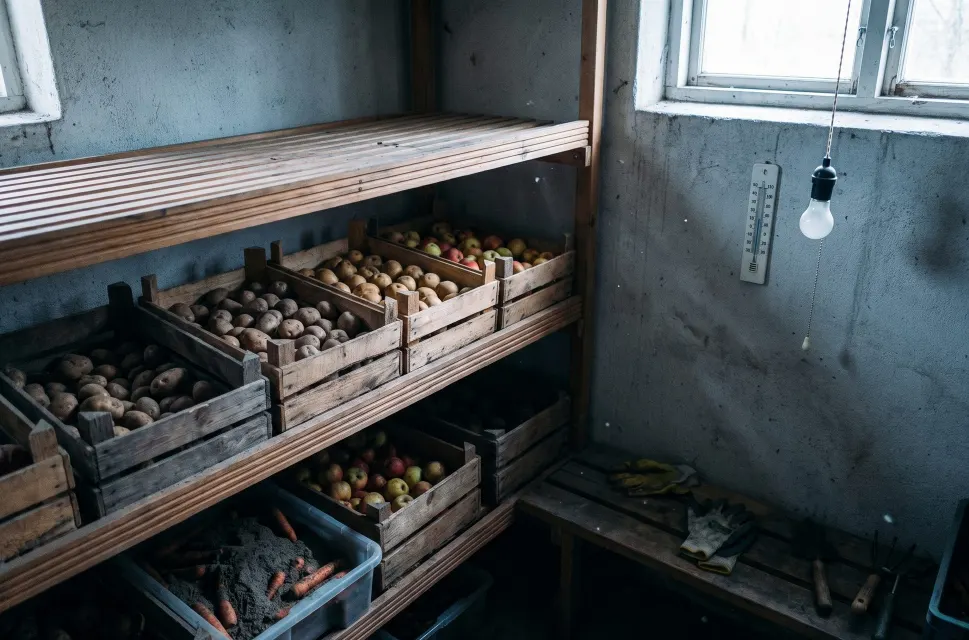
The simplest way to build a root cellar is to wall off the coldest corner of an unheated basement. Insulate the two new inside walls, leave the two outside walls bare so the cold ground does the work, and add a low vent that brings cold air in and a high vent that lets warm air out. Aim for 32 to 40°F and about 85 to 95% humidity for most root crops.
No basement? A 55-gallon barrel buried at a 45-degree angle below the frost line does the same job on a smaller scale. The Off-Grid Handbook covers both, as Projects 34 and 35, and calls the root cellar the oldest storage technology in the book and still the cheapest per pound.
Root cellar temperature and humidity, crop by crop
Most vegetables keep best between 32 and 40°F with high humidity, according to the University of Alaska Fairbanks Cooperative Extension. A few crops break the rule, and the cellar layout has to account for them.
| Crop | Temperature | Humidity | Notes |
|---|---|---|---|
| Carrots | 32 to 35°F | Very high, 95%+ | Bury in damp sand or sawdust |
| Beets, turnips | 32 to 35°F | 90 to 95% | Trim tops, leave a short stem |
| Potatoes | 38 to 40°F | 85 to 95% | Dark, cured first, away from apples |
| Onions | 32°F | Dry, 55 to 60% | Cure first, hang in mesh bags |
| Winter squash, pumpkins | 50 to 55°F | Dry | Too cold and damp for the cellar floor |
Potatoes need a little care at the cold end. Iowa State University Extension notes they turn sugary below 40°F, and Alaska's extension warns they start sprouting above it, so keep them right around 38 to 40°F.
How to build a root cellar in a basement
Project 34 is rated hard: a weekend of work and $150 to $300 in materials, per the book. You need 2×4 framing, rigid foam insulation, two 4-inch vents with adjustable dampers, an exterior-grade door or insulated hatch, a thermometer with a hygrometer, slatted shelves and wooden crates.
- Pick the coldest corner. North side, two exterior walls, no heating ducts or pipes, and ideally a small window that can host the vents.
- Frame and insulate the two interior partition walls. Leave the exterior walls uninsulated, because the cold ground is the cooling system.
- Install the vent pair. The intake sits low to pull cold air in, the exhaust sits high to let warm air out, and the dampers let you steer the temperature.
- Shelve for airflow. Slatted shelves and crates, nothing tight against the walls and nothing on bare concrete.
- Load by crop rules (below), with the damp-loving roots low and the dry crops high.
- Manage by thermometer. Check the reading and adjust the dampers once a week.
A concrete floor dries the air out. Alaska's extension suggests setting pans of water on the floor to raise humidity, and notes that a small, full cellar holds moisture better than a big, half-empty one.
Loading the cellar: the crop rules
Warm air rises, so every cellar has a colder, damper bottom and a warmer, drier top. The book uses that gradient on purpose.
- Potatoes: in the dark, and never beside apples. Ripening fruit gives off ethylene gas, which makes the tubers sprout.
- Carrots and beets: layered in damp sand in a bin or crate, low in the cellar.
- Onions: in mesh bags hung in the drier top zone.
- Apples: in their own crates, as far from the potatoes as the room allows.
The book also places winter squash in the top zone. Iowa State's extension recommends storing cured squash at 50 to 55°F in a dry, well-ventilated spot, which is warmer than most cellars run. If your top shelf stays near 40°F, a cool spare bedroom or closet is the better home for squash and pumpkins.
Cure before you store. Iowa State recommends holding potatoes at 50 to 60°F for about two weeks so small cuts heal and skins thicken, and onions need several weeks of drying after harvest. Grow your own with potatoes in containers or a raised garden bed, and the cellar refills itself every fall.
Buried barrel root cellar: no basement needed
Project 35 is a root cellar the size of a washing machine, holding 150 pounds or more of roots through winter, per the book. It takes about half a day and around $80 in materials: a clean food-grade 55-gallon barrel with a locking lid, gravel, straw bales, a 6-mil plastic sheet and a plywood cover.
- Choose high, well-drained ground. A flooded cellar is a compost bin.
- Call 811 before you dig, so buried utility lines get marked.
- Dig the hole at a 45-degree angle, deep enough that the barrel body sits below your local frost line, with a gravel bed at the bottom.
- Set the barrel with its mouth facing up the slope, backfill around the body, and leave the lid slightly above grade.
- Load crops layered in straw, each variety in a labeled mesh bag so you can pull one without unloading the rest.
- Insulate the lid with the plastic sheet, a straw bale and the plywood, and mark it with a stake you can find under snow.
The 45-degree angle is the trick. It gives reach-in access and drainage in one shape, which is the difference between a cellar and a well.
Running a root cellar through the winter
Check the basement cellar weekly and the barrel monthly, on a mild day, venting the barrel for a few minutes each visit. Pull anything soft or sprouting at once, because one rotting potato spreads to its neighbors.
A cellar pairs well with the rest of a food plan. Roots and apples cover fresh food through the winter, while a 30-day pantry and a crock of sauerkraut cover the rest. Save seed from your best keepers with seed saving for beginners, and next year's harvest is already planned.
Frequently asked questions
What temperature should a root cellar be?
Most root crops keep best between 32 and 40°F with 85 to 95% humidity. Carrots and beets like the cold, damp end. Potatoes do best around 38 to 40°F, since they turn sweet below 40°F and sprout above it. Onions want cold but dry air, and winter squash prefers a warmer 50 to 55°F in dry storage.
Can you build a root cellar in a basement?
Yes. Wall off the coldest corner of an unheated basement, ideally on the north side with two exterior walls and no heating ducts. Insulate the two new inside walls, leave the exterior walls bare, and add a low intake vent and a high exhaust vent with dampers. Use slatted shelves and crates so air moves around the produce.
How does a buried barrel root cellar work?
A food-grade 55-gallon barrel is buried at a 45-degree angle on high, well-drained ground, with its body below the local frost line and a gravel bed underneath. The surrounding soil holds it cold and steady. Crops go in layered with straw, and the lid is insulated with plastic, straw and plywood. It can hold 150 pounds or more of roots.
Can potatoes and apples be stored together?
No. Ripening apples give off ethylene gas, which causes potatoes to sprout, according to Iowa State University Extension. Keep them in separate crates on opposite sides of the cellar, or in different rooms if the space is small. Potatoes also need darkness, because light turns them green.
Sources
- The Off-Grid Handbook, Garrett Dalton, Projects 34 and 35
- University of Alaska Fairbanks Cooperative Extension: Vegetable Storage in Root Cellars
- Iowa State University Extension: Storing Winter Storage Vegetables
Safety guidance changes. Check the agency pages above for the current version, and follow your local code and manufacturer instructions.