How to make sauerkraut: the salt ratio, the jar and the rules that keep it safe
Cabbage, salt and time preserve food for months with no heat source at all, as long as you keep the salt math and keep everything under the brine.
In this article
To make sauerkraut, shred fresh cabbage, mix it with canning or pickling salt at 3 tablespoons of salt per 5 pounds of cabbage (about 2.25 to 2.5 percent by weight), and massage it until it releases brine. Pack it hard into a jar or crock so the cabbage stays under the brine, weight it, and let it ferment at 70 to 75°F. Small jar batches are usually ready in about 2 to 3 weeks; larger batches take 3 to 4.
Fermentation preserves vegetables with salt and time and no heat at all, which is why Project 42 of The Off-Grid Handbook includes it in the food chapter. The setup costs about $30, per the book, and the result keeps for months in the refrigerator or a cold cellar.
Sauerkraut salt ratio
Salt is what makes sauerkraut safe. It draws water out of the cabbage to make the brine and favors the lactic acid bacteria that sour the cabbage over the organisms that spoil it.
The National Center for Home Food Preservation's tested recipe uses 3/4 cup of canning or pickling salt for 25 pounds of cabbage, or 3 tablespoons per 5 pounds. UC Cooperative Extension's food preservers state the same thing by weight: 2.25 to 2.5 percent salt. The Off-Grid Handbook rounds this to 2 percent; follow the tested 2.25 to 2.5 percent.
| Shredded cabbage | Salt by weight (2.25 to 2.5%) |
|---|---|
| 1 pound (454 g) | 10 to 11 g |
| 2 pounds (907 g) | 20 to 23 g |
| 1 kilogram (2.2 lb) | 23 to 25 g |
| 5 pounds (2.27 kg) | 51 to 57 g, or 3 tablespoons |
A kitchen scale makes this exact, which is why the book lists one. Weigh the cabbage after coring and shredding, then weigh the salt.
What you need
- Fresh, firm cabbage.
- Canning or pickling salt, which is non-iodized and free of anti-caking agents.
- A large mixing bowl and a kitchen scale.
- Quart or half-gallon jars, or a fermentation crock.
- Fermentation weights and airlock lids, or clean improvised weights such as a smaller jar filled with water.
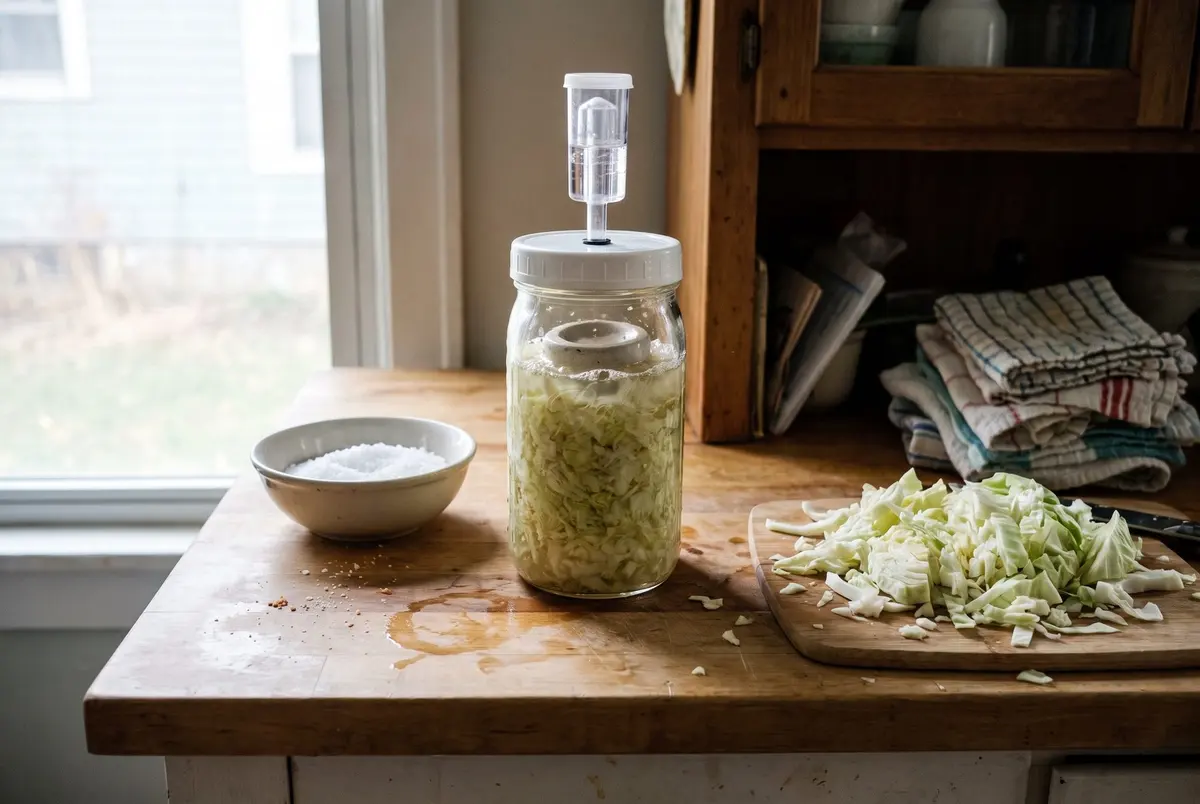
A dedicated fermentation crock is nice for large batches but not required. Wide-mouth glass jars with airlock lids, like the one in the photo above, are the easiest way to start.
How much will it make?
The NCHFP recipe yields about 9 quarts of kraut from 25 pounds of cabbage, so 5 pounds fills a little under 2 quarts. A single medium head is a good size for a first quart jar.
If you ferment in a crock, the NCHFP says it should be deep enough that the rim sits at least 4 or 5 inches above the cabbage.
How to make sauerkraut, step by step
- Prepare the cabbage. Remove the outer leaves and core, then shred it finely.
- Weigh and salt. Weigh the shredded cabbage and add salt at 2.25 to 2.5 percent of that weight.
- Massage. Work the salt into the cabbage with your hands until the brine flows freely, usually several minutes.
- Pack hard. Press handfuls into the jar, pushing down until brine rises over the cabbage. Leave headspace at the top.
- Weight it. Set a weight on top so every piece stays below the brine, always. If the cabbage's own juice does not cover it, the NCHFP says to add boiled and cooled brine made with 1 1/2 tablespoons of salt per quart of water.
- Cover. Fit an airlock lid, or a loose lid that you burp daily to release gas.
- Ferment in a spot that holds 70 to 75°F, out of direct sun. Check two or three times a week and skim any scum from the surface.
- Finish. When it is fully fermented, cap it and move it to cold storage.
How long does sauerkraut take to ferment?
Temperature sets the pace. These are the National Center for Home Food Preservation's figures:
| Room temperature | What happens |
|---|---|
| Below 60°F | Kraut may not ferment |
| 60 to 65°F | Fermentation may take 5 to 6 weeks |
| 70 to 75°F | Fully fermented in about 3 to 4 weeks |
| Above 75°F | Kraut may become soft |
UC Cooperative Extension adds that small batches at 70 to 75°F are usually ready in about 2 to 3 weeks. Fermentation is complete when the cabbage turns from opaque green-white to a translucent golden color and smells like sauerkraut, and the bubbling stops.
White film, mold and spoilage: what is safe?
- Thin white film on the surface: usually kahm yeast. The book calls it skimmable and harmless; skim it off as the NCHFP directs for scum.
- Fuzzy mold in blue, green, black or pink: discard the batch.
- Slimy, soft or foul-smelling kraut: discard. UC Extension lists off colors, off odors and soft texture as signs of spoilage.
Most problems trace back to the same causes: too little salt, uneven salting, air pockets from loose packing, or a room that runs too warm. When a batch is genuinely in doubt, throw it out.
Storing sauerkraut, and fermenting vegetables at home
Fully fermented kraut keeps tightly covered in the refrigerator for several months, according to the NCHFP. It also keeps in a cold root cellar, which matters if the power is out; see how long food lasts in a fridge without power for the rest of the refrigerator.
For shelf-stable jars, kraut can be canned, but only by a tested NCHFP procedure. The rules are the same as for water bath canning: tested recipe, tested time, no improvising.
The same salt-and-brine method works for other firm vegetables, and kimchi and pickles are next steps. For fermented foods outside the refrigerator, stick to tested recipes. A few jars of kraut make a welcome change in a 30-day food supply built mostly on dry goods.
Frequently asked questions
How much salt do you use for sauerkraut?
The tested NCHFP recipe uses 3 tablespoons of canning or pickling salt per 5 pounds of shredded cabbage, which is about 2.25 to 2.5 percent salt by weight. With a kitchen scale, that is 23 to 25 grams of salt per kilogram of cabbage, or about 10 to 11 grams per pound. Too little salt leads to soft, spoiled kraut.
Can I use table salt to make sauerkraut?
Use canning or pickling salt. Tested recipes from the National Center for Home Food Preservation call for it because it is pure salt without iodine or anti-caking agents, which can affect the brine and fermentation. Measure by weight if you switch salt types, since different salts weigh different amounts per spoonful.
How long does sauerkraut take to ferment?
At 70 to 75°F, sauerkraut is fully fermented in about 3 to 4 weeks, and small jar batches often in 2 to 3. At 60 to 65°F it may take 5 to 6 weeks. Below 60°F it may not ferment, and above 75°F it may turn soft. It is done when it looks translucent and golden and stops bubbling.
Is the white film on sauerkraut safe?
A thin white film on the surface is usually kahm yeast, which is harmless; skim it off and make sure the cabbage is still under the brine. Fuzzy, colored mold is different and means the batch should be discarded. Kraut that is slimy, soft or smells foul should also be thrown out.
Do I need a fermentation crock to make sauerkraut?
No. A wide-mouth quart or half-gallon glass jar works well for home batches, with a fermentation weight and an airlock lid, or a loose lid you burp daily. A crock is useful for large batches. Whatever the container, the rule is the same: keep every piece of cabbage below the brine.
Sources
- The Off-Grid Handbook, Garrett Dalton, Project 42
- National Center for Home Food Preservation: Sauerkraut
- UC Agriculture and Natural Resources, Master Food Preservers: Sauerkraut (PDF)
Safety guidance changes. Check the agency pages above for the current version, and follow your local code and manufacturer instructions.