Seed saving for beginners: which seeds to save, how to dry them and how long they keep
Saved seed is what lets this year's garden pay for next year's, and a jar the size of a lunchbox can hold a whole season of food.
In this article
Seed saving for beginners comes down to three rules: save seed only from open-pollinated (heirloom) varieties, let it mature and dry fully, and store it in an airtight container that stays cool, dark and dry. The easiest crops to start with are beans, peas and tomatoes, which pollinate themselves and need little special handling.
Project 44 of The Off-Grid Handbook calls this the step that makes the food system self-recharging. The vault costs about $15 in envelopes, labels, a jar and desiccant, per the book.
Open-pollinated vs. hybrid seeds
This is the first thing to check, on the seed packet or in the catalog. Open-pollinated varieties breed true: University of Minnesota Extension explains that their seed grows into plants very similar to the parent, with nearly identical fruit.
Hybrid seed, often labeled F1, is a cross of two parent lines. Its seed will grow, but not into the plant you saved it from; Oregon State University Extension says seed from hybrids produces a mixture of plant types, most of them inferior to the parent. The book's rule is simple: save from open-pollinated plants only.
The easiest seeds to save
University of Minnesota Extension recommends tomatoes, peppers, beans and peas for beginners, because their flowers pollinate themselves and their seeds need little or no treatment before storage.
Biennial crops such as carrots and beets are harder, because they need two growing seasons to set seed. Leave those for later.
How to save seeds: dry and wet methods
Dry-seed crops: beans, peas, lettuce
- Choose your best, healthiest plants of an open-pollinated variety.
- Leave the pods or seed heads on the plant until the seed is mature and dry.
- Pick them and finish drying indoors for about two weeks, spread out in a single layer.
- Shell or rub the seed free, then sift out the chaff with a fine sieve.
Wet-seed crops: tomatoes
- Scoop the seeds and gel from a fully ripe tomato into a jar with a little water.
- Let it sit and ferment for 2 to 3 days, per the book; University of Minnesota Extension notes the good seeds sink to the bottom within about five days.
- Pour off the liquid and floating debris, and rinse the seeds.
- Spread them on a plate or paper towel to dry completely at room temperature.
Seed must be thoroughly dry before it goes into storage. Damp seed sealed in a jar will mold or lose its ability to sprout.
For beans and peas, Oregon State University Extension suggests leaving the pods until they are "rattle dry" and watching them closely, since some varieties split and scatter their seed. To control weevils, it recommends putting the dry seed in the freezer for 24 to 30 hours.
Cross-pollination: which seeds are harder to save
Some crops are pollinated by insects or wind and cross readily with neighboring varieties. Oregon State University Extension says it usually does not pay to save seed from squash, cucumbers and melons without controlled pollination, because they cross with other varieties.
- Squash family: hand-pollinate. Tie a male and a female flower shut in the evening, transfer the pollen in the morning, close the female flower again and tag it.
- Cabbage family: many members intercross, and they can also cross with wild relatives such as mustard, cress, radish and turnip.
- Carrots: they cross with wild carrot, and they need two seasons to set seed.
For a first year, stay with the self-pollinating crops and add the others once the routine is familiar.
Seed storage: building the vault
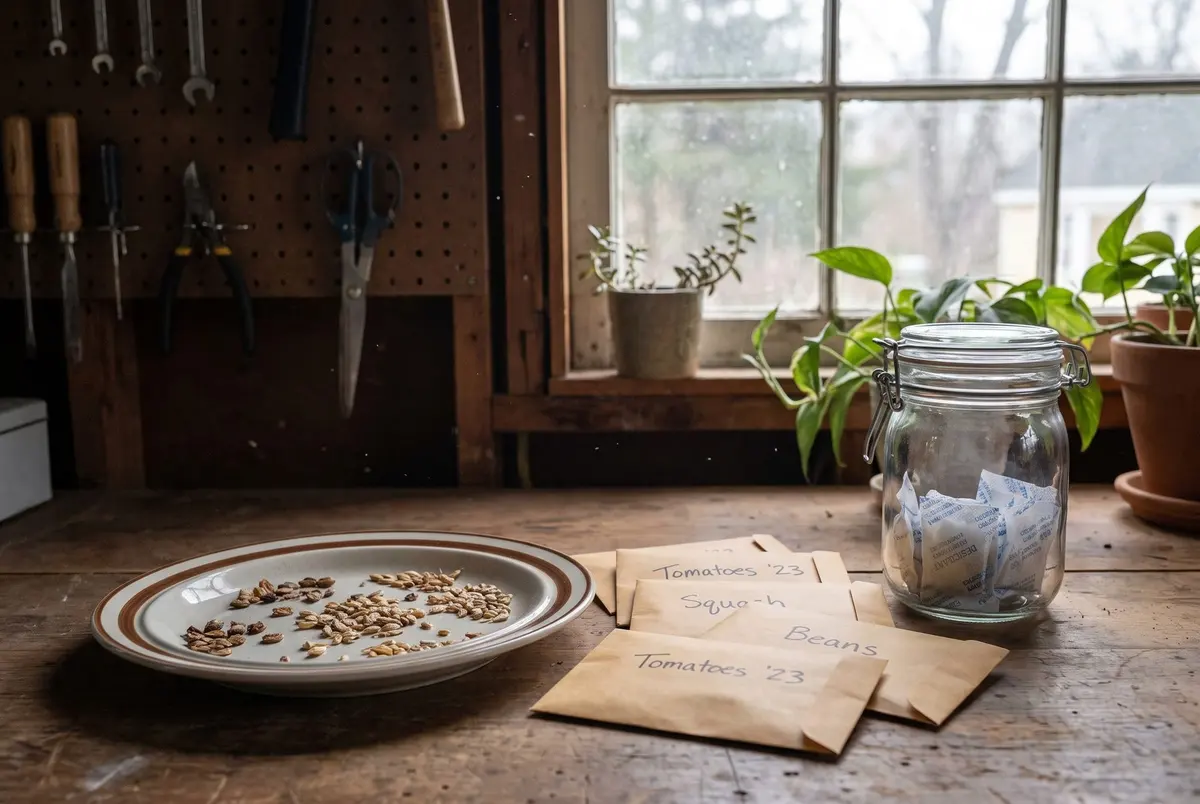
Put each variety in its own envelope and label it with the name, the variety and the year. Then store the envelopes in an airtight container with a desiccant.
- Container: a tightly sealed glass jar or a gasketed dry box.
- Desiccant: silica gel packets. University of Minnesota Extension also suggests one to two tablespoons of fresh powdered milk wrapped in tissue, which absorbs moisture for about six months.
- Temperature: cool and steady. Minnesota Extension calls 32 to 41°F ideal, which makes the refrigerator a good spot.
- Light: dark.
The book's field note puts it well: no other item in the book concentrates that much capability per cubic inch. Keep a list of what the vault holds in your emergency binder.
How long do saved seeds last?
The book says most garden seed holds 3 to 5 years, with onion and parsnip fading fastest. Oregon State University Extension groups common vegetables like this:
| Seed life | Crops |
|---|---|
| Short, 1 to 2 years | Corn, onion, parsley, parsnip, pepper |
| Intermediate, 3 to 4 years | Asparagus, bean, broccoli, carrot, celery, leek, pea, spinach |
| Long, 4 to 5 years | Beet, chard, cabbage family, turnip, radish, cucumber, eggplant, lettuce, melon, squash and pumpkin, tomato, watermelon |
These are averages under good storage, and germination drops gradually with age. University of Minnesota Extension advises using saved seed within one year for best results, so treat older seed as a backup and test it before you rely on it.
A simple germination test
Roll 10 seeds in a damp paper towel, keep it in a plastic bag at room temperature, and count how many sprout over the next week or two. Seven out of ten means roughly 70 percent germination, so sow a little more thickly to make up for it.
Vault a restart core
Beyond the seed you plant each year, the book recommends keeping a restart core: one season's worth of the calorie and storage crops, refreshed by rotation as you use it. Dry beans and the other storage crops from a raised garden bed belong there; for crops that cross easily, such as squash, vault fresh open-pollinated packets until you can hand-pollinate your own.
Potatoes are the exception. They grow from tubers, not true seed, and University of Minnesota Extension recommends certified seed potatoes each year; see growing potatoes in containers.
Garden seed is also not sprouting seed. Packets sold for planting may be treated and are not meant for eating, so keep a separate supply for sprouting in a jar. The cold-hardy greens you grow in a cold frame can go in the vault too, if they are open-pollinated.
Frequently asked questions
What is the difference between open-pollinated and hybrid seeds?
Open-pollinated, or heirloom, varieties breed true: seed saved from them grows into plants very much like the parent. Hybrid seed, often labeled F1, comes from crossing two parent lines, and seed saved from a hybrid produces a mix of plant types, most of them inferior to the parent. For seed saving, choose open-pollinated varieties only.
How long do saved seeds last?
Most garden seed stays usable for about 3 to 5 years when stored cool, dark and dry. Some fade much faster: onion, parsnip, parsley, corn and pepper are short-lived at 1 to 2 years, according to Oregon State University Extension. Germination drops with age, so run a quick paper-towel test on older seed before you plant it.
What are the easiest seeds to save for beginners?
Tomatoes, peppers, beans and peas are the best starting point. Their flowers pollinate themselves, so the seed comes true more reliably, and the seeds need little special treatment. Beans and peas dry right on the plant. Tomatoes need a short fermentation in water to remove the gel. Leave carrots and beets for later, since they take two seasons.
Should I store seeds in the refrigerator?
A refrigerator is a good place, as long as the seed is fully dry and sealed in an airtight jar with a desiccant such as silica gel. University of Minnesota Extension calls 32 to 41°F ideal for seed storage. Let a cold jar warm to room temperature before opening it, so moisture does not condense on the seeds.
Sources
- The Off-Grid Handbook, Garrett Dalton, Project 44
- University of Minnesota Extension: Saving vegetable seeds
- Oregon State University Extension: Collecting and storing seeds from your garden
Safety guidance changes. Check the agency pages above for the current version, and follow your local code and manufacturer instructions.