How to sprout seeds in a jar: fresh greens in four days, with no soil and no sun
A quart jar, a mesh lid and two rinses a day turn a spoonful of seed into a week of fresh greens, in any season.
In this article
To sprout seeds in a jar, soak about 2 tablespoons of sprouting seed overnight in a wide-mouth quart jar of cool water, then drain it through a mesh lid. Rinse and drain twice a day, leaving the jar tilted mouth-down so air can move. Most sprouts are ready in 3 to 5 days; give them a final rinse and refrigerate them for up to a week.
Sprouts are the fastest food crop there is. They need no soil, no sunlight and no garden, which is why Project 38 of The Off-Grid Handbook sets up a small jar station on the counter to keep fresh greens coming when the garden cannot.
What you need for a sprouting jar
The whole setup costs about $20 in materials, per the book, and fits on one shelf.
- Wide-mouth quart jars. Two is the useful minimum, for reasons explained below.
- Sprouting lids (mesh screw-on lids), or a square of cheesecloth held on with a canning band.
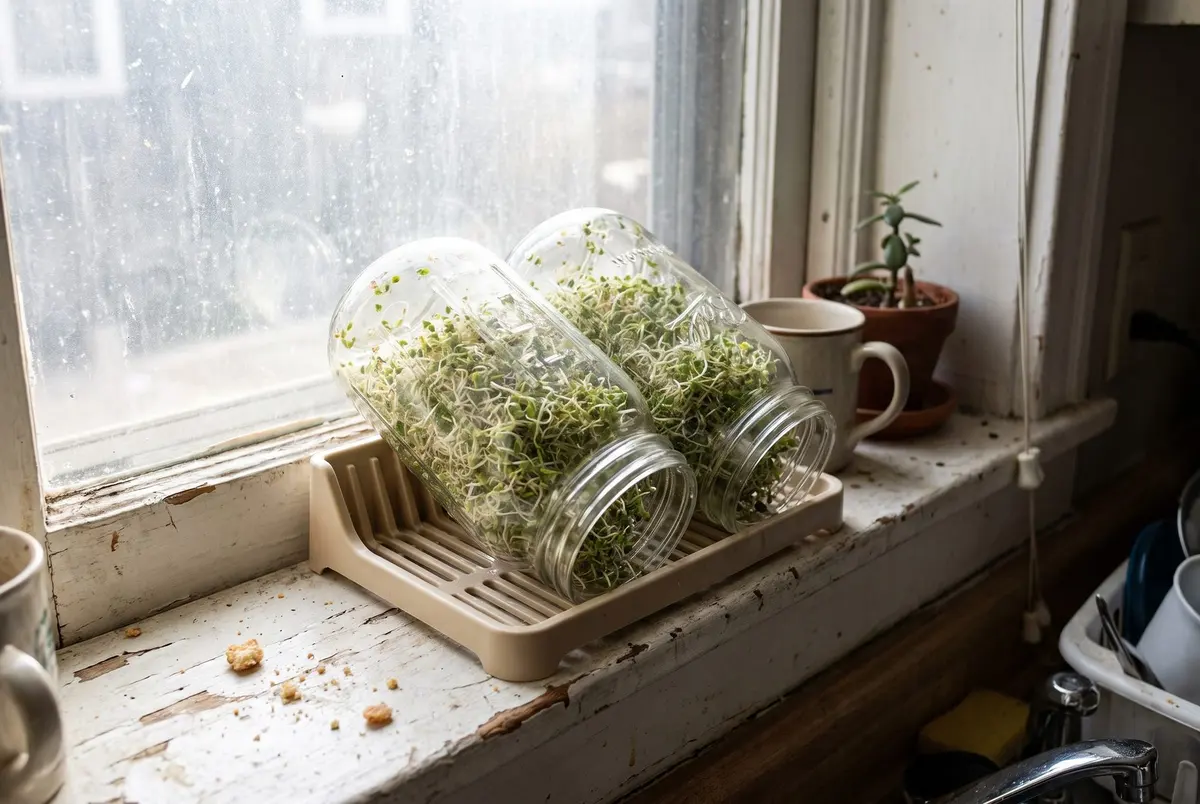
- A draining rack or bowl that holds the jars tilted mouth-down.
- Seed sold for sprouting: alfalfa, mung bean, radish, broccoli or lentil.
The seed is the one item not to improvise. Buy seed labeled for sprouting, which means tested and untreated, rather than garden seed packets, which may be treated with fungicide and are not meant to be eaten.
How to sprout seeds in a jar, step by step
- Soak. Put 2 tablespoons of seed in the jar, fill it with cool water, cap it with the mesh lid and leave it overnight.
- Drain. In the morning, pour the water out through the lid. Shake out as much as you can.
- Rinse twice a day. Fill with fresh cool water, swirl, and drain again, morning and evening.
- Tilt the jar. Rest it mouth-down at an angle in the rack or bowl so leftover water runs out and air gets in. Standing water is what turns a jar sour.
- Harvest. At day 3 to 5, depending on the seed, give the sprouts a last rinse, drain them well and move them to the refrigerator.
Sprouts do not need light to grow. A spot out of direct sun, at ordinary room temperature, is fine.
Which seeds to sprout: alfalfa, mung bean and more
The book lists five reliable starter seeds. They all follow the same soak, rinse and tilt routine; they differ mainly in size and how they are eaten.
| Seed | What you get | Typical use |
|---|---|---|
| Alfalfa | Fine, thread-like sprouts with small leaves | Sandwiches and salads |
| Mung bean | Thick white shoots, the familiar bean sprout | Stir-fries, soups, noodle dishes |
| Radish | Thin sprouts with a peppery bite | Mixed with milder sprouts |
| Broccoli | Small sprouts, mild cabbage flavor | Salads and wraps |
| Lentil | Short, crunchy sprouts | Soups, stews, grain bowls |
Mung bean sprouts at home
Mung beans are the easiest seed for a first try because they are large and forgiving. They are ready at the short end of the range, once the white shoot is the length you like. Since mung bean sprouts are usually eaten cooked, they also fit the food-safety advice below.
Alfalfa sprouts
Alfalfa seed is tiny and goes a long way. By the book's figure, a pound of alfalfa seed yields well over ten pounds of sprouts, so a single bag on the pantry shelf is months of greens.
Are homegrown sprouts safe to eat?
Sprouts grow in exactly the warm, wet conditions that bacteria also like. The FDA explains that if a few harmful bacteria such as Salmonella, Listeria or E. coli are on the seed, they can multiply during sprouting, even if you grow your own sprouts under sanitary conditions at home.
For that reason, the FDA advises that children, older adults, pregnant women and anyone with a weakened immune system avoid raw or lightly cooked sprouts of any kind. Penn State Extension adds that cooking sprouts significantly reduces the risk. For those households, put sprouts in soups, stir-fries and casseroles instead of on a sandwich.
For everyone, three habits keep risk down:
- Use seed labeled for sprouting, from a source you trust.
- Rinse on schedule, twice a day, and never leave sprouts sitting in water.
- Refrigerate promptly once they are done, and eat them within a week.
If a jar smells sour or rotten, or the sprouts turn slimy, throw the batch out. During an outage, sprouts are a refrigerated food like any other, so the same rules apply as in how long food lasts in a fridge without power.
How to keep a continuous supply
The trick in the book is simple: run two jars offset by two days. When one jar is ready to harvest, the other is halfway, and you start a new soak in the empty jar.
That rhythm gives a steady supply from one shelf of seed. It also makes sprouts a practical part of a 30-day food supply, where fresh greens are usually the first thing to run out.
Plan for the water, too. Each jar needs a soak and two rinses a day, which is small but real if the taps stop; it belongs in the household figure from how much water per person per day.
Common sprouting problems
- Sprouts smell sour. Usually too little drainage. Tilt the jar more steeply and shake it out harder after each rinse.
- Seeds did not sprout. The seed may be old, or the jar may be too cold. Try a warmer spot in the house and fresh seed.
- Fuzzy growth or slime. Discard the batch, wash the jar and lid in hot soapy water, and start again.
Sprouting seed is different from the seed you save for the garden. For that side of the pantry, see seed saving for beginners.
Frequently asked questions
How long does it take to sprout seeds in a jar?
Most seeds are ready to eat in 3 to 5 days after an overnight soak. Mung beans tend to be ready at the short end, once the white shoot reaches the length you like. Rinse and drain the jar twice a day during that time, then give the sprouts a final rinse and refrigerate them for up to a week.
Are homegrown sprouts safe to eat raw?
Raw sprouts carry a known risk because bacteria on the seed can multiply during sprouting, even in a clean home kitchen. The FDA advises children, older adults, pregnant women and people with weakened immune systems to avoid raw or lightly cooked sprouts. Cooking them significantly reduces the risk. Everyone should use seed labeled for sprouting and refrigerate the harvest promptly.
Do sprouts need sunlight to grow?
No. Sprouts grow from the energy stored in the seed, so a jar in a spot out of direct sun at ordinary room temperature works well. What they do need is drainage and air: rest the jar tilted mouth-down in a rack or bowl between rinses so water cannot pool in the bottom.
Can I use regular garden seeds for sprouting?
It is better not to. Garden seed packets may be treated with fungicide and are not meant for eating. Buy seed sold and labeled for sprouting, which is tested and untreated. It is also more economical: a pound of alfalfa sprouting seed yields well over ten pounds of sprouts.
Sources
- The Off-Grid Handbook, Garrett Dalton, Project 38
- FDA: Selecting and Serving Produce Safely (sprouts)
- Penn State Extension: What You Should Know About Sprouts
Safety guidance changes. Check the agency pages above for the current version, and follow your local code and manufacturer instructions.