How to cook without electricity: a camp stove, a solar oven and the fuel math for a week
When the range goes dark, meals move outside, and the households that eat well are the ones that counted their fuel before the outage.
In this article
To cook without electricity, move cooking outdoors to a propane camp stove, a gas or charcoal grill, or a rocket stove, and let a solar oven handle slow cooking on sunny days. Never use a camp stove, grill or charcoal indoors, in a garage or near an open window: the CDC warns that these produce carbon monoxide. Then count your fuel, so you know the stove will last as long as the outage.
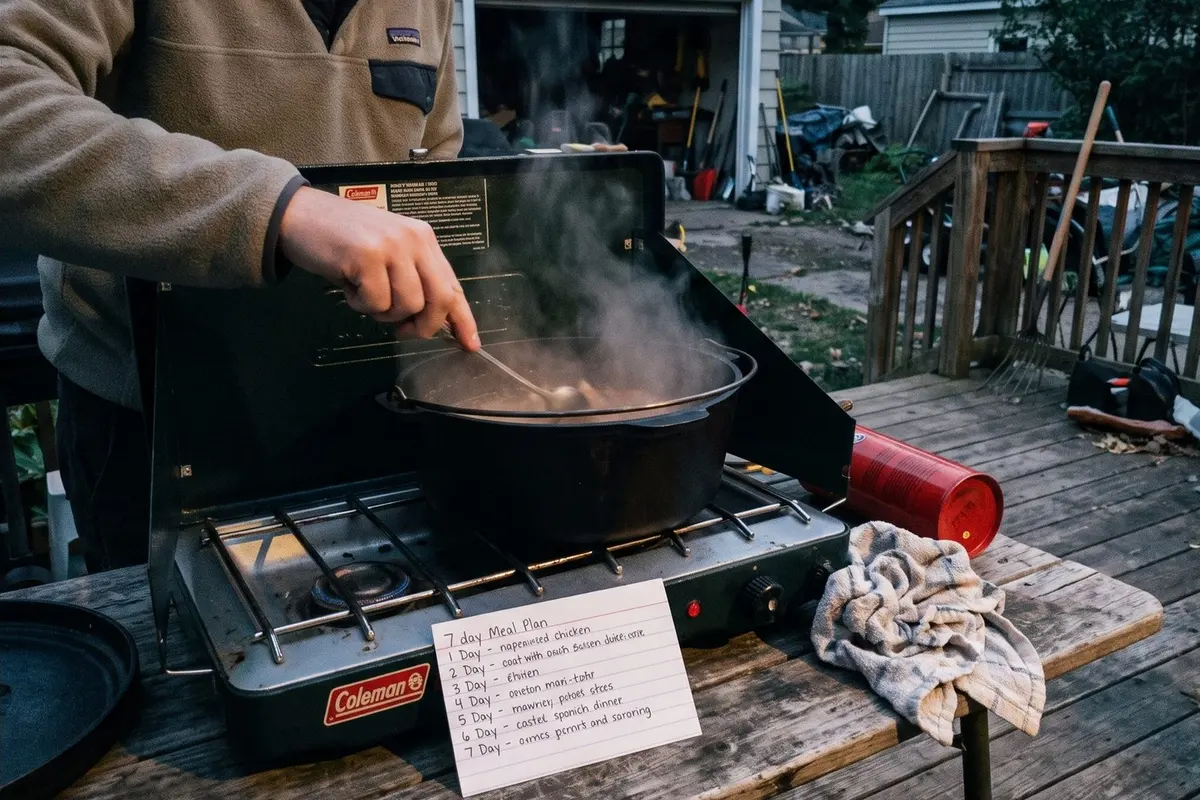
The Off-Grid Handbook builds this in three parts: an outdoor cooking station (Project 56), a solar box oven (Project 57), and a seven-day menu with the fuel math to match (Project 45). This guide follows the same order.
Cooking during a power outage: the one rule
Every flame-based cooker produces carbon monoxide, a gas you cannot see or smell. The CDC is direct about it: never use a portable gas camp stove indoors, and never burn charcoal indoors.
Storms are when people bend this rule, carrying the camp stove into the kitchen or the grill into the garage to get out of the rain. The book's answer is to prepare a covered outdoor station in advance, so the temptation never comes up. Make sure you also have working CO alarms, placed as described in carbon monoxide detector placement.
The same law applies to generators: outdoors only, more than 20 feet from windows, doors and vents, and never in a garage even with the door open. See why a generator never goes in the garage.
Ways to cook without power, compared
| Method | Fuel | Best for | Where |
|---|---|---|---|
| Two-burner propane camp stove | Propane canisters or a 20 lb tank with an adapter hose | Boiling, frying, everyday meals | Outdoors only |
| Gas or charcoal grill | Propane or charcoal | Grilling, and cast iron on the grate | Outdoors, well away from the house |
| Brick rocket stove | Twigs and scrap wood | Boiling water when fuel is scarce | Outdoors, 10+ ft from structures |
| Solar box oven | Sunlight | Stews, beans, rice, baking | A sunny spot outdoors |
NFPA advises placing a grill well away from the home and deck railings, and out from under eaves and overhanging branches. Instructions for the twig-burning option are in how to build a DIY rocket stove.
Set up an outdoor cooking station
The station in Project 56 costs about $80 in materials, per the book, and the goal is that it can be set up in five minutes:
- A two-burner propane camp stove and/or the existing grill
- A cast iron skillet and a Dutch oven, which move between grill, camp stove, rocket stove and solar oven
- A folding table, two wash bins and a roll of utensils
- One or two 20 lb propane tanks plus spare canisters
Fuel storage follows the book's rule: propane tanks live outdoors or in a detached, ventilated space, never in the house or basement, and small canisters are kept cool and dry. Cook one ordinary dinner a month at the station, so the gear is familiar before you need it.
Camp stove fuel math for a week
The book gives working figures. A typical canister stove burns about 8 grams of fuel per minute at full flame, so a 450 g canister lasts roughly 55 to 60 full-flame minutes; a 20 lb tank runs a two-burner stove for roughly 18 to 20 hours of full burn.
- Write the menu. Plan seven days of real meals from the food you actually have on the shelf.
- Count boil-minutes. Estimate the full-flame minutes each day takes, including boiling water.
- Multiply by 7 for the week.
- Add half again for margin, wind and cold.
- Stage that much fuel, stored by the rules above.
Example: 30 full-flame minutes a day is 210 minutes a week, or 315 with the margin. That is about six 450 g canisters, or a small fraction of one 20 lb tank. Record the result in the plan that goes with your 30-day food supply list.
DIY solar oven: free heat for the slow jobs
A solar box oven, per Project 57, is two nested cardboard boxes with 1 to 2 inches of insulation between them, a foil-lined interior with a black base, a glass or acrylic lid, and a foil reflector flap. The book says it reaches 250 to 350°F in decent sun, and side reflectors add 50°F or more.
- Cook in a thin, dark pot with a lid.
- Aim the box at the sun and re-aim every 30 to 45 minutes.
- Expect roughly double normal cooking times; start dinner stews in the morning.
- Keep an oven thermometer where you can see it.
Every hour of sun-baking is canister fuel saved for cloudy days. The same box can pasteurize water, as covered in solar water pasteurization.
Food safety when you cook off-grid
Low-and-slow outdoor cooking makes a food thermometer more important, not less. USDA's minimum internal temperatures still apply: poultry 165°F, ground meats 160°F, steaks, chops and roasts 145°F with a 3-minute rest, and leftovers and casseroles 165°F.
Use the refrigerator's contents first. USDA says a closed refrigerator keeps food safe for only about 4 hours without power, and a full freezer holds about 48 hours (24 if half full); how long food lasts in a fridge without power has the full list.
Then practice. The book's capstone is one storage-only day per quarter, cooked entirely on the backup gear, with a log of what ran short and what took longer than planned. That log goes back into the pantry list and the fuel cache.
Frequently asked questions
How can I cook food during a power outage?
Cook outdoors on a propane camp stove, a gas or charcoal grill, or a rocket stove, and use a solar oven for slow dishes on sunny days. Keep a cast iron skillet and Dutch oven, which work on all of them. Plan meals from your pantry, count the fuel they need, and use refrigerated food first while it is still safe.
Can I use a camp stove indoors during a power outage?
No. The CDC says never to use a portable gas camp stove indoors, and never to burn charcoal indoors, because both produce carbon monoxide, which is colorless, odorless and deadly. That includes garages, basements and porches near open windows. Set up a covered cooking spot outdoors instead, and keep working CO alarms in the house.
How long will a 20 lb propane tank last on a camp stove?
The Off-Grid Handbook estimates that a 20 lb tank runs a two-burner camp stove for roughly 18 to 20 hours at full burn, which is weeks of realistic cooking. A 450 g canister lasts about 55 to 60 full-flame minutes. Store tanks outdoors or in a detached, ventilated space, never in the house or basement.
How hot does a DIY solar oven get?
A well-built solar box oven reaches about 250 to 350°F in decent sun, according to The Off-Grid Handbook, and side reflectors add 50°F or more. Expect cooking to take roughly twice as long as in a kitchen oven. Use a thermometer and cook meat to USDA safe temperatures: 165°F for poultry and 160°F for ground meats.
Sources
- The Off-Grid Handbook, Garrett Dalton, Projects 45, 56 and 57
- CDC: Carbon Monoxide Poisoning Basics
- USDA FSIS: Safe Minimum Internal Temperature Chart
- USDA FSIS: Keep Your Food Safe During Emergencies
- NFPA: Grilling Safety
Safety guidance changes. Check the agency pages above for the current version, and follow your local code and manufacturer instructions.