Solar water pasteurization: safe water from sun, a black jar and a wax indicator
Water doesn't have to boil to be safe. It has to get hot enough, and a small wax indicator tells you when it has.
In this article
Solar water pasteurization uses the sun's heat to bring clear water to about 149°F (65°C), hot enough to kill the germs behind most waterborne illness, without ever boiling it. A flat-black jar, a reflector and a WAPI (water pasteurization indicator) do the job in roughly 2 to 4 hours of strong sun, using no fuel at all.
It is Project 7 of The Off-Grid Handbook, about an hour to build and about $20 in materials, per the book. The book calls it the fuel-saver: every gallon the sun treats is fuel the stove keeps for cooking.
How does solar pasteurization work?
Pasteurization is heat treatment below boiling. Germs die at lower temperatures than most people expect, and they die faster the hotter the water gets.
Research on solar pasteurization from Robert Metcalf's lab at California State University, Sacramento, published in Applied and Environmental Microbiology, summarizes the thresholds for killing pathogens in about a minute:
| Germ type | Temperature for roughly 1-minute kill |
|---|---|
| Protozoan cysts (such as Giardia) | 131°F (55°C) |
| E. coli and other enteric bacteria | 140°F (60°C) |
| Hepatitis A virus | 149°F (65°C) |
Boiling at 212°F works because it overshoots all of these by a wide margin. Pasteurization works because reaching and holding about 149°F is enough, and on a clear day the sun supplies that heat for free.
What is a WAPI water pasteurization indicator?
A WAPI is a small clear plastic tube partly filled with soybean wax. The same research describes a wax that melts at about 158°F (70°C), which gives a safety margin above the pasteurization point.
The tube sits in the jar with the wax at the upper end. When the water has been hot enough, the wax melts and drops to the bottom of the tube, and you can see it through the glass or when you lift the lid.
Once the wax hardens again, flip the tube and it is ready for the next batch. The book's verdict is short: the WAPI removes the guesswork.
How to pasteurize water with the sun, step by step
The materials list from the book:
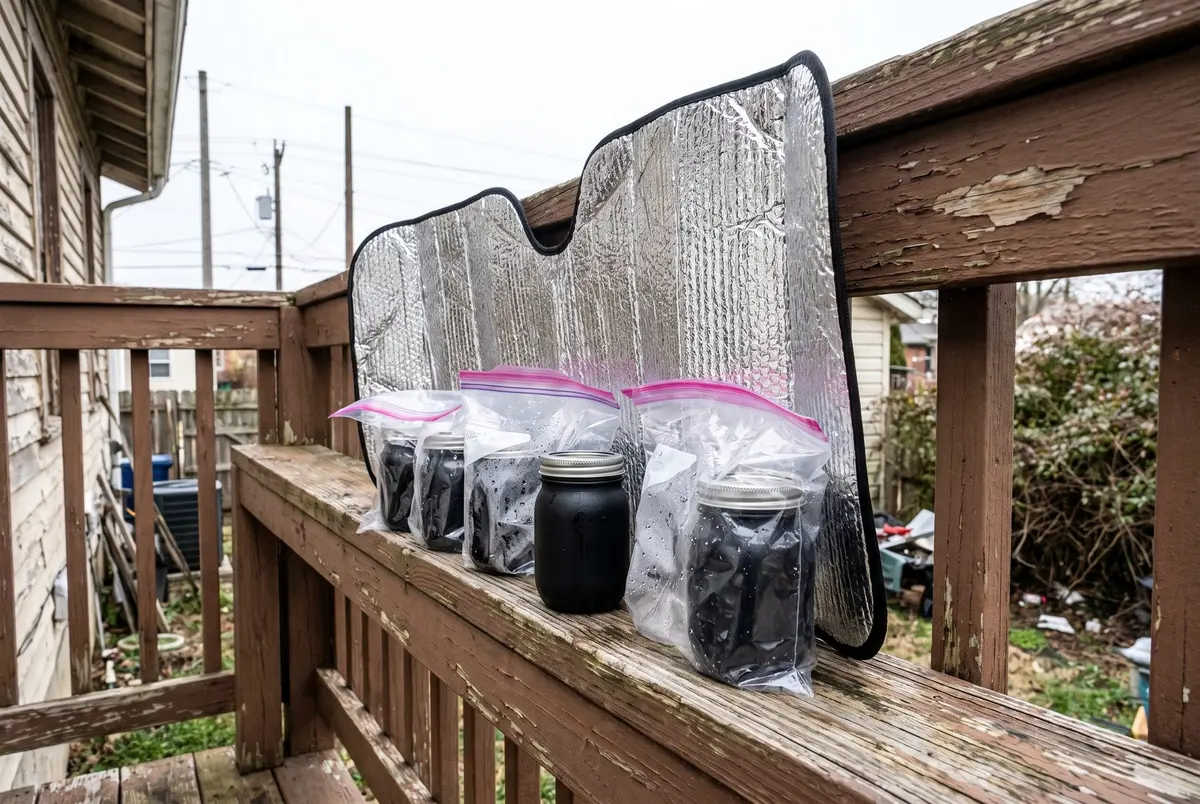
- Glass jars painted flat black, or clear bottles with a black backing
- A reflective panel: a windshield sun reflector or foil glued to cardboard
- A WAPI with its wax pellet
- Clear oven bags to act as heat traps
- Scissors, and glue or tape
- Pre-filter. Start with clear water; run cloudy water through a gravity bucket filter or a biosand filter first.
- Fill the jars and drop the WAPI in, wax end up.
- Bag each jar in a clear oven bag to trap heat.
- Set the jars in the fold of the reflector, facing full sun.
- Wait for the wax to fall. Typical time is 2 to 4 hours of strong sun.
- Cool covered and store as treated water.
Jar size changes the clock. In the published tests with a reflector-style solar cooker, 1.4-liter black jars reached 158°F in about 1.5 to 2 hours, while 1-gallon containers took 3 to 4 hours.
The same study found that on sunny days a black jar in a good reflector reached pasteurization temperature even without a bag. The book keeps the bag anyway as a heat trap, which helps on cooler or breezier days.
Getting better results
- Use smaller jars when the sun is weaker; they reach temperature sooner than gallon jugs.
- Keep the jars in full sun. Check them as shadows move across the yard and turn the reflector to follow the sun.
- Don't open a jar early to check it. The WAPI is the check, and every lid lift lets heat out.
- Label treated jars once they cool, so they never get mixed with untreated water.
Pasteurized water goes into storage like any other treated water: covered, cool, dark and dated.
Solar pasteurization vs. SODIS
SODIS, short for solar water disinfection, is a different method that often gets mixed up with this one. It uses clear plastic PET bottles and relies mainly on the sun's ultraviolet light, not on reaching a set temperature.
The World Health Organization's emergency guidance for SODIS: clean the bottles, fill them three-quarters, shake 20 times, top them up, and expose them to sunlight for 6 hours, or for 2 days if clouds obscure the sun. Like the jar method, it only works on relatively clear water.
| Solar pasteurization | SODIS | |
|---|---|---|
| Container | Black jar, reflector, oven bag | Clear PET bottle |
| What kills germs | Heat, about 149°F and up | Mainly UV light |
| Time | About 2 to 4 hours of strong sun | 6 hours of sun, 2 days if cloudy |
| Proof it worked | The WAPI wax drops | None; you go by the clock |
The practical advantage of the jar and WAPI is the signal. You know the batch is done instead of hoping it is.
What if you don't have a WAPI?
The book's fallback is to heat water until a visible shimmer and fine bubbles form on the base of the pot, around 150°F or more, and hold it there. Treat that as an estimate, not a measurement.
If you can't confirm the temperature, use the CDC standard: a rolling boil for 1 minute, or 3 minutes above 6,500 feet. When fuel is short, the other no-heat option is chlorine; our guide to purifying water with bleach has the full dosing chart.
What solar pasteurization can't do
Heat kills pathogens. Like boiling, it does nothing for chemical contamination: fuel, pesticides, metals and salts come through untouched.
The book's order is fixed: filter first, pasteurize second, store covered. Never try to treat water you suspect has fuel or chemicals in it; find another source.
It also depends on the weather, so it works best as one part of a plan, not the whole plan. Keep a stored reserve sized with our guide to how much water per person per day, and let the sun stretch it on clear days.
Frequently asked questions
What temperature pasteurizes water?
About 149°F (65°C). Research on solar pasteurization reports that protozoan cysts die in about a minute at 131°F, E. coli and similar bacteria at 140°F, and hepatitis A virus at 149°F. A WAPI's wax melts at about 158°F, which adds a margin. Boiling is not required, but it remains the CDC's standard method.
How long does it take to pasteurize water in the sun?
With a black jar in a reflector, The Off-Grid Handbook gives 2 to 4 hours of strong sun. Published tests found 1.4-liter black jars reached 158°F in about 1.5 to 2 hours, while 1-gallon containers took 3 to 4 hours. Cloud, wind and cold slow it down.
Is SODIS the same as solar pasteurization?
No. SODIS uses clear PET bottles and mainly the sun's UV light, with WHO guidance of 6 hours of sunlight, or 2 days under cloud. Solar pasteurization uses black jars to heat water to about 149°F, and a WAPI confirms the temperature. Both need clear water to work.
Does solar pasteurization remove chemicals from water?
No. Heat kills germs but does nothing for fuel, pesticides, heavy metals or salts. Filter cloudy water first, pasteurize second and store it covered. If you suspect chemical contamination, don't treat that water at all; use a different source and ask your local health department for advice.
Sources
- The Off-Grid Handbook, Garrett Dalton, Project 7
- Safapour and Metcalf, Enhancement of Solar Water Pasteurization with Reflectors, Applied and Environmental Microbiology (1999)
- WHO: Household Water Treatment and Safe Storage Following Emergencies and Disasters
- CDC: How to Make Water Safe in an Emergency
Safety guidance changes. Check the agency pages above for the current version, and follow your local code and manufacturer instructions.