A greywater system for home that needs no plumbing: the bucket loop
In a week without running water, the toilet is where drinking water goes to die. Three labeled buckets fix that.
In this article
The simplest greywater system for home use needs no pipes and no permit: catch used wash water in a basin, strain it into labeled buckets, and use it within 24 hours to flush the toilet or water ornamental plants. Pour about 1.5 to 2 gallons straight into the toilet bowl and it flushes without using a drop of your drinking water.
That is Project 10 of The Off-Grid Handbook, the Greywater Bucket Loop: three 5-gallon buckets, a basin and a strainer, about an hour and $25 in materials, per the book. The reason for it is blunt: in a grid-down week, flushing toilets with drinking water is how reserves die.
What counts as greywater?
Greywater is used household water that has not touched a toilet. California law defines it as wastewater from bathtubs, showers, bathroom washbasins, clothes washers and laundry tubs, and excludes kitchen sinks and dishwashers; Utah uses the same definition.
- Good for the buckets: shower and tub water, bathroom sink water, laundry rinse water.
- Keep out: toilet water, kitchen sink and dishwasher water (food and grease), and water used to wash diapers or soiled clothing.
The book's strainer step exists for the same reason the codes exclude kitchen water. Food solids sour fast, and soured water smells within hours.
How to reuse shower water: the bucket loop, step by step
What you need, per the book:
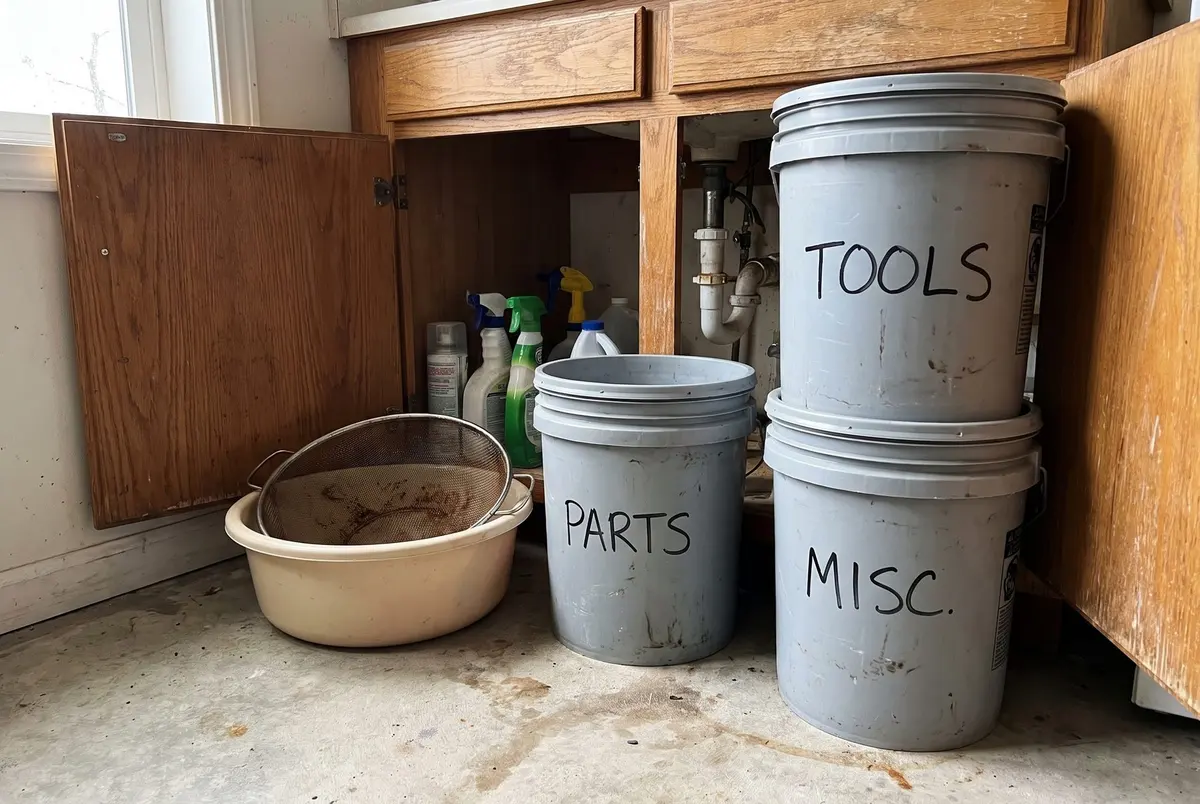
- Three 5-gallon buckets, boldly labeled GREYWATER
- A basin that fits your sink or shower floor
- A small mesh strainer
- A marker, and a drill if you want lid handles
- Catch. Set a basin in the bathroom sink and another on the shower floor to collect wash water.
- Strain it through the mesh strainer into the labeled buckets.
- Flush. Pour 1.5 to 2 gallons directly into the toilet bowl, not the tank, for a full flush.
- Garden. Soapy water goes on ornamentals, not on vegetables you eat raw.
- Empty the buckets within 24 hours. Greywater is not for storage.
Set it up before you need it
The loop works best when it is already assembled. Keep the buckets and basins together in the bathroom closet or next to the tub, labeled and nested, so setting up takes a minute instead of a search.
Lids keep smells down and keep children and pets out. Drilling holes for lid handles, as the book suggests, makes full buckets easier to carry; 5 gallons of water weighs over 40 pounds, so fill them only as far as you can lift comfortably.
Why the bowl and not the tank?
Pouring a bucket briskly into the bowl starts the flush directly, so the tank stays out of it. Filling the tank with greywater would leave soap and grime sitting on the flapper and fill valve.
For scale, the EPA's federal standard for new toilets is 1.6 gallons per flush, and older toilets can use as much as 6 gallons. The EPA also puts toilets at nearly 30% of an average home's indoor water use, which is the share a bucket loop takes off your drinking reserve.
Is greywater safe for the garden?
For ornamental plants, yes, with care. University of California Cooperative Extension advises that greywater never be applied to edible plant parts or root crops, and recommends using it only on nonedible ornamentals without splashing nearby edibles.
The book's rule is the same: soapy water on ornamentals, never on vegetables you eat raw. Trees and shrubs are the best targets.
- Pour at the base of plants, never through a sprinkler or spray nozzle.
- Don't let it pool or run off the soil surface.
- Skip lawns and ground covers, where germs stay on the surface.
- Wear gloves and avoid direct contact with the water.
Soaps that plants tolerate
Extension guidance favors liquid detergents over powders because they are generally lower in sodium, and products free of salt and borax. Avoid chlorine bleach, which harms plants, and send any bleach load to the drain or the toilet.
Oxygen bleaches based on hydrogen peroxide are the usual substitute.
Greywater recycling: bucket loop vs. plumbed systems
A bucket loop is a manual habit, not plumbing. Permanent greywater recycling systems, such as laundry-to-landscape lines or diverted shower drains, are governed by state and local codes.
Utah State University Extension advises contacting your local health department about permits before installing one. Rules differ from state to state, so check before you cut into a drain line.
The bucket version needs nothing but a marker and three buckets, which is why it is the place to start. It also pairs well with rain catchment: a rain barrel supplies flushing water when the wash water runs short.
The greywater bucket system safety rules
- Greywater is non-potable, always and without exception.
- Never store it beyond a day. UC Extension sets the same limit: no more than 24 hours.
- Keep it away from food, dishes and food-prep surfaces.
- Make the buckets visually distinct from every water container in the house: a different color, a bold label, a separate spot.
- Wash your hands after handling it.
The point of all this is to protect clean water. Size that reserve with our guide to how much water per person per day, and see water during a power outage for the first-hour steps that fill it.
The book starts the greywater loop in the first hour of any outage where water is out, right after the triage block. Our guide to what to do when the power goes out walks through that sequence.
Frequently asked questions
Can I use shower water to flush the toilet?
Yes. Collect shower water in a basin or bucket and pour about 1.5 to 2 gallons directly into the toilet bowl, not the tank, for a full flush. Strain out hair and solids first and use the water within 24 hours. It saves drinking water during an outage.
How long can you keep greywater?
No more than 24 hours. University of California Cooperative Extension and The Off-Grid Handbook give the same limit. Greywater carries soap, skin and organic matter that break down quickly, so it starts to smell and grow bacteria. Use it for flushing or ornamental plants the same day you collect it.
Can I water vegetables with greywater?
Extension guidance says no for edible plant parts and root crops. Greywater should go on nonedible ornamentals, trees and shrubs, poured at the base without splashing nearby food plants. Don't use sprinklers, don't let it pool or run off, and keep it off lawns and ground covers.
Is kitchen sink water considered greywater?
Not under most state definitions. California and Utah exclude kitchen sinks and dishwashers, because food scraps and grease sour fast and carry more germs. Keep kitchen water out of garden buckets. Showers, tubs, bathroom sinks and laundry rinse water are the usual greywater sources.
Do I need a permit for a greywater system?
For a manual bucket loop, generally not, since nothing is plumbed. Permanent systems that divert drains or laundry lines fall under state and local codes. Utah State University Extension advises checking with your local health department about permits before you install one, and rules vary by state.
Sources
- The Off-Grid Handbook, Garrett Dalton, Project 10
- UC Cooperative Extension: Use of Graywater in Urban Landscapes in California (Hartin and Faber)
- Utah State University Extension: Graywater Systems
- EPA WaterSense: Residential Toilets
Safety guidance changes. Check the agency pages above for the current version, and follow your local code and manufacturer instructions.