How to set up a rain barrel: blocks, spigot, diverter and overflow
One barrel, one spigot, two concrete blocks: the setup takes under an hour, and the most common mistake costs nothing to avoid.
In this article
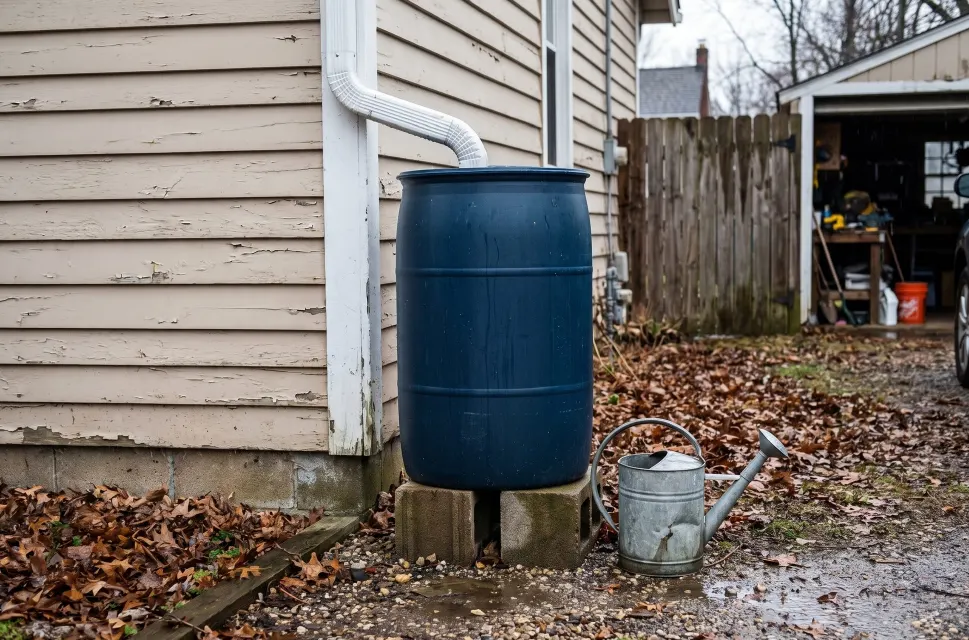
To set up a rain barrel, put a 55-gallon food-grade barrel on two level concrete blocks under a downspout, fit a brass spigot 3 to 4 inches above the bottom, and install a downspout diverter that sends overflow back down the spout. Screen every opening against mosquitoes and debris. Never set the barrel on the ground: height is your water pressure.
That is Project 1 of The Off-Grid Handbook, the first build in the book: about 45 minutes and $60 in materials, per the book. No pump, no power, nothing to switch on.
What you need for a rain barrel system
The parts list is short. Buy a barrel that held food or drinks, never one that held chemicals, because the plastic can leach what it carried into the water.
- One 55-gallon food-grade plastic barrel
- A 3/4-inch brass spigot with locknut and washers
- A downspout diverter kit
- Two concrete blocks
- Fine mesh screen
- Tools: drill with a hole saw matched to the spigot, hacksaw, adjustable wrench, level
Rutgers Cooperative Extension adds one cleaning step for used barrels: scrub with soap and water and triple-rinse before use.
How to set up a rain barrel, step by step
- Set the base. Place two concrete blocks on level ground under the downspout and check them with a level, side to side and front to back.
- Fit the spigot. Drill the spigot hole 3 to 4 inches above the bottom of the barrel. Put a washer on the inside and outside, then tighten the locknut.
- Install the diverter. Cut the downspout and fit the diverter per the kit instructions, so that once the barrel is full, the overflow goes back down the downspout.
- Screen every opening. Cover the inlet and any vents with fine mesh to keep out leaves, grit and mosquitoes.
- Connect and test. Set the barrel on the blocks, connect the diverter hose and wait for rain. Check the spigot for leaks on the first fill.
Why put a rain barrel on blocks?
A gravity barrel has no pump, so the only thing pushing water out of the spigot is the height of the water above it. Every foot of elevation adds roughly 0.43 psi, which matches the Texas Water Development Board's rule of 1 psi for every 2.31 feet of rise.
The book's field note is blunt: the most common first-build mistake is putting the barrel on the ground. A barrel at ground level cannot fill a watering can, while two blocks of elevation make the whole system usable.
The base has to be solid, because a full 55-gallon barrel weighs about 460 pounds, according to Rutgers. If the ground is uneven, Rutgers suggests leveling it with crushed stone or gravel before the blocks go down, so the barrel cannot tip when full.
Rain barrel spigot: where it goes and how to seal it
Keep the spigot 3 to 4 inches off the bottom, as the book specifies. That leaves a little room below the outlet for the fine grit that settles in any barrel, and with the blocks underneath, a watering can or bucket fits under the tap.
Leaks almost always come from a missing washer or a loose locknut. Use a washer on both faces of the barrel wall, snug the nut with a wrench, and recheck it after the first storm, when the barrel is at its heaviest.
If you later want more storage, add barrels at the base rather than buying a bigger one. Our guide to connecting rain barrels together shows how to link them so one spigot drains them all.
Rain barrel diverter and overflow
A barrel fills faster than most people expect. One inch of rain on 1,000 square feet of roof yields roughly 600 gallons, so a single 55-gallon barrel is full after about an inch of rain on 90 square feet of roof.
That is why the book says to plan overflow from day one. A diverter that returns the extra water to the downspout is the simplest answer, because the water leaves the way it always did.
If your barrel uses an overflow hose instead, Rutgers recommends sending it to a lawn or bed at least 6 feet from the foundation if you have a basement, and at least 2 feet if you have a crawl space. A first flush diverter upstream of the barrel keeps the dirtiest roof water out in the first place.
Keeping mosquitoes and debris out
Open water breeds mosquitoes within days. Rutgers advises keeping a screen on every opening at all times, including the overflow, which should always have its hose attached.
Debris is the other problem. Clean and screen the gutters that feed the barrel, and drop a leaf strainer into the downspout head; the book's Project 8 covers that roof prep in about an hour.
Can you drink rain barrel water?
Not as collected. Rainwater from a roof is not drinking water: roofing materials, bird droppings and airborne dust all end up in the barrel, and the book treats harvested rain as non-potable until it has been filtered and disinfected.
Use it for the garden, flushing and washing. Extension services differ on edible plants: Nebraska and Wisconsin advise against using barrel water on vegetables, while Rutgers says to wash anything you harvest with drinking water before eating it. Rutgers also says not to collect rain for up to three months after a moss killer has been used on the roof.
For emergency drinking water, run barrel water through a gravity drip filter and then disinfect it as described in how to purify water with bleach. Before the first hard freeze, drain the barrel and follow the steps in how to winterize a rain barrel.
Frequently asked questions
How high should a rain barrel be off the ground?
High enough to fit a watering can or bucket under the spigot. Two standard concrete blocks are the usual answer, and the Off-Grid Handbook calls that the minimum that makes a barrel usable. Each foot of height adds about 0.43 psi of pressure, so higher is better, as long as the base is level and solid enough for about 460 pounds.
Where should the spigot go on a rain barrel?
About 3 to 4 inches above the bottom of the barrel. That keeps the outlet slightly above the grit that settles on the floor while still draining most of the water. Use a washer on the inside and outside of the barrel wall, tighten the locknut with a wrench, and check for drips on the first fill.
Do I need a diverter for a rain barrel?
You need some way to handle overflow, because one inch of rain on 1,000 square feet of roof yields about 600 gallons. A downspout diverter is the simplest choice: when the barrel is full, water continues down the downspout as before. Without one, route an overflow hose well away from the foundation.
Is rain barrel water safe to drink?
No, not as collected. Roof runoff carries bird droppings, dust and residue from roofing materials. Use it for gardens, flushing and washing. In an emergency it can be made drinkable only by filtering it and then disinfecting it with bleach or boiling, and it should never be used if the roof was recently treated with moss killer.
Sources
- The Off-Grid Handbook, Garrett Dalton, Project 1
- Rutgers Cooperative Extension: Rain Barrels Part II, Installation and Use (FS1118)
- Texas Water Development Board: The Texas Manual on Rainwater Harvesting
- Nebraska Extension: Rainwater Harvesting with Rain Barrels (G2220)
- University of Wisconsin-Madison Extension: Rain Barrels
Safety guidance changes. Check the agency pages above for the current version, and follow your local code and manufacturer instructions.