First flush diverter: how it works, how to size it and how to build one
The first water off a roof carries the worst of what sits on it. A length of PVC pipe and a floating ball keep it out of your barrel.
In this article
- How a first flush diverter works
- How much water should a first flush diverter hold?
- First flush diverter DIY: tools and materials
- How to build a first flush diverter for a rain barrel
- The weep hole is the part people skip
- Does a first flush diverter make rainwater safe to drink?
- Frequently asked questions
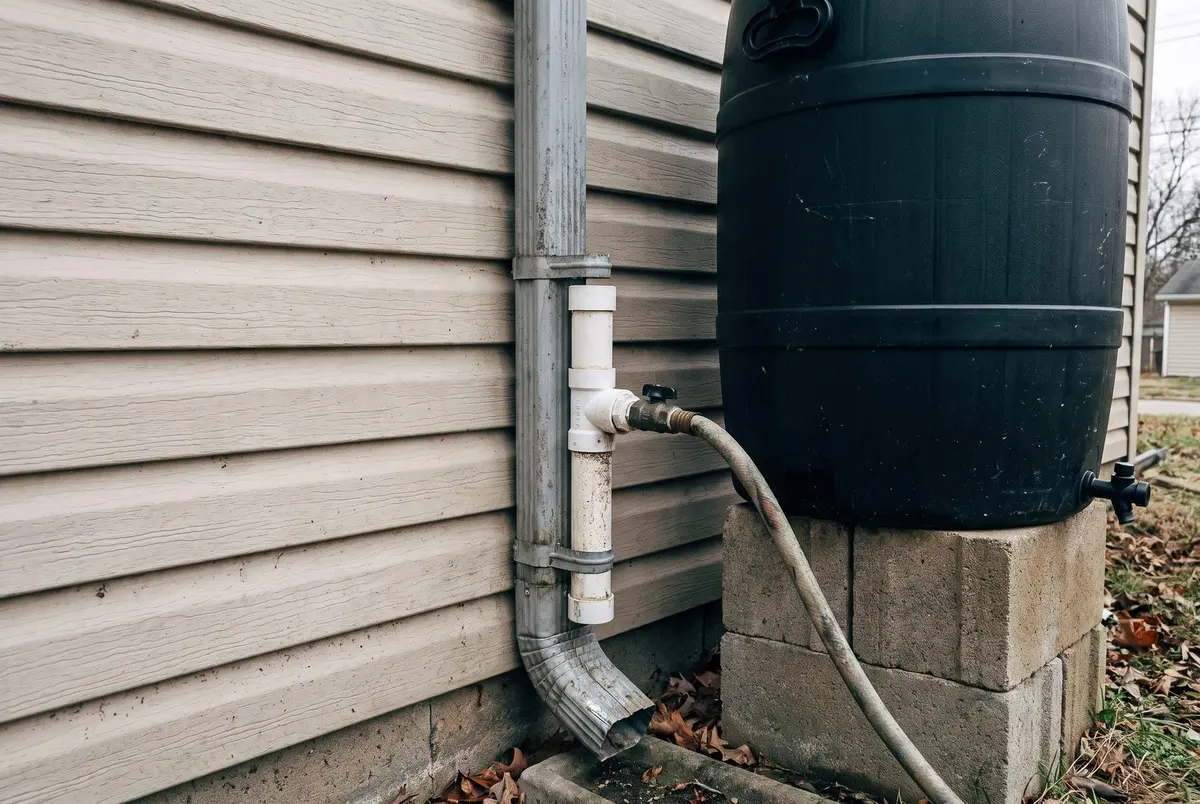
A first flush diverter is a vertical pipe teed into the downspout ahead of a rain barrel that catches the first, dirtiest water off the roof. When the pipe fills, a floating ball seals it and the cleaner flow continues to the barrel; a tiny weep hole drains the pipe between storms. A common rule of thumb is to divert about 10 gallons for every 1,000 square feet of roof.
Project 2 of The Off-Grid Handbook builds one from 4-inch PVC in about 30 minutes, for about $25 in materials, per the book. It means cleaner water in the barrel and filters that last longer.
How a first flush diverter works
A roof collects dust, pollen, leaves, insect bodies, bird and rodent droppings and other airborne residue between storms. The Texas Manual on Rainwater Harvesting explains that leaf screens catch the large debris, while the first-flush diverter gets rid of the smaller contaminants that wash off first.
The standpipe version works in three stages. As rain begins, the vertical pipe fills first, the ball floats up and seals the tee, and every gallon after that flows on to the barrel.
Between storms, the weep hole lets the trapped water drain slowly. The ball drops, the pipe is empty, and the diverter is ready for the next rain.
Rain intensity matters too. The Texas manual says it takes about one-tenth of an inch of rain per hour to wash a sloped roof, and about 0.18 inches per hour for a flat or nearly flat one, so a light drizzle may fill the diverter before the roof is truly rinsed.
How much water should a first flush diverter hold?
There is no exact number, and the Texas manual says so plainly: the right volume depends on roof slope and surface, how hard it rains, how many dry days have passed, overhanging trees and the season. Its recommendations range from a minimum of 10 gallons per 1,000 square feet up to 1 to 2 gallons per 100 square feet.
Count only the roof area that drains to the downspout you are fitting, measured as the flat footprint, not the sloped surface. Then use pipe volume to set the length. The Texas manual gives the conversions: 4-inch pipe holds about one gallon per 18 inches, and 6-inch pipe about one gallon per 8 inches.
| Roof area to this downspout | Divert (10 gal per 1,000 sq ft) | 4-inch pipe length | 6-inch pipe length |
|---|---|---|---|
| 250 sq ft | 2.5 gallons | about 4 ft | about 1.7 ft |
| 500 sq ft | 5 gallons | about 7.5 ft | about 3.5 ft |
| 750 sq ft | 7.5 gallons | about 11 ft | about 5 ft |
| 1,000 sq ft | 10 gallons | about 15 ft | about 7 ft |
The table shows the practical limit: a barrel on blocks leaves only a few feet of wall below the tee. If the math calls for more pipe than you have room for, step up to 6-inch pipe or accept a smaller diversion, and keep the gutters screened so less dirt reaches the roof drain.
First flush diverter DIY: tools and materials
- 4-inch PVC pipe, cut to the length your roof area calls for
- A 4-inch PVC tee and end cap
- A floating ball sized to the pipe
- PVC cement
- Tools: hacksaw or PVC cutter, drill with a 1/16-inch bit, tape measure
How to build a first flush diverter for a rain barrel
- Size it. Work out the diversion volume from the roof area feeding the downspout and cut the pipe to length.
- Fit the tee. Install the tee in the downspout line ahead of the barrel inlet, with the diverter pipe dropping straight down below it.
- Drill the weep hole. Drill a 1/16-inch hole in the end cap.
- Add the ball and cap. Drop the float ball into the vertical pipe and fit the end cap.
- Test it. Run a hose onto the roof or into the gutter and watch the pipe fill, the ball seal, and the flow move on to the barrel.
The book cements the end cap on. A threaded cleanout cap is worth the small extra cost, because the Texas manual describes standpipes with a cleanout fitting at the bottom that is opened to remove debris.
The weep hole is the part people skip
The book's field note is about one detail. Without the weep hole, the diverter stays full, never resets, and quietly stops working after the first storm.
The hole is small on purpose, so it drains slowly and does not waste much water during the rain itself. The trade-off is that silt from the roof collects at the bottom of the pipe and can plug it.
The Texas manual says standpipes should be emptied and cleaned out after each rainfall event. At the very least, open the cap after big storms and in the fall, and disconnect and drain the diverter before the first hard freeze.
Does a first flush diverter make rainwater safe to drink?
No. A diverter improves what goes into the barrel, but the water is still roof runoff and must be treated as non-potable until it is filtered and disinfected.
The diverter works best with clean gutters above it. The book's Project 8 clears and screens every gutter run that feeds a collection downspout and adds a leaf strainer at the downspout head; its safety note is that ladder work causes more household injuries than any project in the book, so use a stabilizer, keep three points of contact, and never work a roof edge alone or in wind.
For drinking in an emergency, pass barrel water through a two-bucket gravity filter or a biosand filter, then disinfect it. The diverter's real job is to make those filters clog less often.
If you are starting from scratch, set up the barrel first with our guide to how to set up a rain barrel. One diverter per downspout is enough even if you later connect several barrels together.
Frequently asked questions
How much water should a first flush diverter divert?
A common rule of thumb is at least 10 gallons for every 1,000 square feet of roof, and the Texas Manual on Rainwater Harvesting also cites 1 to 2 gallons per 100 square feet. Divert more if the roof sits under trees or has gone weeks without rain. Count only the roof area that drains to that downspout.
Do I need a first flush diverter for a rain barrel?
It is not required, but it keeps the dirtiest roof water, with its dust, pollen and droppings, out of the barrel. That means less sludge to clean out and longer life for any filter you use later. Rutgers Cooperative Extension suggests one wherever water quality is a concern.
How does a first flush diverter reset?
Through a small weep hole, about 1/16 inch, at the bottom of the vertical pipe. It drains the trapped water slowly between storms so the floating ball drops and the pipe is empty for the next rain. If the hole clogs with silt, the diverter stays full and stops working, so clean it out regularly.
What size pipe do I need for a first flush diverter?
Most DIY diverters use 4-inch PVC, which holds about one gallon per 18 inches of length. Ten gallons would take about 15 feet of pipe, which rarely fits under a barrel. Six-inch pipe holds about a gallon per 8 inches, so it is the better choice when you need more volume in less height.
Sources
- The Off-Grid Handbook, Garrett Dalton, Project 2
- Texas Water Development Board: The Texas Manual on Rainwater Harvesting
- Texas Water Development Board: Rainwater Harvesting Training Manual
- Rutgers Cooperative Extension: Rain Barrels Part II, Installation and Use (FS1118)
Safety guidance changes. Check the agency pages above for the current version, and follow your local code and manufacturer instructions.