How to connect rain barrels together so they fill and drain as one tank
One barrel proves the system. A chain of three, linked the right way, turns it into a 165-gallon tank with one tap.
In this article
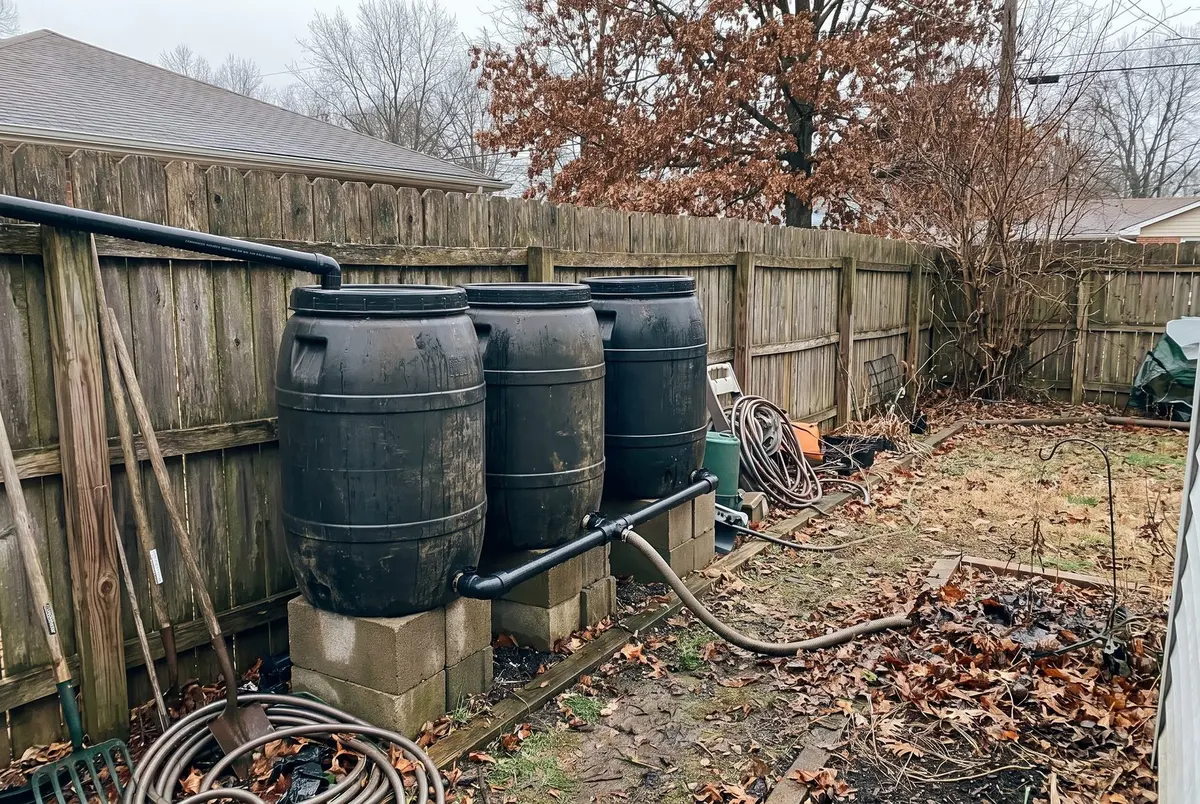
To connect rain barrels together, set them side by side on one continuous, level base, then join them near the bottom with bulkhead fittings and short hose or PVC links. Keep a single spigot on the most accessible barrel and fit an overflow on the last one. Linked at the base, three 55-gallon barrels fill and drain as one 165-gallon tank.
That is Project 9 of The Off-Grid Handbook, a two-hour build at about $120 in materials, per the book. It assumes you already have one working barrel; if not, start with how to set up a rain barrel.
Daisy chain rain barrels: link at the top or the bottom?
There are two ways to link barrels, and they behave very differently. The Alabama Cooperative Extension System explains the principle: water seeks its own level, so as the first barrel fills, the barrels connected to it fill too, more slowly.
| Linked at the base | Linked at the top | |
|---|---|---|
| How water moves | Levels equalize across all barrels | Only overflow passes to the next barrel |
| Spigots needed | One for the whole chain | One on every barrel |
| Drains fully from one tap | Yes | No |
| Base | Must be level across every barrel | More forgiving |
Top links are the common shortcut because they are easy to plumb. The book's field note explains the cost: top-linked chains strand the bottom half of every barrel where a single spigot cannot reach it.
What you need to link rain barrels
- Two more food-grade barrels to match your first one
- 3/4-inch bulkhead fittings, two per joint
- Short 3/4-inch hose or PVC links
- An overflow kit for the final barrel
- Enough concrete blocks for one continuous base
- Tools: drill with a hole saw, wrench, level
Use barrels of the same model if you can, so their fittings line up at the same height and the base stays simple. A bulkhead fitting clamps through the barrel wall with a gasket on each side, which is what keeps a low joint dry under the full weight of the water above it.
How to connect rain barrels together, step by step
- Build one level base. Lay a single, continuous row of blocks under all the barrels and check it with a level along its whole length.
- Drill the links low. Drill each barrel near its base and fit bulkhead fittings, two per joint, so each link has a sealed fitting at both ends.
- Join the barrels. Connect neighboring barrels with short hose or PVC links so the chain equalizes and drains fully.
- Keep one spigot. Put the single tap on the barrel that is easiest to reach with a bucket or hose.
- Route the overflow. Fit the overflow to the final barrel and send it at least 6 feet away from the foundation.
- Fill-test. Fill the chain with a garden hose before the first storm and check every joint for drips.
Why the base must be level
The book's first step is "level is everything," and the reason is the same physics that makes linking work. Base-linked barrels settle to one water line, so a barrel set lower than its neighbors fills and overflows first, while a higher one never fills.
The base also carries real weight. Rutgers Cooperative Extension puts a full 55-gallon barrel at about 460 pounds, so a chain of three is close to 1,400 pounds sitting on the blocks.
Build on firm, compacted ground and level it with crushed stone or gravel if needed, as Rutgers suggests. Keep the blocks tight together so no barrel straddles a gap.
Moving the water is the other half of the job. At 8.3 pounds per gallon, the book's Project 11 uses a squeeze-bulb siphon to move water from barrel to jug without lifting, and without ever starting the flow by mouth.
Where the overflow goes
A chain fills faster than you might think. One inch of rain on 1,000 square feet of roof yields roughly 600 gallons, so a 165-gallon chain is full after about a quarter inch of rain on that roof.
Every gallon after that leaves through the last barrel's overflow. Rutgers recommends directing overflow at least 6 feet from the foundation where there is a basement and at least 2 feet where there is a crawl space, and Nebraska Extension notes that the last barrel in any chain still needs an overflow.
Screen the overflow opening and keep its hose attached, or mosquitoes will find their way in. A first flush diverter on the downspout keeps the dirtiest roof water out of all three barrels.
How many rain barrels do you need?
Match the chain to your household's number rather than to the space by the wall. The book's threshold: 165 gallons is a two-week drinking reserve for a household of six with margin, or roughly 40 days for two people, based on one gallon per person per day.
That figure assumes the water is filtered and disinfected before anyone drinks it, because rain barrel water is not drinking water as collected. Our guide to how much water per person per day shows how to work out your own number.
Longer chains work on the same principle, and the Texas Manual on Rainwater Harvesting points out one more advantage of linked storage: one tank can be taken off line for cleaning. If you want pressure at a tap or a garden line, the next step is a gravity-fed water system.
Winter care for a barrel chain
Ice is the enemy of every joint in the chain. Extension services, including Rutgers, Nebraska and Wisconsin, advise draining and disconnecting rain barrels before freezing weather so the water cannot freeze and crack them.
Open the spigot, let the linked barrels drain together, and disconnect the downspout. The full routine is in how to winterize a rain barrel.
Frequently asked questions
Should rain barrels be connected at the top or bottom?
At the bottom, if you want one spigot to drain the whole chain. Base links let the water level equalize across every barrel, so all the water is usable. Top links pass only overflow from barrel to barrel, which means each barrel needs its own spigot and the lower half of each one is hard to reach.
Can you connect rain barrels that sit at different heights?
Not with base links. Connected barrels settle to the same water line, so a lower barrel fills and overflows first while a higher one never fills completely. Put every barrel on one continuous, level base of blocks and check it with a level before you drill anything.
How many rain barrels can you link together?
There is no fixed limit, but every joint is a possible leak and every full barrel adds about 460 pounds to the base. Size the chain to your need: three 55-gallon barrels give 165 gallons, which the Off-Grid Handbook counts as a two-week drinking reserve for six people once treated.
Do linked rain barrels need more than one overflow?
No. When the barrels are linked at the base, one overflow on the final barrel handles the whole chain. Route it at least 6 feet from a basement foundation, or at least 2 feet from a crawl space, and keep the opening screened against mosquitoes.
Sources
- The Off-Grid Handbook, Garrett Dalton, Project 9
- Alabama Cooperative Extension System: A Homeowner's Guide to Rainwater Harvesting, Chapter 6
- Rutgers Cooperative Extension: Rain Barrels Part II, Installation and Use (FS1118)
- Nebraska Extension: Rainwater Harvesting with Rain Barrels (G2220)
- Texas Water Development Board: The Texas Manual on Rainwater Harvesting
Safety guidance changes. Check the agency pages above for the current version, and follow your local code and manufacturer instructions.