DIY water filter for drinking: the two-bucket ceramic build and its limits
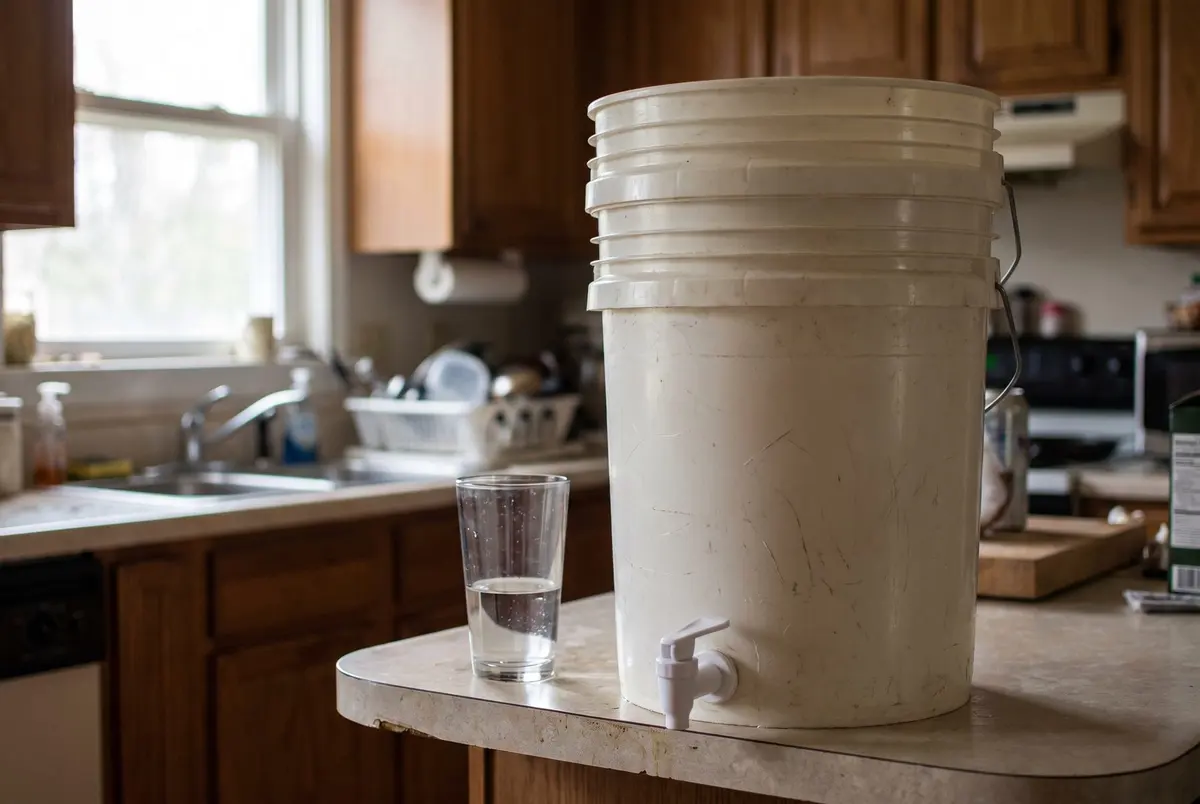
Two stacked buckets and a ceramic element turn stored or harvested water into clear water with nothing but gravity. It is half of the job.
In this article
- How a two-bucket water filter works
- Choosing a ceramic filter element: what the micron rating means
- Gravity water filter DIY: materials and steps
- What a DIY water filter will not remove
- What about sand, charcoal and bottle filters?
- Cleaning the element and knowing when to replace it
- Frequently asked questions
The most dependable DIY water filter for drinking is a two-bucket gravity filter: two stacked food-grade 5-gallon buckets with a ceramic filter element between them. It removes sediment, protozoa and most bacteria, but no gravity filter reliably removes viruses or chemicals, so water from an uncertain source still needs to be disinfected after filtering.
Project 3 of The Off-Grid Handbook calls this the workhorse filter of the book. It takes about 40 minutes and $55 in materials, per the book.
How a two-bucket water filter works
The top bucket holds the raw water. A ceramic element mounted in its floor lets water seep through tiny pores while it traps particles and microbes on the outside surface.
Filtered water drips into the bottom bucket, which has a spigot near its base. Nothing moves except water and gravity, so there is nothing to power and nothing to break in a blackout.
The trade-off is speed. Expect one to two gallons per hour, the book says, so the routine is to fill it at night and draw clean water in the morning.
That pace is enough for most households. Eight hours overnight yields roughly 8 to 16 gallons, against a baseline of one gallon per person per day, which our guide to how much water per person per day breaks down by household size.
Choosing a ceramic filter element: what the micron rating means
The element is the only part that does the filtering, so its rating matters more than anything else in the build. CDC ties what a filter removes to its absolute pore size:
| Absolute pore size | Removes | Does not remove |
|---|---|---|
| 1 micron or smaller | Parasites such as Giardia and Cryptosporidium | Viruses, all bacteria |
| 0.3 micron or smaller | Parasites and bacteria | Viruses |
| Reverse osmosis | Parasites, bacteria and viruses | Not a gravity bucket option |
The book specifies a ceramic element rated 0.2 to 0.5 micron, with a sock prefilter. Since CDC sets the bacteria line at 0.3 micron, buy an element rated 0.3 micron absolute or smaller, and check that the rating says absolute rather than nominal.
Gravity water filter DIY: materials and steps
- Two 5-gallon food-grade buckets with lids
- A ceramic drip filter element rated 0.3 micron absolute or smaller, with a sock prefilter
- A 3/4-inch spigot with washers
- Food-grade silicone sealant
- Tools: drill with a 1/2-inch bit, utility knife, marker
- Drill the holes. Drill a 1/2-inch hole in the center of the top bucket's floor and a matching hole in the bottom bucket's lid.
- Mount the element. Set the ceramic element in the top bucket with its stem passing through both holes, then hand-tighten the wing nut.
- Fit the spigot. Install the spigot near the base of the bottom bucket, with washers on both sides.
- Flush the ceramic. Stack the buckets, fill the top one, and throw away the first two full runs of water.
- Start using it. Fill the top bucket in the evening and draw from the spigot in the morning.
Feed it the clearest water you can. Let cloudy water settle and pour off the top, or run it through a clean cloth, before it goes in the top bucket; the sock prefilter catches the rest of the grit, and the ceramic clogs far more slowly.
Keep both buckets dedicated to this job. A bucket that once held paint, pool chemicals or anything else will taint the water no matter how good the element is.
What a DIY water filter will not remove
Viruses are far smaller than bacteria, and CDC says portable filters will not remove them. Filtering is the step before disinfection, not a substitute for it.
After filtering water from a barrel, a stream or any uncertain source, disinfect it. CDC's emergency method is 8 drops of unscented 5 to 9 percent bleach per gallon of clear water, then a 30-minute wait; the full method is in how to purify water with bleach.
Boiling works too: CDC says a rolling boil for 1 minute, or 3 minutes at high elevation. On sunny days, solar water pasteurization treats filtered water with no fuel at all.
Chemicals are a different problem. Neither the filter nor disinfection deals with fuel, pesticides or heavy metals, so do not try to treat water you suspect is chemically contaminated, and test your well or source water so you know what you are working with.
What about sand, charcoal and bottle filters?
Improvised filters made from cloth, coffee filters or layers of sand in a cut-off bottle can make cloudy water clearer. CDC treats that as preparation: filter cloudy water through a clean cloth, paper towel or coffee filter, or let it settle, then disinfect the clear water.
If you want a sand filter that does real biological work, it needs to be built and run properly. Our guide to the biosand filter covers the larger, slower-to-start alternative.
Cleaning the element and knowing when to replace it
When the flow slows, lift out the element and scrub it gently under clean water. Use clean water for this, never the raw water you are filtering.
Each scrub removes a hair's width of ceramic, the book notes, and the element is spent when it reaches its wear line. Keep a spare on the shelf.
The book is clear that this build is not a substitute for a certified filter where one is required, and it is not a medical device. It is a sturdy way to turn stored or harvested water into clean water when the tap is not an option.
Frequently asked questions
Can you make a DIY water filter that is safe for drinking?
A two-bucket filter with a ceramic element rated 0.3 micron absolute or smaller removes sediment, parasites and bacteria. It does not remove viruses or chemicals. For water from an uncertain source, filter it first and then disinfect it with unscented bleach or by boiling, as CDC recommends, before anyone drinks it.
How does a two-bucket water filter work?
Raw water goes in the top bucket, which has a ceramic element mounted in its floor. Gravity pushes the water through the ceramic pores, which trap particles and microbes, and clean water drips into the bottom bucket. A spigot near the base of the bottom bucket dispenses it. Expect one to two gallons per hour.
What micron rating do I need for a ceramic filter bucket?
CDC says an absolute pore size of 1 micron or smaller removes parasites, and 0.3 micron or smaller removes bacteria as well. No portable filter in that range removes viruses. Look for an element rated 0.3 micron absolute or smaller, and treat the filtered water with bleach or boiling when the source is uncertain.
Do I need to boil water after filtering it?
If the source is uncertain, yes, or use another disinfection method. Filtering removes parasites and most bacteria but not viruses. CDC recommends a rolling boil for 1 minute, or 3 minutes at high elevation, or 8 drops of 5 to 9 percent unscented bleach per gallon of clear water with a 30-minute wait.
Sources
- The Off-Grid Handbook, Garrett Dalton, Project 3
- CDC: About Water Treatment Options When Hiking, Camping, or Traveling
- CDC: How to Make Water Safe in an Emergency
- EPA: Emergency Disinfection of Drinking Water
Safety guidance changes. Check the agency pages above for the current version, and follow your local code and manufacturer instructions.