How to purify water with bleach: the exact ratio, and when it isn't enough
Eight drops, thirty minutes, and a card on the counter so nobody has to remember the numbers in the dark.
In this article
- How many drops of bleach per gallon of water?
- Which bleach is safe for drinking water?
- Step by step: emergency water disinfection with bleach
- Boiling water to purify: how long is enough?
- Boiling vs. bleach: which one should you use?
- When bleach and boiling aren't enough
- How much treated water should you keep?
- Frequently asked questions
The standard bleach to purify water ratio is 8 drops of plain, unscented 6% household bleach per gallon of clear water, or 6 drops if the label says 8.25%. Stir, cover, and let it stand 30 minutes before anyone drinks it. Double the dose for cloudy, colored or very cold water, and if you can't smell a faint chlorine odor after the wait, dose again and wait another 15 minutes.
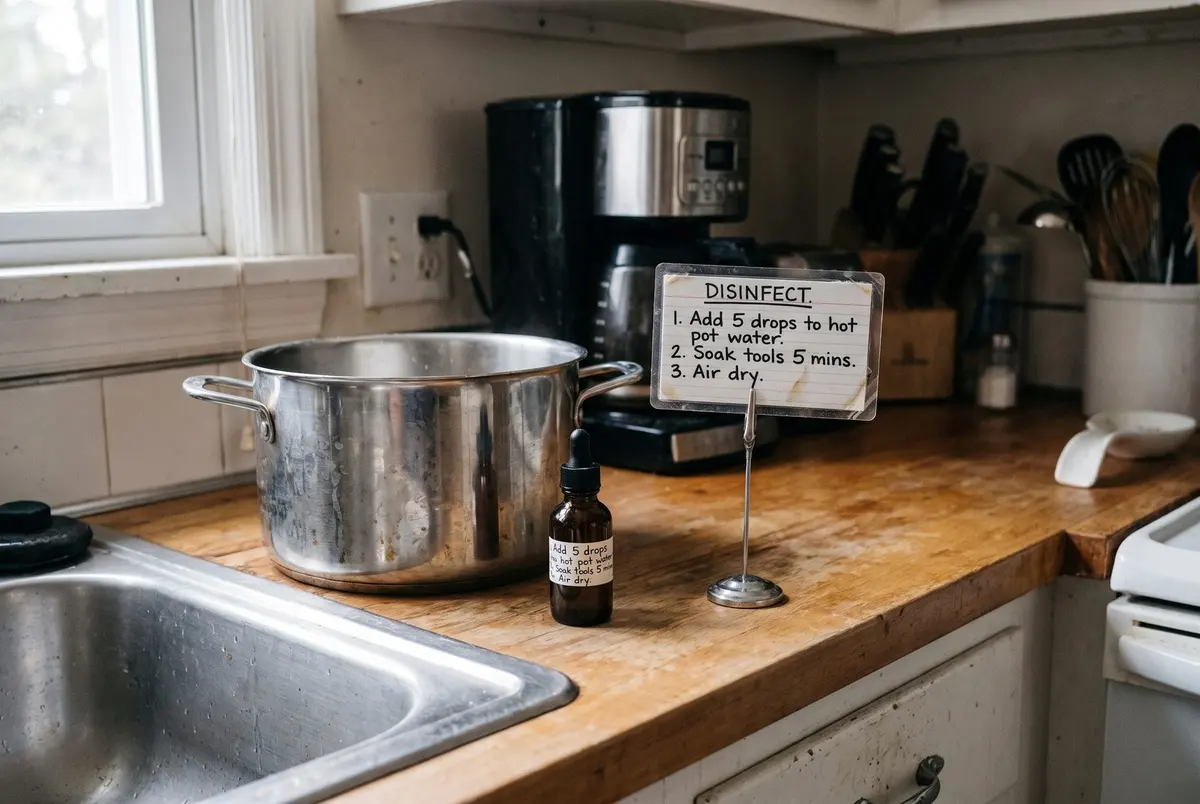
Those numbers come from the EPA's emergency disinfection guidance. They are also the numbers Project 6 of The Off-Grid Handbook writes onto a laminated card for its Emergency Disinfection Station, because under stress nobody remembers drops per gallon.
How many drops of bleach per gallon of water?
The dose depends on the strength printed on your bottle. Regular household bleach in the US is usually sold at about 6% or 8.25% sodium hypochlorite, and the EPA chart covers both.
| Volume of water | 6% bleach | 8.25% bleach |
|---|---|---|
| 1 quart | 2 drops | 2 drops |
| 1 gallon | 8 drops | 6 drops |
| 2 gallons | 16 drops (1/4 teaspoon) | 12 drops (1/8 teaspoon) |
| 4 gallons | 1/3 teaspoon | 1/4 teaspoon |
| 8 gallons | 2/3 teaspoon | 1/2 teaspoon |
Measure with a clean medicine dropper, not a splash from the bottle. For cloudy, colored or very cold water, double every number in the table.
The CDC gives a simpler version: for bleach between 5% and 9%, add 8 drops, a little less than 1/8 teaspoon, per gallon. If you remember one figure, make it that one, and keep the exact chart on the card.
Which bleach is safe for drinking water?
Use only regular, unscented chlorine bleach whose label lists sodium hypochlorite. Skip scented and color-safe products and anything with added cleaners.
Bleach also loses strength as it ages. The book's rule is to write the purchase date on the bottle and replace it every year, and to write your bottle's exact concentration on the instruction card so the dose always matches what is on the shelf.
The whole station takes about 20 minutes and roughly $15 in materials, per the book:
- Unscented household bleach, 5% to 9% sodium hypochlorite, no additives
- A medicine dropper kept only for this job
- A waterproof instruction card, written out and laminated
- A dedicated stock pot for boiling
- Clean containers with lids for the treated water
Step by step: emergency water disinfection with bleach
- Clear the water first. If it is cloudy, let it settle, then pour it through a clean cloth, paper towel or coffee filter.
- Check the label for the sodium hypochlorite percentage and find your dose in the table.
- Add the drops with a clean dropper and stir well.
- Cover and wait 30 minutes.
- Smell it. A slight chlorine odor means the dose did its job. No odor: repeat the dose once and wait 15 more minutes.
- Store it covered in clean containers, labeled with the date.
Storing water you have treated
Treated water keeps best in clean, food-grade containers with tight lids, stored somewhere cool and dark. Label each one with the date and the method, so nobody has to guess which jug was dosed.
Clearing comes first because disinfection works on clear water. A two-bucket gravity filter or a biosand filter does the clarifying, and bleach or heat does the disinfecting.
Boiling water to purify: how long is enough?
The CDC calls boiling the best way to kill germs in water. Bring clear water to a rolling boil for 1 full minute, or 3 minutes at elevations above 6,500 feet, then let it cool with a lid on.
The EPA uses a lower cutoff for the longer boil: 5,000 feet. If you live anywhere between 5,000 and 6,500 feet, boil for 3 minutes and you satisfy both agencies.
Boiling needs fuel and time to cool, which is why the station keeps a pot next to the bleach. If the power is out, our guide to cooking without electricity covers safe heat sources, and grills and camp stoves stay outdoors.
Boiling vs. bleach: which one should you use?
Use both, for different jobs. Each has a clear strength and a clear gap.
| Boiling | Bleach | |
|---|---|---|
| Germs covered | The widest range, including the parasites Giardia and Cryptosporidium | Most bacteria and viruses; less effective against Giardia and Cryptosporidium, per the CDC |
| Needs | Fuel, a pot, cooling time | A bottle and a dropper |
| Volume | A pot at a time | Many gallons at once |
| Wait | 1 to 3 minutes of boil, then cooling | 30 minutes |
When fuel is plentiful and the source is questionable, boil. When you need to treat a lot of stored water with no fuel to spare, bleach is the practical tool.
When bleach and boiling aren't enough
Both methods target microorganisms. Neither removes fuel, pesticides, heavy metals, salts or most other chemicals, and the CDC is direct: you cannot make water containing fuel or toxic chemicals safe by boiling or disinfecting it. Use bottled water or another source, and ask your health department.
Never mix bleach with ammonia or other cleaners. If local authorities issue a boil-water or do-not-drink notice, their instructions come first.
If your water comes from a well, a lab test tells you what you are actually treating. See how to test well water for what to test and how often.
How much treated water should you keep?
The baseline is one gallon per person per day, with three days as the minimum and two weeks as the working target. Our guide to how much water per person per day has the household totals.
The card matters most in the first hours of an outage, when there is no time to look anything up. Pair it with the steps in water during a power outage and the numbers are already on the counter when you need them.
Frequently asked questions
How long should water sit after adding bleach?
Let it stand for at least 30 minutes after stirring in the bleach. The water should then have a slight chlorine smell. If it doesn't, the EPA says to add the same dose again and wait another 15 minutes before drinking. Cover the container while it stands so nothing falls in.
How many drops of bleach do I need for 5 gallons of water?
At the EPA rate of 8 drops per gallon for 6% bleach, 5 gallons of clear water needs 40 drops. With 8.25% bleach, at 6 drops per gallon, it needs 30 drops. Double either amount if the water is cloudy, colored or very cold, then wait 30 minutes.
Is boiling water better than using bleach?
Boiling kills the widest range of germs, and the CDC calls it the best method. Bleach is less effective against the parasites Giardia and Cryptosporidium but treats many gallons with no fuel. Neither method removes fuel, metals or other chemicals, so chemically contaminated water needs a different source.
Can you use any bleach to purify water?
No. Use only regular, unscented chlorine bleach that lists sodium hypochlorite, typically 6% or 8.25%. Avoid scented and color-safe products or anything with added cleaners. Check the concentration on the label, because the number of drops per gallon depends on it.
Does bleach expire for water purification?
Bleach slowly loses strength once it sits on the shelf, so older bottles may under-dose your water. The Off-Grid Handbook's rule is to write the purchase date on the bottle and replace it every year. The chlorine smell test after 30 minutes is your check that the dose worked.
Sources
- The Off-Grid Handbook, Garrett Dalton, Project 6
- EPA: Emergency Disinfection of Drinking Water
- CDC: How to Make Water Safe in an Emergency
- CDC: Creating and Storing an Emergency Water Supply
Safety guidance changes. Check the agency pages above for the current version, and follow your local code and manufacturer instructions.