Biosand filter: how it works, how to build one, and what it cannot do
A column of washed sand and gravel, kept wet, grows its own filter. It needs weeks to start and daily feeding, and it rewards both.
In this article
A biosand filter is a container of layered gravel and fine sand, kept under a shallow layer of standing water, in which a living biological layer forms on the sand surface and helps remove pathogens. CDC reports that lab studies of filters with a mature biolayer showed 99.98 percent reduction of protozoa and 90 to 99 percent reduction of bacteria, with variable results for viruses.
That makes it a strong filter, but not a complete treatment. Water from an uncertain source still needs disinfection afterward.
How a biosand filter works
Water poured in the top passes through a diffuser plate, then slowly down through fine sand, coarse sand and gravel to an outlet tube at the base. The tube rises outside the container to just above the sand line, so the sand always stays under water.
CDC describes the common design as holding the water level 5 to 6 centimeters, about 2 inches, above the sand. That shallow layer lets a bioactive film grow on top of the sand, called the biolayer or schmutzdecke, and the book's field note sums it up: the biolayer is the filter.
The diffuser plate matters because it keeps poured water from gouging the sand surface and tearing the biolayer. Without it, every refill would damage the part that does the work.
Biosand filter vs. slow sand filter vs. ceramic
CDC's fact sheet notes that "BioSand Filter" is a trademarked name for one particular design, and that it covers all household slow sand filters under the same heading. In practice, a DIY biosand filter is a household slow sand filter.
Compared with the two-bucket ceramic filter, it trades a slow start for higher volume and no replacement parts:
| Biosand filter | Two-bucket ceramic filter | |
|---|---|---|
| Flow | Up to about 0.6 liters (2.5 cups) per minute, per CDC | 1 to 2 gallons per hour, per the book |
| Ready to use | After 2 to 3 weeks of daily charging | After two flushing runs |
| Replacement parts | None; CDC estimates a life of over 10 years | Ceramic element wears out |
| Viruses | Variable reduction | Not removed |
| Chemicals | Not addressed | Not addressed |
DIY biosand filter: materials
Project 4 of The Off-Grid Handbook is a weekend build, at about $80 in materials, per the book. It calls the biosand filter the step up from the drip filter: higher volume, no replacement elements, and a proven design used worldwide.
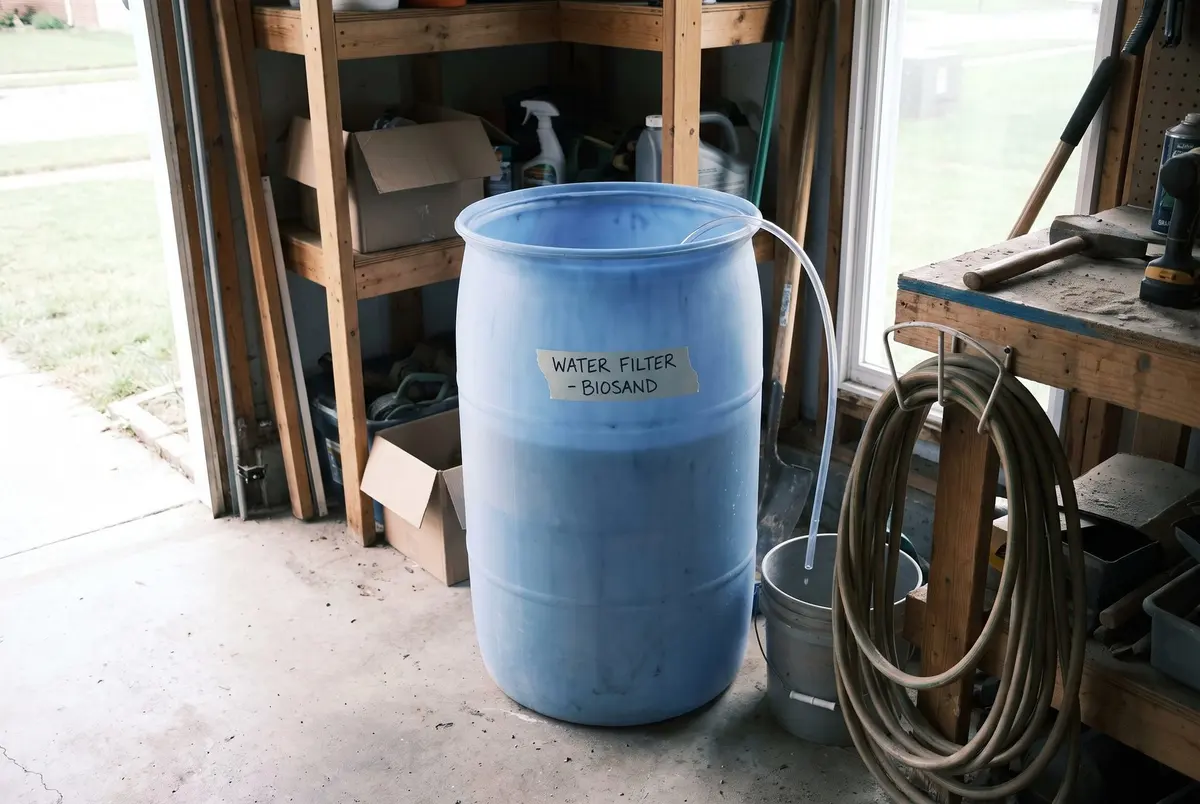
Choose its spot before you start. A container full of wet sand and gravel is very heavy, and CDC lists weight as one of the design's drawbacks, so build it where it will stay: a garage corner, utility room or covered porch close to your raw water, such as a rain barrel, with room for a bucket under the outlet.
- A rigid 30- to 55-gallon food-safe container, or a purpose-built filter body
- Washed fine sand, coarse sand and pea gravel
- 1/2-inch outlet tubing and fittings
- A diffuser plate, such as a perforated lid or basin
- Tools: drill, hacksaw, a bucket for washing media, measuring tape
How to build a biosand filter, step by step
- Wash the media. Rinse every batch of sand and gravel until the rinse water runs clear. The book calls dirty media the number one cause of failed builds.
- Install the outlet. Run tubing from the base of the container up the outside to just above the top of the planned sand line, so the sand stays submerged.
- Layer the media. From the bottom: 3 inches of gravel, 2 inches of coarse sand, then 18 to 24 inches of fine sand.
- Fit the diffuser. Mount the diffuser plate above the sand so poured water never hits the surface directly.
- Charge it daily. Pour water through every day for two to three weeks while the biolayer forms. Output quality climbs as it matures.
- Keep feeding it. A biosand filter is a living system and works best with daily use.
How to keep a biosand filter working
Flow drops over time, especially with cloudy source water. CDC notes that users can restore it by agitating the top layer of sand or by pretreating turbid water, for example by letting it settle first or by running a first flush diverter on the rain barrel that feeds it.
Resist the urge to clean the sand completely. The book's method is to swirl the standing water, scoop out the cloudy layer, and stop, because routine heavy cleaning harms the biolayer, a drawback CDC lists as well.
Feed it consistently. Skipping days starves the biolayer, and its performance falls until it recovers.
A simple routine keeps it on track. Pour one batch of water each day at the same time, collect the output in a clean, covered container, and write the date and any drop in flow on a log sheet, so you notice a change before it becomes a problem.
Is water from a biosand filter safe to drink?
Not on its own. The book's safety note is plain: like all field filtration, a biosand filter reduces pathogens, but it does not guarantee potable water and does nothing for chemical contamination.
CDC adds a second reason to treat the output: the filter leaves no residual protection, so clean water can be recontaminated in a dirty container. Collect it in a clean, covered vessel and disinfect water from uncertain sources with the method in how to purify water with bleach.
If your raw water comes from a well or a source near farms, roads or fuel storage, test it before relying on any filter. Neither sand nor bleach removes nitrates, fuel or heavy metals.
Frequently asked questions
How does a biosand filter work?
Water passes slowly through layers of fine sand, coarse sand and gravel that always stay under about 2 inches of standing water. A living biological layer grows on the sand surface and, together with the sand, removes most protozoa and bacteria. A diffuser plate protects that layer when you pour water in, and an outlet tube sets the water level.
How long does a biosand filter take to start working?
The Off-Grid Handbook says to charge the filter daily for two to three weeks while the biological layer forms on the sand. Output quality keeps improving as the layer matures. Even after that, disinfect the water from uncertain sources, because a biosand filter does not reliably remove viruses.
What is the difference between a biosand filter and a slow sand filter?
Very little at household scale. CDC notes that BioSand Filter is a trademarked name for one specific design, and groups it with other household slow sand filters. All of them rely on a submerged sand bed and the biological layer that grows on top of it.
How do you clean a biosand filter?
Gently. When flow slows, swirl the standing water above the sand, scoop out the cloudy water, and stop there. Scrubbing or removing the sand surface destroys the biological layer that does most of the work, and CDC lists routine cleaning as something that can reduce effectiveness.
Sources
- The Off-Grid Handbook, Garrett Dalton, Project 4
- CDC: Household Water Treatment, Slow Sand Filtration (fact sheet)
- CDC: How to Make Water Safe in an Emergency
- CDC: About Water Treatment Options When Hiking, Camping, or Traveling
Safety guidance changes. Check the agency pages above for the current version, and follow your local code and manufacturer instructions.