Gravity fed water system: how high the tank goes, what pressure you get, and how to build it safely
Raise the water and every tap in the loop works without a pump. Height is pressure, and weight is the hazard.
In this article
A gravity fed water system runs on height alone: every foot the water sits above the tap adds about 0.43 psi of pressure. A tank on a stand 6 to 8 feet high delivers roughly 2.6 to 3.5 psi, enough for a working gravity tap, filling buckets and low-pressure drip lines, with no pump and no power.
The Off-Grid Handbook builds it in two projects. Project 14, Elevated Tank Gravity Feed, is a half-day build around a 65-gallon tank for about $150 in materials, per the book; Project 15, The Full Rain-to-Tap Line, connects roof, barrels, tank, filter and disinfection into one passive line over a weekend.
Gravity water pressure: psi per foot of height
Pressure from height is plain physics. Utah State University Extension puts it this way: for every foot of elevation change, pressure changes by 0.433 psi. Turned around, it takes 2.31 feet of height to gain 1 psi, per UC Cooperative Extension.
| Height of water above the tap | Approximate pressure |
|---|---|
| 2 feet | 0.9 psi |
| 4 feet | 1.7 psi |
| 6 feet | 2.6 psi |
| 8 feet | 3.5 psi |
| 23 feet | 10 psi |
Measure height from the water surface in the tank to the outlet where you use it. Siting the stand uphill from the garden adds free height without adding framing.
Know what that pressure can and can't do. USU Extension notes that most drip irrigation systems operate at 10 to 30 psi, which would take more than 23 feet of height, so a gravity system needs drip lines and emitters made for low pressure, or open taps and buckets.
Why 8 feet is enough
The book's field note is worth taping to the lumber: height is pressure and pressure is comfort, but 8 feet is plenty. Chasing 20 feet of head with amateur framing trades a convenience for a hazard.
Building an elevated water tank stand
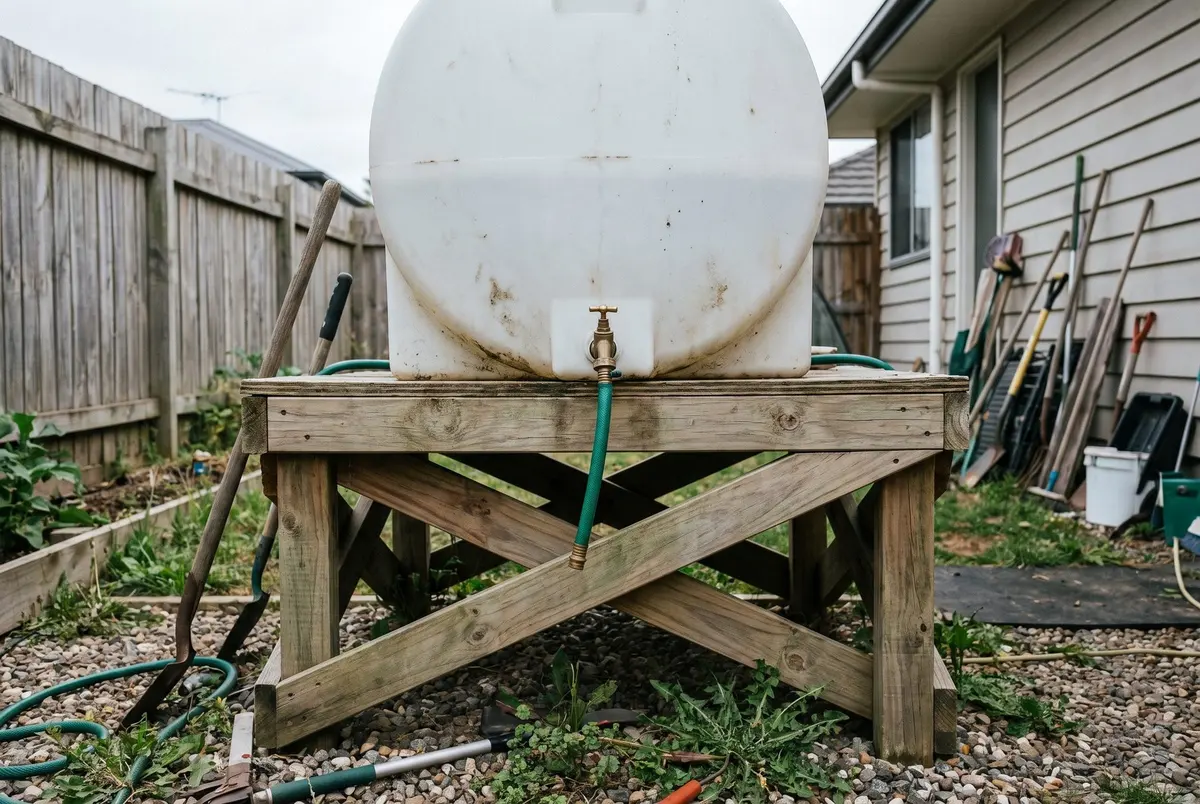
The real engineering problem is weight. Water weighs 8.34 pounds per gallon, per the USGS, so a full 65-gallon tank weighs about 540 pounds, sitting overhead, and the book says to build the stand for 700 pounds or more.
Materials from the book:
- Pressure-treated 4x4 posts and 2x6 framing
- A 65-gallon tank rated for the purpose
- A 3/4-inch outlet, a valve, and food-grade supply line
- Anchors or ground screws
- Tools: saw, drill/driver, level, wrench
- Site the stand uphill if you can, or build it to 6 to 8 feet.
- Frame it with cross-bracing on all four faces. Overbuild deliberately.
- Anchor it. Wind load on an empty tank platform is real.
- Plumb the outlet with a shutoff at the tank and a tap at the point of use.
- Fill in stages on the first test, checking the structure at quarter, half and full.
If the design goes beyond simple framing, or the stand sits near buildings or where people walk, have it checked by someone qualified. Follow local codes for structures and setbacks.
Common stand mistakes
- Going too tall. Every extra foot adds a little pressure and a lot of leverage on the frame.
- Skipping bracing on one face. The book braces all four, because a stand only fails once.
- Leaving it unanchored. An empty tank on a platform catches wind like a sail.
- Filling it all at once on the first test, instead of checking at quarter, half and full.
- Building where people walk or right against a building, where a failure does the most harm.
Rain to tap: the full gravity system
Project 15 is the capstone of the book's water chapter: roof to gutter to first-flush to barrel chain to elevated tank to filter to disinfection to a labeled tap. It runs on rain and gravity alone, at $250 to $300 for the full line, per the book.
- Roof and gutters: screened and clean, because the roof is the catchment surface.
- Diversion: a first-flush diverter dumps the dirtiest first water of each storm.
- Storage: a chain of barrels, linked as in how to connect rain barrels.
- Height: the elevated tank supplies the pressure.
- Treatment: a gravity filter such as a two-bucket drip filter feeds the disinfection station.
- One potable tap, labeled so nobody can mistake it.
The book's first step happens on paper: catchment area, diversion volume, chain capacity, tank height, filter throughput and disinfection point, all on one page. Then build upstream to downstream: roof prep, diverter, chain, tank.
Is gravity fed rainwater safe to drink?
Not as collected. The CDC says rainwater is not necessarily safe to drink without first removing germs and chemicals, and recommends testing it regularly if you drink, cook or bathe with it.
The book agrees on every point. Only one tap is potable, it sits after the filter and disinfection pair, and after a full storm cycle the tap output is tested before anyone drinks a drop; our guide to water testing covers how.
The CDC also warns that rainwater must not get into pipes carrying treated tap water. Keep the gravity line separate from household plumbing, and ask your health department and a licensed plumber before connecting anything to the house.
Keeping the system running
A passive system still needs a schedule. The book posts a laminated system map at the tap showing what is potable, what is not, and who maintains what, and it sets the calendar:
- Gutter screens cleaned each fall
- Filter serviced by flow rate, when it slows
- Disinfection stock replaced by date
- Winterization by first frost: see how to winterize a rain barrel
Disinfection is the last stage before the tap, and its numbers belong on the map. Our guide to purifying water with bleach has the drops-per-gallon chart.
Frequently asked questions
How much pressure does a gravity fed water system have?
About 0.43 psi for every foot of height between the water surface and the tap. A tank 6 feet up gives about 2.6 psi, and 8 feet gives about 3.5 psi. That is enough for a gravity tap, filling containers and low-pressure drip lines, but far below household water pressure.
How high does a water tank need to be for gravity flow?
Any height gives some flow, but The Off-Grid Handbook recommends 6 to 8 feet, or an uphill site, for a usable tap. Going much higher with homemade framing adds risk faster than comfort: a full 65-gallon tank weighs about 540 pounds. Each 2.31 feet of height adds 1 psi.
How much does a full 65-gallon water tank weigh?
Water weighs 8.34 pounds per gallon, per the USGS, so 65 gallons is about 540 pounds before the tank itself. The Off-Grid Handbook says to build the stand for 700 pounds or more, cross-brace all four faces, anchor it against wind and fill it in stages on the first test.
Can you drink water from a gravity fed rain system?
Only after treatment and testing. The CDC says rainwater is not necessarily safe to drink without removing germs and chemicals. Put a filter and disinfection between the tank and one clearly labeled potable tap, test the output before anyone drinks it, and keep the line separate from household plumbing.
Will a gravity fed tank run drip irrigation?
Standard drip systems mostly operate at 10 to 30 psi, according to Utah State University Extension, which would need a tank more than 23 feet up. A tank at 6 to 8 feet works with drip lines and emitters designed for low pressure, or with open taps and watering by bucket.
Sources
- The Off-Grid Handbook, Garrett Dalton, Projects 14 and 15, Elevated Tank Gravity Feed and The Full Rain-to-Tap Line
- Utah State University Extension: Drip Irrigation for Trees
- UC Cooperative Extension: Energy and Cost Required to Lift or Pressurize Water
- USGS: A Million Gallons of Water, How Much Is It?
- CDC: Collecting Rainwater and Your Health
Safety guidance changes. Check the agency pages above for the current version, and follow your local code and manufacturer instructions.