Pickling vs fermenting: how vinegar pickles and fermented pickles differ
Both end in a sour, crunchy jar. One borrows its acid from a bottle of vinegar, the other grows it over a few weeks on the counter.
In this article
Pickling vs fermenting is a question of where the sourness comes from. Vinegar pickles, also called fresh-pack or quick pickles, are acidified right away with vinegar. Fermented pickles make their own acid: salt lets lactic-acid bacteria turn the vegetables' natural sugars into lactic acid over a few weeks. The USDA counts both as pickled foods, but they are made, stored and kept safe in different ways.
This guide compares the two, explains which one can live on a pantry shelf, and lists the rules you can't bend for either.
How fermenting works
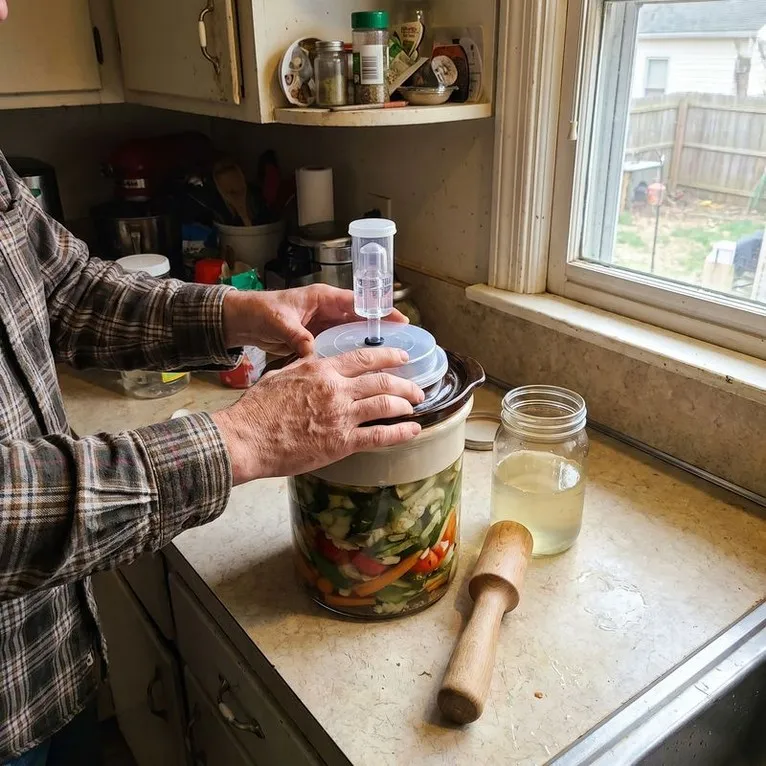
Fermentation needs no stove at all. Project 42 of The Off-Grid Handbook describes it as preserving vegetables with salt, time and no heat source, in a jar on the counter, for about $30 and half an hour of work.
The salt does the selecting. The USDA explains that in fermented foods, salt favors the growth of desirable bacteria while inhibiting others, so it is vital to safety and texture, not just flavor. As the good bacteria work, the acidity climbs and the flavor turns sour. The book's method for kraut:
- Salt at 2% by weight: 20 g per 1,000 g of shredded cabbage.
- Keep everything under the brine, weighted down.
- Ferment at a cool room temperature, 60 to 75°F, with an airlock or a loose lid burped daily.
- Taste from day 5; kraut typically lands between 1 and 4 weeks.
The USDA's tested kraut recipe gives a longer timeline for full fermentation: about 3 to 4 weeks at 70 to 75°F, or 5 to 6 weeks at 60 to 65°F. Below 60°F, kraut may not ferment. The USDA says regular dill pickles and sauerkraut ferment and cure for about 3 weeks, and refrigerator dills for about 1 week. The full kraut method is in how to make sauerkraut.
How vinegar pickling works
A fresh-pack pickle skips the waiting. The USDA describes it as cucumbers or other vegetables that may be brined a few hours or overnight, then drained and covered with vinegar and seasonings. The vinegar supplies the acid at once, so the jar is ready to process the same day.
Because the vinegar is the safety system, the proportions are fixed. The USDA's rules:
- Use vinegar of 5% acidity, white distilled or cider. Never a vinegar of unknown strength.
- Don't change the vinegar, food or water proportions in a recipe.
- Use only tested recipes. There must be a minimum, even level of acid throughout the jar to prevent the growth of botulinum bacteria.
Salt matters less here. The USDA notes that quick pickles can be made with reduced or no salt, though the texture and flavor may suffer. If you want to try a lower-salt jar, make a small batch first, as the USDA suggests, so you can judge whether your household likes the result before you put up a full canner load.
Fermented vs vinegar pickles, side by side
| Fermented pickles | Vinegar (fresh-pack) pickles | |
|---|---|---|
| Source of acid | Lactic acid made by bacteria | Vinegar added to the jar |
| Time | About 1 to 6 weeks, depending on food and temperature | Same day, plus any brining time |
| Salt | Essential for safety; no reduced-sodium salt | Mostly for flavor and texture |
| Heat | None while fermenting | Water-bath processing for shelf storage |
| Flavor | Tangy, sour, more complex | Sharp and bright, shaped by the vinegar and spices |
| Keeping without canning | Refrigerated: kraut several months, dills 4 to 6 months | Only as a refrigerator pickle |
So are fermented pickles the same as pickles? They are one kind of pickle. A traditional crock-cured dill is fermented; most sweet pickles, bread-and-butter pickles and pickled beets are vinegar pickles.
Which one keeps on the shelf?
Neither one, until it has been canned by a tested method. A ferment on the counter is not shelf stable, and neither is a jar of vinegar pickles that hasn't been processed.
For fermented foods, the USDA says fully fermented kraut keeps several months tightly covered in the refrigerator, and fully fermented dill pickles about 4 to 6 months refrigerated in their container, provided surface scum is removed regularly. It adds that canning fully fermented pickles is a better way to store them. The Handbook agrees: in Project 42's safety box, fermented vegetables for shelf-stable canning must follow tested NCHFP recipes, under the rules of Project 31.
Vinegar pickles reach the shelf the same way. Project 31, the water-bath canning station, lists pickles among the high-acid foods that belong in a water bath, processed fully submerged at a rolling boil for the full published time, then cooled 12 to 24 hours and checked for a seal. Some USDA pickle recipes allow a gentler low-temperature pasteurization at 180 to 185°F for 30 minutes for crisper results, but only when the recipe calls for it.
Processing times change above 1,000 feet. See canning at high altitude, and what you can water bath can for the full list of foods.
The rules you can't change, for either method
- Use canning or pickling salt. The USDA says flake salt varies in density and is not recommended, and the anti-caking agents in table salt can cloud the brine.
- Trim the blossom end of cucumbers, a 1/16-inch slice, because the blossom may hold an enzyme that softens pickles.
- Keep ferments under the brine, and learn the difference between harmless film and mold in kahm yeast vs mold. Soft, slimy or bad-smelling pickles get thrown out, per the USDA.
- Never improvise a canning recipe. The Handbook's chapter on food puts it simply: creativity belongs in the recipe, while processing times, methods and acidity rules are non-negotiable.
- Use new flat lids every time you can. See can you reuse canning lids.
Which method to start with
If you have a cool corner and a few weeks, fermenting is the cheapest way in and needs no heat. If you want jars for the pantry by tonight, a tested vinegar pickle recipe and a water bath will get you there. Many households end up doing both: kraut in the fridge or root cellar, and canned dills on the shelf. The canning method is in water bath canning for beginners.
Frequently asked questions
Are fermented pickles the same as pickles?
They are one type of pickle. Fermented pickles get their sourness from lactic acid made by bacteria over a few weeks, while fresh-pack pickles are made sour right away with vinegar. Both are pickled foods, but they are made and stored differently.
Is pickling or fermenting healthier?
Both preserve vegetables, and both can be part of a varied diet. The bigger practical difference is storage: fermented vegetables keep in the refrigerator for months, while either kind needs a tested water-bath recipe to be stored on a pantry shelf.
Can you water bath can fermented foods?
Yes, with tested recipes. The USDA has water-bath processes for fully fermented sauerkraut and dill pickles, with times that rise with altitude. Canning heats the jars, so the finished product is shelf stable rather than an active ferment.
Do fermented pickles need vinegar?
Not for the fermentation itself, which runs on salt and time. Some tested recipes, such as the USDA fermented dill pickle, add a small amount of 5% vinegar to the brine. Follow the recipe as written.
Sources
- The Off-Grid Handbook, Garrett Dalton, Project 42
- USDA Complete Guide to Home Canning, Guide 1: Principles of Home Canning (PDF)
- USDA Complete Guide to Home Canning, Guide 6: Fermented Foods and Pickled Vegetables (PDF)
- National Center for Home Food Preservation: Pickling
- National Center for Home Food Preservation: Fermenting
- University of Illinois Extension: Fermenting FAQ
Safety guidance changes. Check the agency pages above for the current version, and follow your local code and manufacturer instructions.