Charging LiFePO4 below freezing: the rule, the reason and how to keep a battery warm
A lithium battery can run in the cold. Charging it there is the problem, and the fix is usually as simple as moving it indoors.
In this article
Charging LiFePO4 below freezing is something to avoid. The Off-Grid Handbook states the rule in the safety box of Project 18: never charge below freezing unless the battery has low-temperature protection, and follow the manufacturer's charge specifications exactly. Most LiFePO4 batteries can still power your devices in the cold within the range on their datasheet; it is putting charge back in while the cells are frozen that does the harm.
The simplest fix is to keep the battery in heated living space, which LiFePO4 allows because it is sealed and gives off no hydrogen. The details follow.
Why charging LiFePO4 below freezing is a problem
When a lithium battery charges, lithium ions travel to the negative electrode and settle into it. In the cold, that process slows down. If charging current keeps arriving faster than the ions can settle in, some of the lithium deposits on the surface as metal instead. This is called lithium plating.
Research for the U.S. Department of Energy's Vehicle Technologies Office, by Argonne National Laboratory and the National Renewable Energy Laboratory, puts it plainly: lithium plating is more likely at lower temperature. Plated lithium no longer stores energy the way it should, so the battery wears faster.
There is no warning light. A battery charged in the cold can look and work normally for a while, which is why the rule has to be followed before the damage, not after.
It's the battery's temperature that counts
The rule is about the cells, not the air in the room. A battery carried in from a freezing garage stays cold inside for hours, even in a warm kitchen. Give it time to warm up before you connect a charger or a panel. If you suspect a battery was charged while frozen, a capacity test shows whether it lost ground; see how to test battery capacity.
LiFePO4 low temperature protection: what it is
Many LiFePO4 batteries include a temperature sensor in their battery management system (BMS). When the cells are too cold, the BMS blocks charging current and lets it back in once they warm up. That is the low-temperature protection the Handbook refers to.
Some batteries go a step further with built-in heaters that warm the cells before charging begins. Either way, the battery is protecting itself; your job is to know whether yours has it.
How to tell from the datasheet
- Look for two separate temperature ranges: one for charging, one for discharging. The charging range is the one that matters here.
- Look for words like low-temperature charge protection, low-temperature cutoff or self-heating.
- If the datasheet doesn't mention it, assume the battery has no protection and keep it above freezing whenever it might charge.
- Write the charging range on the battery box, next to your daily load from the Handbook's watt-hour audit in Project 17.
Some solar charge controllers can read battery temperature through a probe, but don't count on that unless the manual says it stops lithium charging in the cold. The battery's own specifications are what count.
LiFePO4 cold weather: discharging and capacity
Running devices from the battery in the cold is a different matter from charging it. Most LiFePO4 datasheets allow discharging at temperatures below freezing, down to a stated limit. Stay inside that range.
Expect less from a cold battery. Chemical reactions slow down in the cold, so the battery may deliver less of its capacity until it warms up. Take voltmeter readings after the battery has rested; the Handbook's guide for LiFePO4 is about 13.0 volts at rest is comfortable and under 12.0 volts means time to charge. Our LiFePO4 voltage chart has the full range.
NFPA's lithium battery guidance also advises against storing batteries in extremely hot or cold places. For off-season storage, see how to store lithium batteries.
Where to keep the battery in winter
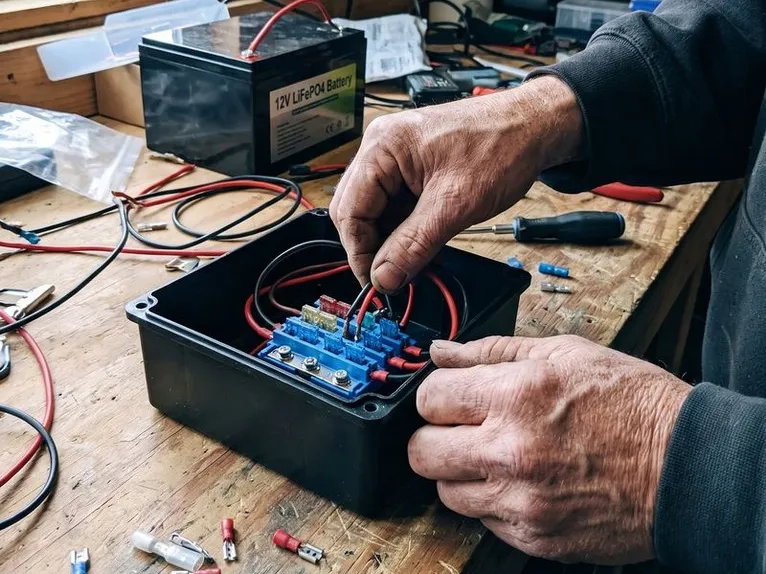
The Handbook builds its LiFePO4 battery box for indoor use: stable, sealed, no acid, no hydrogen. That makes the warm house the natural winter home for it.
- Keep the battery in a heated room and run the panel cable in to it. A longer run may need heavier wire; see what gauge wire for 12V.
- Avoid the unheated garage or shed unless the battery has low-temperature protection.
- Don't rely on an insulated box alone. A battery at rest makes little heat of its own, so insulation only slows cooling.
- Never warm a battery with a space heater, heat lamp or heating pad pressed against it.
- Keep it clear of exits. NFPA advises against storing larger lithium batteries where they block the way out of a room.
Remember that the "one warm room" you heat during a winter outage is also the best place for the battery.
Solar charging on cold mornings
Winter sun often reaches the panel while the battery is still at its coldest. If the battery sits outdoors, a protected battery will refuse charge until it warms, and an unprotected one will accept current it shouldn't. Keeping the battery indoors solves both.
The rest of the Handbook's charging rules stay the same in winter. The controller's battery profile must match the chemistry, per Project 20, and the wiring order is battery first, then panel; see how to connect a solar panel to a battery. Steepening the panel about 15 degrees for winter, as the Handbook's ground mount allows, helps it make the most of short days.
A winter checklist for a LiFePO4 battery
- Find the charging temperature range on the datasheet and write it on the box.
- Confirm whether the battery has low-temperature protection.
- Bring the battery inside before the first hard freeze.
- Check the voltage at rest every few weeks and recharge under 12.0 volts.
- Look the case over for swelling, heat or odd smells. NFPA says to stop using a battery that shows them.
- Never bypass the BMS, and keep the master fuse in the circuit, as Project 18 requires.
If you are still choosing a battery for a cold building, our comparison of LiFePO4 vs lead acid explains where each one has the edge. For the full build, see the DIY LiFePO4 battery box, and pair it with a DIY solar charging station.
Frequently asked questions
Can you charge LiFePO4 below 32°F?
Not unless the battery has low-temperature protection. The Off-Grid Handbook's rule is never to charge a LiFePO4 battery below freezing without it, and to follow the manufacturer's charge specifications exactly. Check the charging temperature range on your battery's datasheet.
Can LiFePO4 batteries be used in cold weather?
Yes, for discharging, within the range on the datasheet. Most LiFePO4 batteries can power devices below freezing, though they may deliver less capacity until they warm. Charging is the limit: without low-temperature protection, do not charge below freezing.
What happens if you charge a lithium battery below freezing?
Lithium can deposit as metal on the negative electrode instead of being absorbed, a process called lithium plating. Research for the U.S. Department of Energy notes plating is more likely at lower temperature. It wears the battery and gives no visible warning.
How do I keep a LiFePO4 battery warm in winter?
The simplest way is to keep it in a heated room and run the solar cable to it. LiFePO4 is sealed and gives off no hydrogen, which is why The Off-Grid Handbook builds its battery box for indoor use. Never warm a battery with a space heater, heat lamp or heating pad.
Sources
- The Off-Grid Handbook, Garrett Dalton, Project 18
- U.S. DOE Vehicle Technologies Office (Argonne National Laboratory and NREL): Impact of Anode Design on Fast Charge Performance
- NFPA: Lithium-Ion Battery Safety
- University of Arizona Cooperative Extension: Stand Alone Photovoltaic (PV) Systems (AZ1983)
Safety guidance changes. Check the agency pages above for the current version, and follow your local code and manufacturer instructions.