How to store propane tanks: outdoors, upright and away from the house
A 20-pound grill tank is safe outdoors and dangerous indoors. Where it sits between uses matters more than most people think.
In this article
Here is how to store propane tanks safely: keep them outdoors, upright, with the valve closed, on a firm, level surface away from heat and anything that can ignite them. Never store a propane tank in the house, the basement or the garage, even an attached garage with the door open. Local fire officials, working from the national propane code (NFPA 58) and their own state rules, all land in the same place: the tank lives outside.
The rule matters most in a winter outage, when the spare tank for the grill or camp stove becomes the household's cooking fuel. Here is where to keep it, how to handle it, and what to check before the season starts.
How to store propane tanks: the basic rules
The City of Gilroy, California, sums up the standard consumer precautions, and New Jersey's Department of Community Affairs gives the same advice:
- Outdoors only. Never store or use a cylinder in your home or in an enclosed space such as a garage, basement or shed.
- Upright. Use, carry and store cylinders standing up, with the valve turned off.
- Away from heat. Keep them where they won't get hot and away from anything that could ignite them.
- Not under the grill. New Jersey's list says not to store spare cylinders under or near the grill.
- Read the labels on the cylinder, and keep children from playing with it.
A shaded spot on a patio or beside the house, on concrete or pavers, out of the way of foot traffic and cars, works well. Keep it clear of dryer vents, air conditioning units and the place where a generator would run.
Why the basement is the worst place
Propane vapor is heavier than air. Washington State Emergency Management notes that it can collect in low areas such as basements, ditches and along floors. A small leak in a basement doesn't drift away. It pools where a furnace, a water heater or a light switch can ignite it. Propane has a rotten-egg odor added so leaks can be noticed. If you ever smell it indoors, leave, and call the fire department or your propane supplier from outside.
Can you store propane tanks in the garage?
No. The garage is the most common mistake because it feels sheltered and it is where the grill spends the winter. But an attached garage shares air with the house, and it is full of things that spark or get hot: the car, the water heater, power tools, a freezer compressor. The fire safety guidance above names the garage specifically.
The same goes for a garden shed. The Off-Grid Handbook allows a detached, ventilated space in Project 56, its outdoor cooking station, but the consumer guidance from fire officials is stricter: no enclosed spaces at all. We follow the stricter rule. If you want to keep rain and snow off a tank, use an open-sided spot, not a closed building. Some towns also limit how much propane a household can keep and where, so your local fire marshal has the final word.
Moving the grill into the garage for the winter is fine only if you disconnect the tank and leave the tank outside. Never light the grill in there; see can you use a grill in the garage.
How to store propane tanks in winter
Cold weather doesn't change the rules. Portable tanks are made to sit outdoors all year. What winter changes is access and handling:
- Keep the path clear. Choose a spot you can reach after a snowfall without climbing a drift or crossing ice.
- Keep it upright and out of puddles, on pavers or concrete rather than soggy ground.
- Brush snow off the valve and collar before you connect it.
- Close the valve whenever the tank isn't in use, and put the plug or cap back on if it came with one.
- Don't bring it inside to warm it up. That is the one move that turns a safe tank into a hazard.
Do the checks below before the first storm, not during it. Gear you have handled in calm weather is gear you can use in the dark.
Small 1-pound canisters
Camp stove canisters follow the same logic on a smaller scale. The Handbook's rule for them is short: cool and dry. Keep them in a closed bin in the same protected outdoor spot as the big tank, away from heat, sun-baked car trunks and children, and never beside a furnace or water heater. How many you need depends on your menu; our guide to how long a propane canister lasts does the math.
Check the tank before you count on it
| Check | What to look for |
|---|---|
| Valve | An OPD (overfill protection) valve, with a triangular handwheel and the letters "OPD." Round or star-shaped handwheels are obsolete. |
| Date | The date stamped on the collar. In the U.S., a cylinder over 12 years old must be recertified before it can be refilled. |
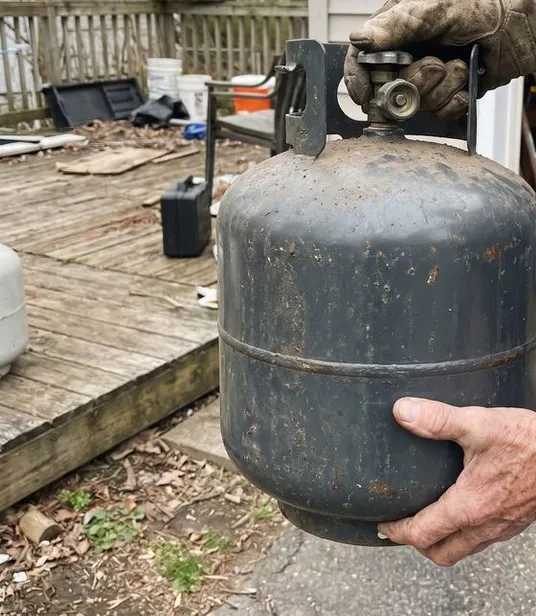
| Body | Dents, damage, rust or leaks. Ask your supplier to check at each refill. |
| Hose and connections | Soapy water brushed on with the valve open. Bubbles mean a leak. |
For the leak test, NFPA's grilling guidance is to brush or spray a soapy solution along the hose, regulator and connections with the cylinder turned on. If bubbles form, turn the cylinder off right away and have the grill serviced before using it. If the leak doesn't stop, call the fire department. Never check for leaks with a match or lighter.
Bringing a tank home
New Jersey's advice: after a refill, take the cylinder straight home, keep the vehicle ventilated with the valve closed and plugged or capped, and don't leave it sitting in the car. Stand it upright and wedge it so it can't tip or roll.
How many tanks to keep, and where they go
Project 56 of the Handbook stocks one or two 20-pound tanks plus spare canisters for a two-burner camp stove and the grill. Per the book, a 20-pound tank runs a two-burner stove for roughly 18 to 20 hours at full burn, which is weeks of realistic cooking. The project takes about two hours and roughly $80 in station gear, and it gives the tanks a defined home: outside, near where you cook, never in the house or basement.
Two tanks let you keep one connected and one full, so you can swap without a trip to the store in the middle of an outage. Keep the spare a few steps from the station, not under it.
For the rest of the setup, see our guide to building an outdoor cooking station and the full plan in how to cook without electricity. The same outdoors-only logic applies to generators; read why a generator never goes in the garage. And keep a battery-backed CO alarm on every level of the house, placed as described in CO detector placement.
Frequently asked questions
Can you store propane tanks in the garage?
No. Fire safety guidance says never to store or use a propane cylinder in the home or an enclosed space such as a garage, basement or shed. An attached garage shares air with the house and has many ignition sources. Store the tank outdoors, upright, with the valve closed.
Can propane tanks be stored outside in winter?
Yes. Portable propane tanks are meant to be stored outdoors year-round. Keep the tank upright on a firm surface out of puddles, close the valve, brush snow off the valve before connecting it, and never bring it indoors to warm it up.
Can you store a propane tank on its side?
No. Consumer guidance from fire officials says to use, transport and store propane cylinders in an upright, vertical position with the valve turned off. In a car, stand the tank up and wedge it so it can't tip or roll.
When does a 20-pound propane tank expire?
Check the date stamped on the collar. In the U.S., a cylinder over 12 years old must be recertified before it can be refilled. The valve should also be an OPD type, with a triangular handwheel marked OPD. Ask your supplier to check for dents, rust and leaks at each refill.
Sources
- The Off-Grid Handbook, Garrett Dalton, Project 56
- City of Gilroy: Guidance on Leak Testing and Maintaining Propane Cylinders (PDF)
- New Jersey Department of Community Affairs: Propane Gas Grill and Range Safety Tips (PDF)
- NFPA: Grilling Safety
- Island County, Wash.: Propane Safety, from Washington State Emergency Management (PDF)
- CDC: Carbon Monoxide Poisoning Basics
Safety guidance changes. Check the agency pages above for the current version, and follow your local code and manufacturer instructions.