How to use a fire extinguisher: decide first, then PASS
The four PASS steps take seconds. The decision before them, fight or leave, is the part that keeps people safe.
In this article
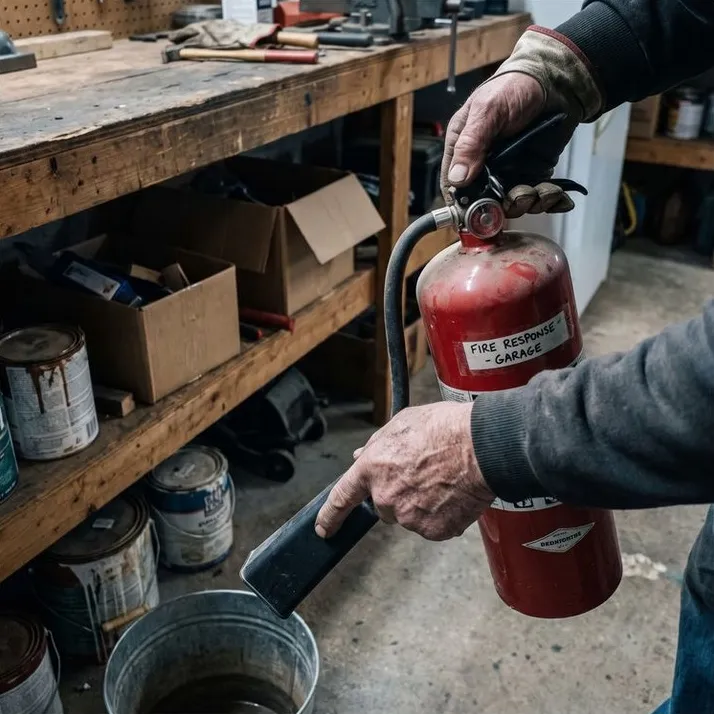
Here is how to use a fire extinguisher: first make sure the fire is small, someone is calling 911 and your way out is behind you. Then remember PASS: Pull the pin, Aim low at the base of the fire, Squeeze the lever slowly and evenly, and Sweep from side to side. If the extinguisher runs empty or the fire grows, stop and get out.
That is the method taught by the U.S. Fire Administration (USFA) and OSHA. This guide walks through it in the order you'll need it, starting with the moment before you touch the handle.
First decide: fight it or leave
Most of the danger comes from using an extinguisher on a fire that is already too big. USFA's checklist asks six questions, and you use the extinguisher only if every answer is yes:
- Have I alerted others in the house that there is a fire?
- Has someone called the fire department?
- Am I physically able to use a fire extinguisher?
- Is the fire small and contained to one object or surface, like a pan or a wastebasket?
- Am I safe from the smoke?
- Do I have a clear escape route?
If any answer is no, or you aren't sure, USFA's advice is to alert others, leave and call 911. The Off-Grid Handbook turns this into a size rule in Project 51: extinguishers are for fires smaller than you. Anything bigger means everyone out and a call to the fire service, because, as the book puts it, the house is not the priority.
NFPA notes that once a smoke alarm sounds, you may have as little as two minutes to get out. The decision has to be quick, which is why it helps to have made it ahead of time.
Who should not use one
USFA says young children and older adults should not use fire extinguishers. If you would struggle to lift the cylinder, hold it steady or back away quickly, your job in a fire is to get yourself and others out and make the call. That is a complete and correct plan, not a lesser one.
How to use a fire extinguisher: the PASS steps
Stand with your back to your exit. OSHA's guidance is to pick a safe way out before you approach, and never let the fire, heat or smoke come between you and it. Then:
- Pull the pin. This breaks the tamper seal. Hold the extinguisher upright with the nozzle pointing away from you.
- Aim low, at the base of the fire, not at the flames. The fuel is at the bottom.
- Squeeze the lever slowly and evenly.
- Sweep the nozzle from side to side across the base of the fire until it appears to be out.
Start a few steps back, within the range printed on the label, and move closer only as the fire shrinks. A small home extinguisher empties fast, so don't spend the first burst on the tops of the flames.
After the flames go out
OSHA's next step is to back away and keep watching, because a fire can flare up again. If it does, repeat the aim, squeeze and sweep. If the extinguisher is empty and the fire isn't out, leave immediately.
Know which fire you're facing
| Fire | What works | What not to do |
|---|---|---|
| Paper, wood, cloth (Class A) | ABC extinguisher | Don't turn your back on it right away |
| Grease in a pan | A lid or baking sheet slid over the pan, burner off | Never water |
| Flammable liquid (Class B) | ABC extinguisher | Never water, which can spread it |
| Plugged-in equipment (Class C) | ABC extinguisher | Never water, which conducts electricity |
OSHA warns that water should never go on a flammable liquid fire, where it can spread the flames, or on an electrical fire, where it can lead to electrocution. A multipurpose ABC extinguisher covers all three classes, which is why it is the standard home choice. For a pan on the stove, USFA's advice is to keep a lid or baking sheet nearby and cover the pan if it catches. The Handbook keeps a fire blanket beside its outdoor cooking station for the same reason: smothering beats spraying on grease.
Practice before you need it
Project 51 asks every adult and capable teen in the house to learn PASS, and it mounts extinguishers on brackets near exits instead of hiding them in cabinets. Per the book, the whole project takes about 30 minutes and roughly $80 for two or three ABC extinguishers, a fire blanket and brackets.
A calm way to rehearse:
- Walk to each extinguisher and lift it off its bracket, so everyone knows how heavy it is.
- Read the label together: the classes, the range and the instructions.
- Say the four steps out loud with the pin still in.
- In each room, point out the exit you would keep behind you.
- Ask your local fire department about hands-on training. USFA suggests them as a resource.
Our guide to the best fire extinguisher for home use covers which model to buy, how to read the rating and where to mount each one.
What to do after you use a fire extinguisher
- Let firefighters check the area, even if the fire looks out. Stay out until they say it's safe.
- Service or replace the extinguisher. The Handbook's rule is that after any use, no matter how brief, it goes back for service or gets replaced.
- Check the others. The book calls for a gauge check every quarter anyway, and USFA's maintenance list includes making sure each extinguisher is easy to reach and holds proper pressure.
- Talk it through. What started it, how long the decision took, whether the exit stayed clear.
Outage nights raise the stakes
The Handbook's reason for staging extinguishers is that outages concentrate fire risk: flames, fuel, cords and distraction all at once. Lanterns, camp stoves and wood stoves all come out while the house is dark and everyone is tired. Keep one extinguisher in the room where you'll spend the outage and one you can carry to the outdoor cooking station.
Prevention does more than any extinguisher. Keep spare fuel outside, as described in how to store propane tanks, put ashes in a covered metal can as in how to dispose of wood stove ashes, and make sure your smoke alarms work, per where to put smoke detectors. Then agree on a meeting spot outside as part of your family emergency communication plan.
Frequently asked questions
What does PASS stand for on a fire extinguisher?
Pull, Aim, Squeeze, Sweep. Pull the pin with the nozzle pointing away from you, aim low at the base of the fire, squeeze the lever slowly and evenly, and sweep from side to side until the fire appears to be out. Then back away and watch for flare-ups.
How far away should you stand when using a fire extinguisher?
Stay within the effective range printed on the extinguisher's label, starting a few steps back and moving closer only as the fire shrinks. OSHA's key rule is to keep your escape route behind you and never let the fire, heat or smoke get between you and the exit.
Can you use a fire extinguisher on a grease fire?
For a pan on the stove, USFA's advice is to slide a lid or baking sheet over the pan and turn off the burner. Never use water on grease. If the fire spreads beyond the pan, get everyone out and call 911 from outside.
What should you do after using a fire extinguisher?
Let firefighters check the area, since heat can hide in walls and furniture, and stay out until they say it is safe. Then have the extinguisher serviced or replace it, even if you used it only briefly, and check the pressure gauges on the others.
Sources
- The Off-Grid Handbook, Garrett Dalton, Project 51
- U.S. Fire Administration: Choosing and Using Fire Extinguishers
- OSHA: Fire Extinguisher Use (Evacuation Plans and Procedures eTool)
- OSHA: Extinguisher Basics and Types of Fire
- U.S. Fire Administration: Cooking Fire Safety
- NFPA: Smoke Alarm Information
Safety guidance changes. Check the agency pages above for the current version, and follow your local code and manufacturer instructions.