Where to put smoke detectors: every room, every level, and the spots to avoid
A smoke alarm in the wrong spot can sound too late or so often that someone takes the battery out. Placement is most of the job.
In this article
Where to put smoke detectors: the U.S. Fire Administration and NFPA guidance say inside every bedroom, outside each sleeping area, and on every level of the home, including the basement. Mount them on the ceiling or high on a wall, at least 10 feet from the stove, and away from windows, doors and air vents. Interconnected alarms are best, so that when one sounds, they all do.
The USFA warns that when a smoke alarm sounds, you may have less than two minutes to get everyone out. Good placement buys those minutes. Carbon monoxide alarms follow different rules, covered in our guide to CO detector placement.
Where to put smoke detectors, room by room
The Off-Grid Handbook starts Project 52 with coverage per NFPA 72, the national fire alarm code: smoke alarms inside each bedroom, outside sleeping areas and on every level. NFPA's homeowner guidance, as published by local fire departments, fills in the details:
- Every bedroom. One inside each room where someone sleeps, including a guest room or a den used as a bedroom.
- Every sleeping area. One in the hallway outside the bedrooms. If bedrooms are in two parts of the house, each area needs its own.
- Every level. On a floor without bedrooms, put one in the living room, den or family room, near the stairway to the upper level, or in both places.
- The basement. On the ceiling at the bottom of the stairs that lead up to the next level.
How many smoke detectors do I need?
Count bedrooms, then add one for each sleeping area and one for each level that doesn't already have one. A two-story house with three bedrooms upstairs and a basement typically needs at least six: three bedrooms, the upstairs hallway, the main floor and the basement. More is fine. Large open floors and long hallways may need extra.
| Home | Minimum smoke alarms |
|---|---|
| One-story, two bedrooms, no basement | 3 (two bedrooms, the hallway) |
| One-story, three bedrooms, with basement | 5 (three bedrooms, the hallway, the basement) |
| Two-story, three bedrooms upstairs, with basement | 6 (three bedrooms, the upstairs hallway, the main floor, the basement) |
Smoke detector placement on ceilings and walls
Smoke rises, so alarms go high. The NFPA guidance:
- On the ceiling, or high on a wall. A wall alarm should be no more than 12 inches below the ceiling, measured to the top of the alarm.
- On a pitched ceiling, within 3 feet of the peak, but not in the very top of the peak. Keep it at least 4 inches down from the apex, where trapped air can keep smoke away.
- Away from corners. The Handbook's placement step says ceilings or high walls away from corners, where air moves less.
- Follow the manufacturer's sheet. Some models have their own spacing rules, and those win.
Where not to put a smoke detector
Most alarms that end up with their batteries removed were put somewhere that sets them off. The Handbook calls these nuisance sources and keeps alarms away from bathrooms and cooking appliances. NFPA guidance gives the distance for the kitchen: at least 10 feet from a cooking appliance.
- Not next to the bathroom door, where shower steam drifts out.
- Not near windows, doors or heating and cooling vents, where drafts can blow smoke away from the sensor.
- Not painted, and nothing stuck on them. Paint, stickers and decorations can keep an alarm from working.
- Not in a garage or unheated attic unless the alarm is made for those conditions. Check the label.
If an alarm in the hallway near the kitchen keeps going off when you cook, move it farther away rather than disabling it.
Choosing the right smoke alarms
The USFA recommends both ionization and photoelectric alarms in the home, or dual-sensor alarms that do both, because each type is better at sensing different kinds of fires. Choose alarms with the label of a recognized testing laboratory.
- Interconnected. When one alarm sounds, they all sound, so a fire in the basement wakes someone upstairs. Wireless interconnected models avoid running new wiring.
- Battery backup. The Handbook calls this the non-negotiable spec: alarms must work exactly when the grid does not. Hardwired alarms need a backup battery, and the book prefers 10-year sealed-battery models.
- For anyone hard of hearing. The USFA notes there are alarms with strobe lights that flash, vibrate, or both.
The Handbook lists the whole grid, smoke and carbon monoxide alarms together, at about an hour of work and roughly $90, and calls it the highest life-safety-per-dollar project in the book.
Installing, testing and replacing
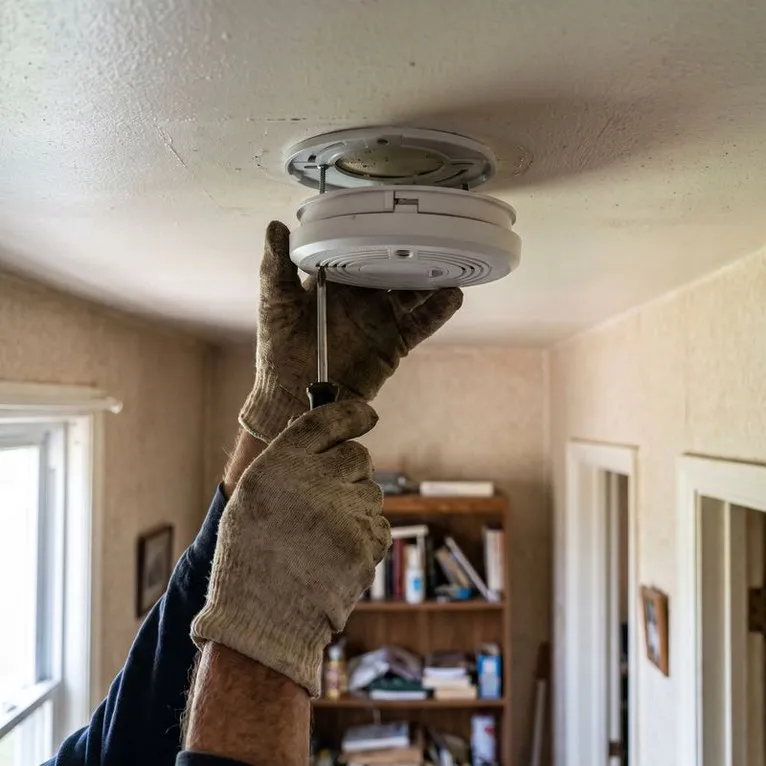
Most battery alarms twist onto a mounting plate held by two screws. Mark the spot, drill pilot holes, screw the plate to the ceiling, then twist the alarm on and press the test button.
Hardwired alarms are different. They connect to your home's 120-volt wiring, so adding new ones or moving existing ones is a job for a licensed electrician. Swapping a hardwired alarm for the same brand's replacement is often plug-in, but turn off the circuit and follow the manufacturer's instructions, or call the electrician if you are unsure. A wireless interconnected battery system avoids the wiring question entirely.
Use a stable ladder or step stool. The book's ladder rule is three points of contact, and don't do it alone. Someone standing below can hand up tools and steady the ladder.
Then keep the system alive:
- Test every alarm monthly with the button, as both the USFA and the Handbook advise.
- Replace batteries at least once a year in alarms that use replaceable ones, per the USFA.
- Replace the whole alarm every 10 years, or at the date stamped on it. Our guide to how long smoke detectors last explains how to read the date.
The last step of Project 52 is a household briefing: everyone learns the sound, and smoke means out by the practiced routes, with a meeting place outside. Keep a mounted extinguisher for small fires, as covered in our guides to the best fire extinguisher for home use and how to use a fire extinguisher, but the alarm's job is to get people out. If you use any fuel-burning heat in winter, read carbon monoxide poisoning symptoms as well.
Frequently asked questions
Where should smoke detectors be placed in a house?
Inside each bedroom, outside each sleeping area and on every level, including the basement, per USFA and NFPA guidance. In the basement, put one on the ceiling at the bottom of the stairs. Mount them on the ceiling or no more than 12 inches below it on a wall.
How far should a smoke detector be from the kitchen?
NFPA guidance says at least 10 feet from a cooking appliance, to cut down on false alarms. If an alarm near the kitchen still sounds every time you cook, move it farther away instead of removing the battery.
How many smoke detectors do I need?
One in every bedroom, one outside each sleeping area and at least one on every level. A two-story house with three bedrooms upstairs and a basement needs at least six. Interconnected alarms are best, so that when one sounds, they all do.
Should smoke detectors be on the wall or the ceiling?
Either works if placed correctly. On a wall, the top of the alarm should be no more than 12 inches below the ceiling. On a pitched ceiling, mount it within 3 feet of the peak but at least 4 inches down from the very top.
Sources
- The Off-Grid Handbook, Garrett Dalton, Project 52
- U.S. Fire Administration: Smoke Alarms
- City of Seabrook, Texas: Smoke Alarms (NFPA installation guidance)
- NFPA: Installing and Maintaining Smoke Alarms
- NFPA: Home Fire Escape Planning
- CDC: Carbon Monoxide Poisoning Basics
Safety guidance changes. Check the agency pages above for the current version, and follow your local code and manufacturer instructions.