Outdoor faucet cover: how to winterize a hose bib before the first hard freeze
Outdoor faucets are among the first pipes to freeze. The cover is the easy part. What happens inside the wall before you put it on matters more.
In this article
An outdoor faucet cover is an insulated cap that fits over a hose bib and holds a little of the house's warmth around it. It helps, but it works best as the last step: first remove and drain the hose, close the indoor valve that feeds the faucet, and open the outdoor faucet so the line can drain. Then put the cover on. Do all of it before the first hard freeze.
Those steps come from the American Red Cross, and The Off-Grid Handbook includes faucet covers for outdoor bibs in the materials list of Project 59, its pipe freeze protection project. Outdoor hose bibs are on the Red Cross list of the pipes that freeze most often.
How to winterize an outdoor faucet, step by step
- Disconnect the hose. The Red Cross says to remove, drain and store hoses used outdoors. Take off splitters, timers and quick-connects too.
- Find the indoor shutoff valve for that faucet. It is usually on the pipe just inside the wall, in the basement, crawl space or a utility room, close to where the faucet comes through.
- Close the indoor valve. Turn the handle clockwise until it stops.
- Open the outdoor faucet and let the water run out. The Red Cross says to keep it open so any water left in the pipe can expand without breaking it.
- Drain the cap on the indoor valve, if it has one. Many of these valves, called stop-and-waste valves, have a small drain cap on the side. Hold a cup under it and loosen it to let the trapped water out, then snug it back.
- Fit the outdoor faucet cover. Texas A&M AgriLife Extension recommends covering hose bibs with insulated covers.
The Handbook's water-system project, Project 12, uses the same idea for rain barrels and spigots: open spigots and low points so trapped water can't expand against the fittings. As its field note puts it, ice needs somewhere to go.
Choosing and fitting an outdoor faucet cover
Hardware stores sell a few types, all inexpensive:
| Type | How it attaches | Good to know |
|---|---|---|
| Hard foam dome | A cord loop goes over the faucet and a screw or lever pulls the dome tight to the wall | Common and reusable. The foam gasket must sit flat against the siding |
| Soft insulated sock | A fabric pouch with a drawstring or hook-and-loop strap | Fits odd shapes. Must stay dry to insulate |
| Hard shell with foam liner | Fastens with a strap or clips | Tougher against snow and lawn equipment |
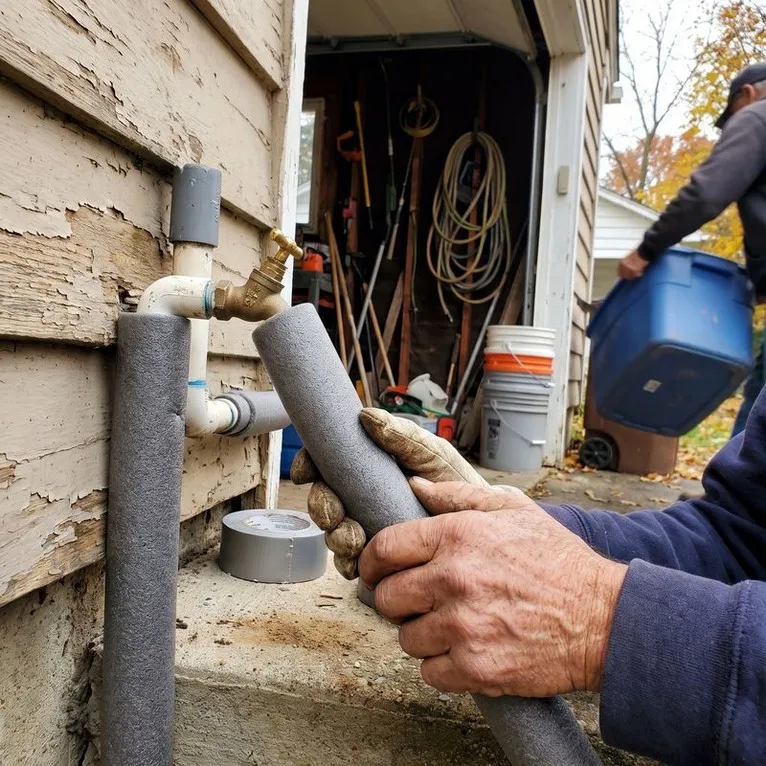
Whatever the type, the seal against the wall is what matters. On rough siding, a dome can sit crooked and let wind in. Press it flat, tighten it, and check it after the first storm. If the pipe runs along the outside wall before it reaches the faucet, sleeve that pipe with foam insulation too, as the Handbook does with every exposed run.
Hose bib freeze protection: frost-free faucets
Many newer homes have frost-free hose bibs, also called frost-proof sillcocks. They have a long stem, so the valve actually closes deep inside the heated wall, and the pipe toward the outside drains each time you shut it off.
The International Code Council notes that the plumbing code requires the water supply to hose bibs subject to freezing to have an accessible stop-and-waste valve inside the building, so the water can be shut off and drained in cold weather, with an exception for frost-proof hose bibs installed so the stem extends into heated space.
Frost-free does not mean hose-on. A hose, splitter or timer left attached can hold water in the faucet so it can't drain. New Mexico State University Extension recommends disconnecting hoses from outdoor faucets in winter for exactly this reason. A cover on a frost-free bib is a good extra layer, but disconnect the hose first.
How to tell which kind you have
- A frost-free bib usually sticks straight out of the wall from a flat flange, and the handle sits at the end of a long body.
- A standard bib often screws onto a pipe that comes right through the wall, with a separate shutoff valve indoors.
- If you are not sure, treat it as standard and do all six steps.
When to put the cover on
Do it in fall, before the first hard freeze, not the night of the storm. Texas A&M AgriLife Extension notes that water pipes can freeze and burst when the outdoor temperature reaches 20°F or below. The National Weather Service's freeze and hard freeze warnings are a good signal that the time has come, and our guide to what temperature pipes freeze explains the numbers.
The Handbook adds a habit worth keeping: write the dates in your household binder, freeze-down in fall and recommission in spring. Do the outdoor faucets at the same time as the rain barrels, which have their own steps in our guide on how to winterize a rain barrel.
If there is no indoor shutoff
Some older homes have none. In that case, disconnect the hose, fit a good cover, insulate any exposed pipe, and ask a plumber about adding a shutoff or a frost-free bib. Project 59 recommends a plumber visit now for any stiff valve, rather than during a freeze.
If an outdoor faucet freezes anyway
Signs include no water or only a trickle when you open the faucet, frost on the pipe, or a bulge or crack. When it thaws, a split pipe inside the wall can leak into the basement or crawl space, so watch that area.
- Know where your main water shutoff is. Project 59 calls rehearsing it the single highest-leverage step in the project.
- Keep the faucet open while you thaw it, as the Red Cross advises, so melting water can flow.
- Use gentle heat, such as towels soaked in hot water. The Red Cross says never to use a blowtorch, kerosene or propane heater, charcoal stove or any open flame.
- Call a licensed plumber if you can't find the frozen spot, can't reach it, or it won't thaw.
The rest of the plumbing needs protecting too when the heat goes off. Our guide to keeping pipes from freezing in a power outage covers dripping faucets, opening cabinet doors and draining the house if the outage lasts. If you live in a mild-winter state, the faucets are part of Texas winter storm preparedness as well.
Frequently asked questions
Do outdoor faucet covers really work?
They help, especially as the last step. A cover holds some of the house's warmth around the faucet. It works best after you remove the hose, close the indoor valve that feeds the faucet and open the outdoor faucet to drain it, as the American Red Cross advises.
Do I need to cover a frost-free outdoor faucet?
It is a good extra layer, but the important step is disconnecting the hose. A hose or splitter left on can trap water in the faucet so it can't drain. New Mexico State University Extension recommends disconnecting hoses from outdoor faucets in winter.
When should I put covers on my outdoor faucets?
In fall, before the first hard freeze. Texas A&M AgriLife Extension notes that water pipes can freeze and burst when the outdoor temperature reaches 20°F or below. Do it at the same time you winterize hoses and rain barrels.
Should I leave my outdoor faucet open in winter?
Yes, after closing the indoor valve that feeds it. The American Red Cross says to keep the outside valve open so any water remaining in the pipe can expand without breaking it. If there is no indoor shutoff, ask a plumber about adding one.
Sources
- The Off-Grid Handbook, Garrett Dalton, Project 59
- American Red Cross: Frozen Pipes
- Texas A&M AgriLife Extension: Winter Storms, Preventing and Thawing Frozen Pipes (PDF)
- International Code Council: Build It to Code to Minimize Damage from Frozen Water Pipes
- New Mexico State University Extension, Southwest Yard and Garden: Disconnect Water Hose in Winter?
- National Weather Service: Before Winter Storms
Safety guidance changes. Check the agency pages above for the current version, and follow your local code and manufacturer instructions.