Fire blanket vs fire extinguisher: what to keep by the stove, and what comes first
For a pan fire, the best first tool is still a lid. Here is where blankets and extinguishers fit after that.
In this article
Fire blanket vs fire extinguisher: for a small pan fire, the first tool safety agencies recommend is neither one. It is a lid or baking sheet slid over the pan, with the burner turned off. After that, a listed fire extinguisher is the proven backup. Fire blankets can smother a small fire, but NFPA, the National Fire Protection Association, says no fire blankets on the market have been listed to existing safety standards, and it does not recommend buying unlisted products.
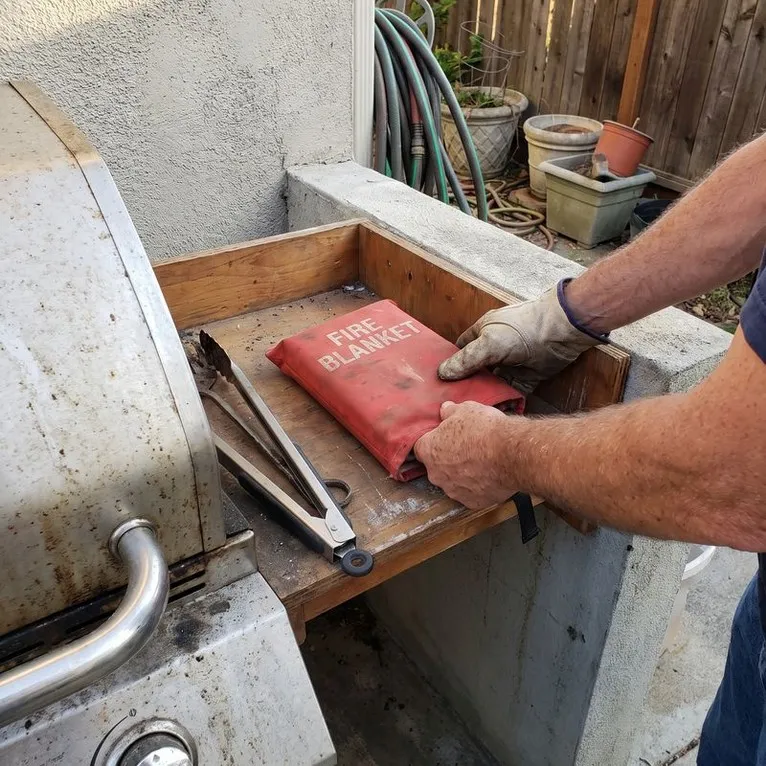
The Off-Grid Handbook's Project 51 keeps a fire blanket beside the outdoor cooking station, because smothering beats spraying on grease. That principle holds. On the blanket itself, this guide follows NFPA's current position and puts the lid first.
Fire blanket vs fire extinguisher at a glance
| Pan lid or baking sheet | Fire blanket | ABC extinguisher | |
|---|---|---|---|
| How it works | Cuts off air | Cuts off air | Dry chemical breaks the fire |
| Best use | A pan fire on a stove or burner | A small fire you can cover completely | Small ordinary, liquid and electrical fires |
| Safety listing | Not needed | None listed yet, per NFPA | Buy one listed by a testing lab |
| Reach | Arm's length | Arm's length | NFPA: 6 to 8 feet back on a grease fire |
| Mess | None | Little | Powder everywhere |
The Handbook's station uses two or three ABC-rated extinguishers for the kitchen, the warm room and the garage or utility area, plus the blanket. A whole kit costs about $80 and takes 30 minutes to mount, per the book.
Fire blanket for a grease fire, or a lid?
A grease fire is burning oil or fat in a pan. NFPA's steps for a small one are short:
- Slide a lid over the pan to smother the flames.
- Turn off the burner.
- Don't move the pan. Carrying it spills burning oil.
- Leave the lid on until the pan has cooled, so the fire can't restart.
The U.S. Fire Administration adds that a baking sheet works if the lid isn't handy. A metal lid is safer than glass, which a Lincoln County, North Carolina fire safety sheet warns can shatter. And never pour water on a grease fire: NFPA and the Consumer Product Safety Commission (CPSC) are both clear on that, and CPSC adds flour to the list.
For an oven fire, NFPA says turn off the heat and keep the door closed until it is cool.
A fire blanket does the same job as a lid, smothering, but it is floppier, you must get close to lay it down, and it has to cover the pan completely.
Do fire blankets work? What the safety groups say
Sometimes, and that is the problem. In July 2026, CPSC staff met with an independent working group drafting a proposal for voluntary standard requirements for residential fire blankets. The incident reports the group reviewed included many successes on small kitchen and appliance fires, but also failed attempts on an oven fire and a furniture fire, several blankets that shed fiberglass and irritated skin, and one that ignited while being used on a cooking fire.
Until a standard exists and products are listed to it, NFPA's advice stands: don't buy unlisted fire safety products. If you already own a fire blanket, treat it as a backup to the lid, never a replacement for the extinguisher, and check whether newer ones carry a listing before you replace it. More on choosing extinguishers in best fire extinguisher for home.
Where an extinguisher fits
An ABC multipurpose extinguisher covers ordinary combustibles, flammable liquids and electrical fires, which is why the Handbook stages them at exits and the cooking area. Its rules:
- Mount, don't shelve: on brackets at exits and the cooking area, visible, at adult chest height.
- Teach PASS: Pull, Aim at the base, Squeeze, Sweep, to every adult and capable teen. Our guide to how to use a fire extinguisher walks through it.
- The size rule: extinguishers are for fires smaller than you. Anything bigger means everyone out and call the fire service.
- Check gauges quarterly, and after any use, however brief, service or replace it.
On grease, NFPA adds two cautions. Only Class K extinguishers are rated for grease and animal fat fires, and they should be used by trained adults. And never use an extinguisher on a grease fire unless you are at least 6 to 8 feet away, because the blast can splash burning oil. Cover the pan and shut off the heat instead.
Setting up the outdoor cooking station
In an outage, cooking often moves outside to a grill, camp stove or rocket stove. Those stay outdoors, never in a garage or under the eaves, as grilling in the garage explains. Stock the station like this:
- A metal lid that fits your largest pan, and a baking sheet
- An ABC extinguisher within reach but not right beside the flame
- Long tongs and oven mitts
- A fire blanket, if you keep one, as a third line, not the first
The station's layout is in our guide to the outdoor cooking station, and fuel planning in how to cook without electricity.
If clothing catches fire
A burning sleeve is a different emergency, and the answer is not an extinguisher. NFPA's advice is stop, drop and roll: stop where you are, drop to the ground, cover your face with your hands, and roll until the flames are out. For anyone who can't drop and roll, NFPA suggests keeping a blanket or towel nearby to cover yourself and smother the flames.
Then cool the burn in cool water for 3 to 5 minutes and cover it with a clean, dry cloth, NFPA says, with no creams, ointments or sprays, and call 911 for medical help.
When to stop and get out
The Handbook's size rule is the one to remember: the house is not the priority. NFPA says the same in four words, when in doubt, get out. Close the door behind you to slow the fire, and call 911 from outside. NFPA also says that if one extinguisher doesn't put the fire out, leave immediately and don't go back in.
After any fire, even a small one, replace or service the extinguisher, as the Handbook requires, and have an oven that caught fire checked by a professional before you use it again, per NFPA. Make sure your smoke alarms work; see where to put smoke detectors.
Frequently asked questions
Is a fire blanket better than a fire extinguisher?
Not as a replacement. NFPA says no fire blankets on the market have been listed to existing safety standards and does not recommend buying unlisted products. For a pan fire, slide a lid over it and turn off the burner. Keep a listed extinguisher as the backup.
Do fire blankets work on grease fires?
They can smother a small one, the same way a lid does, but results vary and you must get close. A CPSC-attended working group reviewing fire blanket incidents in 2026 found successes, failed attempts and fiberglass shedding. A metal lid is the first choice.
What extinguisher works on a grease fire?
NFPA says only Class K extinguishers are rated for grease and animal fat fires, and they should be used by trained adults. Never use any extinguisher on a grease fire closer than 6 to 8 feet. The first step is to cover the pan and turn off the heat.
Can you put water on a grease fire?
No. NFPA and CPSC both say never pour water on a grease fire, and CPSC adds flour. Water can make burning oil splash and spread. Slide a lid or baking sheet over the pan, turn off the burner and leave the cover on until the pan is cool.
Sources
- The Off-Grid Handbook, Garrett Dalton, Project 51
- NFPA: Educational Messages Desk Reference, 2026 Edition (PDF)
- CPSC: Meeting Log, Independent Fire Blanket Working Group, July 29, 2026 (PDF)
- CPSC: Recipe for Safer Cooking
- U.S. Fire Administration: Cooking Fire Safety
- Lincoln County, N.C.: How to Put Out a Grease Fire (PDF)
Safety guidance changes. Check the agency pages above for the current version, and follow your local code and manufacturer instructions.