Hurricane preparedness checklist: what to do at the start of the season, at the watch and at the warning
Most of hurricane preparation is done in calm weather. By the time a storm has a name, the checklist should be down to a few hours of closing up.
In this article
A hurricane preparedness checklist comes down to five jobs: know your evacuation zone and route, store water and food for several days, keep medications and documents ready to grab, close up the house, and plan for the power outage that follows. Ready.gov warns that you may not have access to supplies for days or even weeks after a hurricane, so the heavy work belongs at the start of the season, not after a watch is issued.
This guide splits the list into three stages, so each task lands when it is still easy to do.
When to use this hurricane preparedness checklist
NOAA's Atlantic hurricane season runs June 1 to November 30, and the eastern Pacific season starts earlier, on May 15. Two National Weather Service alerts set the clock once a storm forms:
| Alert | What it means (NWS) | What you do |
|---|---|---|
| Hurricane Watch | Hurricane conditions, sustained winds of 74 mph or more, are possible in your area, usually within 48 hours | Top up supplies and fuel, charge everything, get the window panels out |
| Hurricane Warning | Hurricane conditions are expected in the area, usually within 36 hours | Finish closing up, then shelter or leave as officials direct |
| Storm Surge Warning | Danger of life-threatening flooding from rising water moving inland from the shoreline | Follow evacuation orders at once |
Hurricanes are not only a coastal problem. Ready.gov notes that rain, wind, flooding and even tornadoes can reach far inland from where a storm makes landfall.
Start of season: know your zone and your way out
Ready.gov says that historically, storm surge has been the leading cause of hurricane-related deaths in the United States. No supply list matters more than knowing whether your home sits in an evacuation zone.
- Look up your zone on your county or state emergency management website, and learn the official routes.
- Pick where you would go: a friend or relative inland, a motel, or a shelter. Note which ones accept pets.
- Sign up for local alerts and keep a battery or hand-crank radio. Wireless Emergency Alerts need no sign-up.
- If officials order you to leave, leave. Plywood protects a house, not the people inside it. Our evacuation checklist covers the leaving itself.
Hurricane supply list: water, food and the basics
Water comes first. Project 5 of The Off-Grid Handbook uses the FEMA baseline of 1 gallon per person per day and turns it into a table: a household of two needs 6 gallons for three days or 28 gallons for two weeks, and a household of four needs 12 or 56. Add more for pets, hot weather and anyone pregnant or ill. Hurricane season is hot, so aim high. Our guide to how much water per person per day has the full math.
The rest of the hurricane supply list follows Ready.gov's basic kit:
- Non-perishable food for at least several days, and a manual can opener
- Flashlights for every person, extra batteries, and a battery or hand-crank radio
- First aid kit, a whistle, dust masks, plastic sheeting and duct tape
- Moist towelettes, garbage bags and ties for sanitation
- Phone chargers and a backup battery
- Soap, hand sanitizer and disinfecting wipes
- Pet food and extra water
The Handbook's Project 68 gathers all of this into one 72-hour kit in about two hours, mostly by consolidating what the house already has. The full list is in our 72-hour kit checklist. Fill extra containers or a bathtub water bladder when a watch is issued, for flushing and washing.
Hurricane prep list for the house
Ready.gov's home list is short: clear drains and gutters, bring in outdoor furniture, and consider hurricane shutters. FEMA adds anything the wind can throw: trash cans, grills, planters, tools and children's play sets.
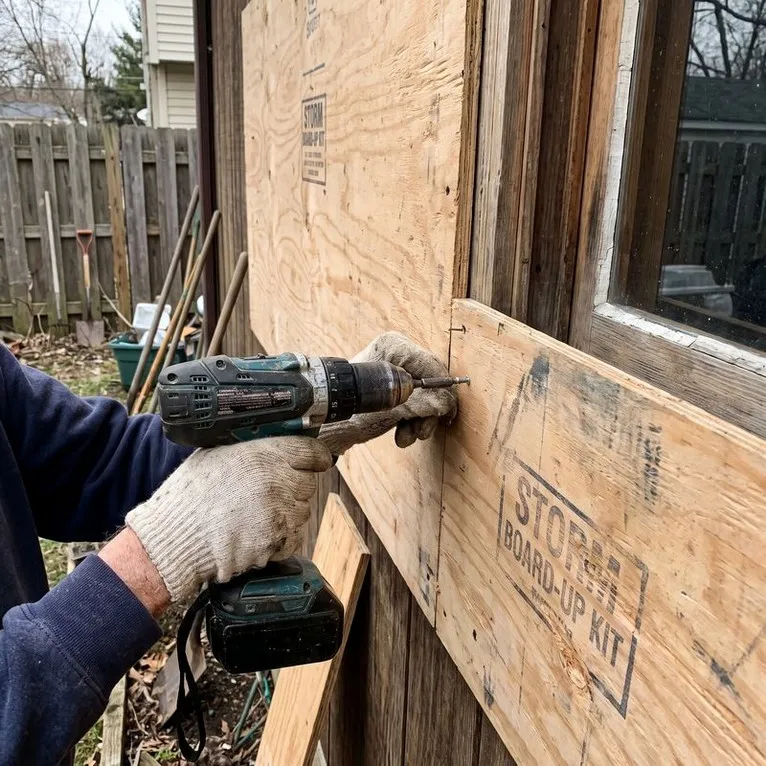
Windows are the big job, and the Handbook's Project 58 makes it a small one. Its storm board-up kit is 5/8-inch exterior plywood cut to each exposed window, labeled, pre-drilled, and stored flat with the hardware bagged and taped to panel one. The book prices it at about $50 in hardware, plus the plywood, and two hours of work. Its standard is the whole kit up in under an hour. The book's field note explains the timing: plywood costs the same in July as in the 48 hours before a named storm, but only one of those weeks has any left. Step-by-step instructions are in how to board up windows for a hurricane, and the choice between panels and permanent shutters is in hurricane shutters vs plywood.
Skip the tape. NOAA's hurricane researchers say taping windows does little or nothing to prevent breakage.
Medications, documents and cash
- Medications. Ready.gov lists medication in the go bag. Ask your pharmacist about refilling early when a storm is forecast, and keep a written list of every prescription and dose.
- Documents. Make copies of IDs and insurance policies and keep them in a waterproof pouch, with a digital copy in a secure place. Our emergency binder checklist shows what goes in.
- Cash in small bills. Card readers and ATMs stop working when the power does.
- Power-dependent medical equipment. Ready.gov advises talking with your medical provider now about a plan for devices and refrigerated medicines.
The outage after the storm
A hurricane usually leaves a power outage behind it. The rules for that stretch are fixed:
- Generators run outdoors only, at least 20 feet from the house, never in a garage, even with the door open, and away from windows, doors and vents. The CDC and Ready.gov apply the same rule to camp stoves and grills. See why the garage is never safe.
- Carbon monoxide alarms with battery backup belong on every level. Headache, dizziness, weakness, upset stomach, vomiting, chest pain or confusion while fuel is burning means everyone outside to fresh air, then call 911.
- Keep the fridge and freezer shut. Ready.gov gives about 4 hours for a closed refrigerator and about 48 hours for a full freezer.
When the wind drops, what to do after a hurricane covers water, cleanup and insurance photos.
Put the season on the calendar
Project 72 of the Handbook sets a yearly calendar so storm work happens when it is merely a chore. Its spring block includes a storm-kit check ahead of severe-weather season, and its summer block adds hurricane-season readiness where it applies. A simple version:
- May: check the board-up kit, rotate stored water, review the evacuation plan and refill prescriptions.
- At a watch: fill the car's tank, charge phones and power banks, bring in yard items, stage the panels.
- At a warning: panels up, kit by the door, phones on, and leave if you are told to.
Frequently asked questions
What should be on a hurricane preparedness checklist?
Your evacuation zone and route, water at 1 gallon per person per day for several days, non-perishable food, flashlights and a radio, a first aid kit, medications, copies of documents, cash, phone chargers, pet supplies, window protection, and a safe plan for the power outage afterward.
How far in advance should you prepare for a hurricane?
Before the season starts. NOAA's Atlantic season runs June 1 to November 30. A hurricane watch usually comes about 48 hours before hurricane conditions are possible and a warning about 36 hours before they are expected, which leaves little time for shopping.
How much water do you need for a hurricane?
The baseline is 1 gallon per person per day. The Handbook's table gives 12 gallons for a household of four for three days and 56 gallons for two weeks. Ready.gov notes supplies may be hard to get for days or weeks after a hurricane, so store more in hot weather and for pets.
Should you tape windows for a hurricane?
No. NOAA's hurricane researchers say tape does little or nothing to prevent breakage. Use fitted plywood panels or tested storm shutters, and stay away from windows while the storm passes.
Sources
- The Off-Grid Handbook, Garrett Dalton, Project 58
- Ready.gov: Hurricanes
- National Weather Service: Hurricane Watches and Warnings
- NOAA: Tropical Cyclone Climatology
- Ready.gov: Build a Kit
- Ready.gov: Power Outages
- CDC: Safety Guidelines After a Hurricane or Other Tropical Storm
Safety guidance changes. Check the agency pages above for the current version, and follow your local code and manufacturer instructions.