Evacuation checklist: what to take, what to do to the house, and how to leave
An evacuation is decided in minutes but prepared over months. A list written on a calm day does the thinking for you when the order comes.
In this article
An evacuation checklist has three parts: what to take (people, pets, medications, documents, water, food, cash and phone chargers), what to do to the house (lock doors and windows, unplug small appliances, leave a note, and shut off utilities only if told to), and how to leave (early, by the official route, with a full tank). If local officials order you to evacuate, Ready.gov says to do so immediately.
The Off-Grid Handbook treats staying home as the default and leaving as a planned exception. That is why the plan for leaving gets written down in advance.
When to leave
- Mandatory order: go right away. Ready.gov says to follow the instructions of local officials.
- Voluntary order, or a storm surge warning for your zone: leaving early is safer than leaving late. Ready.gov advises leaving early enough to avoid being trapped by severe weather.
- Anyone in the house depends on power for oxygen, dialysis or other medical equipment: talk with your medical provider now about when you should leave.
Keep a battery or hand-crank radio on for instructions. Our guide to bug in vs bug out explains when staying put is the better choice.
If you need help to evacuate
Ready.gov asks every household to identify early whether anyone will need extra help in an emergency, such as a person with a disability, limited mobility, or no car. Many counties keep a registry for residents who need help evacuating. Ask your local emergency management office whether yours does, and how transport works. Tell a neighbor or relative too, so someone knows to check on you when an order comes.
What to take when evacuating
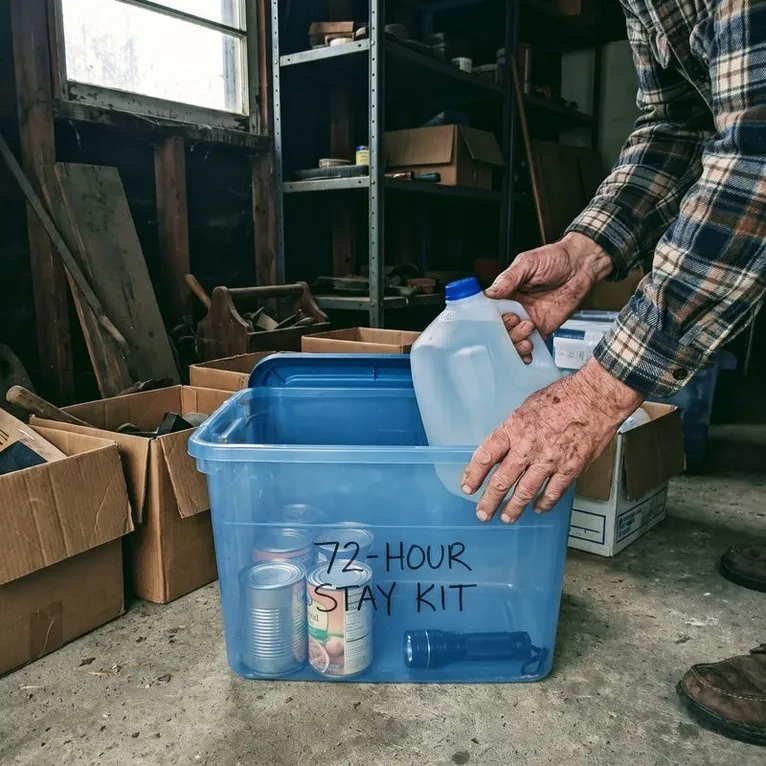
Project 68 of the Handbook builds a 72-hour stay kit in two clear tubs, then adds a duffel rule: the subset that goes if the household must leave is listed in advance, on the tub lid. The book's list is short: documents, medications, water, food bars, warmth and cash. Expanded with Ready.gov's kit list:
| Category | What to pack |
|---|---|
| Medications | Every prescription, a written list of medicines and doses, spare glasses, hearing aid batteries |
| Documents | IDs, insurance policies, deeds or lease, bank and policy numbers, medical records |
| Water and food | Water for the car ride, food bars and snacks that need no cooking |
| Power and light | Phone chargers, a power bank, a flashlight, a battery radio |
| Money | Cash in small bills; card readers may be down |
| Warmth and clothing | A blanket per person, a change of clothes, sturdy shoes |
| Comfort | A book or game for children, a small comfort item |
The documents are the fastest part if you built the Handbook's Project 64 go-binder. The book describes it as the working copy that leaves the house in ninety seconds, with an encrypted USB copy kept elsewhere. See the emergency binder checklist. The full kit is in our 72-hour kit checklist.
If you have only 15 minutes
Grab in this order, and leave the rest:
- People and pets, with leashes and carriers
- Medications and glasses
- The document binder, phone and charger
- Water, food bars, cash and the duffel
Things can be replaced. Insurance exists for them, and the photo inventory in your binder will help with the claim.
Hurricane evacuation checklist for the house
If time allows, Ready.gov lists these steps before you go:
- Close and lock all doors and windows.
- Unplug radios, televisions and small appliances.
- Leave the refrigerator and freezer plugged in unless there is a risk of flooding.
- Shut off water, gas and electricity only if your home is damaged and officials instruct you to. Ready.gov notes that once gas is turned off, only a qualified professional can turn it back on.
- Leave a note saying when you left and where you are going.
- Call your out-of-area contact and tell them your plan. See the family emergency communication plan.
- Dress for the trip: sturdy shoes, long pants, long sleeves and a hat.
For a hurricane, put the window panels up first if there is time and it is still calm. Your hurricane preparedness checklist covers the house in more detail.
Pets
Ready.gov says to take your pets with you, but most public shelters allow only service animals. Plan where they will stay now. The Handbook's Project 74 adds three habits:
- A pet module in the kit: food, water, medications, a leash or carrier, vaccination copies, and a photo of each animal with the family as proof of ownership if you are separated.
- Carrier discipline: every animal that might travel has a carrier it already tolerates, practiced once a year.
- A written fallback list in the binder: a kennel, a relative, a pet-friendly motel.
More in pet emergency preparedness.
Fuel, route and destination
- Keep a half tank of gas at all times, and fill up if an evacuation seems likely. Ready.gov notes gas stations may be closed and unable to pump during power outages.
- Choose several destinations in different directions, such as a friend's home in another town or a motel.
- Take one car per family to reduce congestion.
- Follow the recommended routes and don't take shortcuts, which may be blocked.
- Never drive into flooded roads. One foot of moving water can sweep a vehicle away.
- Check on neighbors who may need a ride. If you have no car, plan now with family, friends or your local emergency management office.
Practice the load-out once a year
A list nobody has tried is a guess. The Handbook's Project 71 rotates an evacuation load-out through its quarterly drills: everyone fetches their part, the duffel and pets go to the car, and someone writes down the time. Expect it to be slow the first time and faster every time after. Our guide to the power outage drill shows how to run it.
Coming home
Ready.gov says to check with officials both where you are staying and back home before you travel, because returning before storm debris is cleared is dangerous. Charge devices, fill the tank, bring water and food for the drive, and avoid downed power lines. Once home, follow what to do after a hurricane, and never run a generator inside a home or garage.
Frequently asked questions
What should you take when you evacuate?
Medications and a written list of them, copies of IDs and insurance documents, water and snacks, phone chargers and a power bank, cash in small bills, a flashlight and radio, a change of clothes, sturdy shoes, and everything your pets need. Keep the list on the lid of your kit.
Should you turn off utilities before evacuating?
Only if your home is damaged and officials tell you to, according to Ready.gov. Unplug small appliances and leave the refrigerator and freezer plugged in unless flooding is likely. Once gas is turned off, only a qualified professional can turn it back on.
Can you take pets to an evacuation shelter?
Often not. Ready.gov says most public shelters allow only service animals. Take your pets with you, and plan a pet-friendly place in advance: a relative, a kennel or a motel that accepts animals.
How much gas should you keep in the car for an evacuation?
Ready.gov advises keeping at least a half tank at all times and filling up when an evacuation seems likely, because stations may close or be unable to pump during power outages.
Sources
- The Off-Grid Handbook, Garrett Dalton, Project 68
- Ready.gov: Evacuation
- Ready.gov: Build a Kit
- Ready.gov: Hurricanes
- Ready.gov: Safety Skills (shutting off utilities)
- Ready.gov: Pets
Safety guidance changes. Check the agency pages above for the current version, and follow your local code and manufacturer instructions.