Bug in vs bug out: when to stay home, when to leave, and one kit for both
Staying and leaving are not rival philosophies. Each one fits certain conditions, and the household that decides those conditions in advance doesn't have to argue in the moment.
In this article
Bug in vs bug out comes down to one rule: for most emergencies, staying home is the stronger choice, because your water, food, heat and bed are already there. Leave when local officials order an evacuation, when the house itself becomes the danger (fire, rising water, a gas smell, a carbon monoxide alarm, serious damage), or when you can't keep everyone safe there. The decision follows the conditions, not a preference.
This guide explains both terms, the situations that call for each, and the single kit The Off-Grid Handbook builds to cover both.
What bug in and bug out mean
Bugging in means staying home with your own supplies through an outage, a storm or a disruption. Bugging out means leaving for a planned destination: a relative's house, a hotel, a shelter. Emergency agencies use plainer words for the same choice, shelter in place or evacuate.
Ready.gov notes that there may be situations when it's best to stay where you are and avoid the uncertainty outside. "Shelter in place" also has a narrower meaning: sealing one room against contaminated outdoor air when officials say so. That is its own skill, covered in our guide to the shelter in place kit.
Why the Handbook defaults to bugging in
The introduction to Chapter 5, Readiness, states the book's doctrine directly: bug-in, not bug-out. For the overwhelming majority of realistic events, the prepared household's strongest position is its own home, with its water, food, heat and power systems around it. Evacuation is a planned exception, not the default.
Think about what leaving costs. On the road you have only what fits in the car, nearby hotels can fill quickly, and Ready.gov points out that only service animals may be allowed in public shelters. At home you have the pantry, the warm room, the stored water and your own bed. For a three-day ice storm or a power outage, home wins.
The chapter also says what it is not about: security means locks, light and a plan, not weapons or fieldcraft.
Bug in vs bug out: the deciding conditions
Shelter in place vs evacuate is easier to decide on a calm evening than in a storm. Write these down before you need them, so the choice is already made:
| Situation | Stay or go? |
|---|---|
| Power outage or winter storm, home intact, heat and water plan in place | Stay |
| Local officials order an evacuation for your area | Go, and go early |
| Hurricane coming and you live in an evacuation zone | Follow the zone orders |
| CO alarm sounds, or anyone has headache, dizziness or nausea while something burns | Everyone outside to fresh air, then call 911 |
| Gas smell, fire, structural damage, water rising toward the house | Get out |
| The house can't be kept safely warm, or a medical device has no backup power | Go to a place with power or a warming center |
Ready.gov is specific on the big ones. If you live in a mandatory evacuation zone and officials tell you to evacuate, do so immediately, and leave early enough to avoid being trapped by severe weather. If you leave by car, the National Weather Service warns that 12 inches of rushing water can carry away most cars, and it is never safe to drive or walk into flood water.
A CO alarm is the one case where you don't weigh anything. Get everyone out first, then call. Our page on carbon monoxide poisoning symptoms lists the signs. For cold, Ready.gov's advice is to go to a community location with power if heat or cold is extreme; our guide on how to stay warm without power helps you hold out safely until then.
Rule of thumb: official orders and danger inside the house decide it. Discomfort alone usually doesn't.
The bug in bag: one kit for both choices
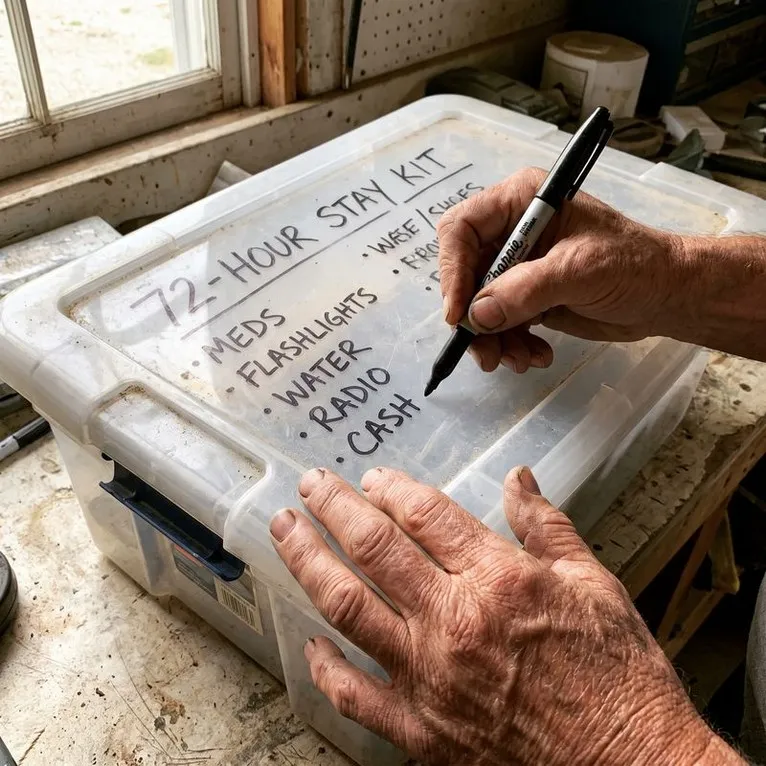
Project 68 of the Handbook builds what it calls the 72-Hour Stay Kit: the core that makes the first three days smooth at home, and doubles as the grab-load in the rare case leaving is right. It costs about $100, mostly consolidation of things you already have, and takes about two hours.
The kit lives in two clear, labeled tubs in the closet of the room you'd shelter in. It holds 3 gallons of water per person, three days of no-cook food, spare lighting, a radio or power bank, a first aid kit, blankets, hygiene basics, small-bill cash and the comfort layer people forget: a medication margin, spare glasses, children's items and the pets' three-day set.
Step 3 is what makes it a bug-in bag and a bug-out bag at once. The book calls it the duffel rule: decide now which subset goes with you if the household must relocate (documents, medications, water, food bars, warmth, cash) and write that list on the tub lid. Nobody has to think about it when the order comes. The full contents are in our 72-hour kit checklist, and the electrical side of staying put is in our power outage kit list.
Plan the exit you hope not to use
Bugging in by default doesn't mean leaving unplanned. Ready.gov's evacuation basics:
- Know where you'd go. Pick several places, such as a friend's or relative's home in another town.
- Keep the car ready. At least half a tank of gas at all times, and a full tank when an evacuation seems likely.
- Plan for the pets. Take them with you, and know that public shelters may admit only service animals. See pet emergency preparedness.
- Arrange help early. Anyone who can't drive or needs help moving should have a ride agreed in advance. Our guide to emergency preparedness for seniors covers this.
The Handbook's quarterly drill, Project 71, rotates an evacuation load-out through the year as one of its annual specials: a practice run of loading the duffel subset. It is the cheapest way to find out the list on the lid is missing the glasses.
Decide before the emergency, not during it
The households that handle these choices well are the ones that settled them at the kitchen table on a quiet evening. Write your "go" conditions on your first-hour card, name who drives and who carries the duffel, and choose an out-of-area contact everyone calls if you're separated. Our family emergency communication plan template keeps that on one page.
Then, when the radio says the storm is coming, the question isn't "should we leave?" It's "does this match one of our go conditions?" Most of the time, it won't, and you'll stay home with everything you need.
Frequently asked questions
Is it better to bug in or bug out?
For most emergencies, bugging in is better: your water, food, heat and bed are at home, and roads, hotels and shelters fill up fast. Leave when officials order an evacuation, when the home itself becomes dangerous, or when you can't keep everyone safe and warm there.
What is a bug in bag?
A bug in bag, or stay kit, holds the supplies for the first three days at home in one known place: water, no-cook food, lights, a radio, first aid, blankets, medications and cash. The Off-Grid Handbook's version lists on the lid the smaller set that goes with you if you must leave.
When should you evacuate instead of sheltering in place?
When local officials order an evacuation for your area, especially in a hurricane evacuation zone, and whenever the house itself is the danger: fire, gas smell, flood water rising, serious damage. If a CO alarm sounds, get everyone outside first, then call 911.
Should I leave home during a power outage?
Usually not, if the home is safe and you have water, light and a way to stay warm. Ready.gov advises going to a community location with power when heat or cold is extreme, and anyone with a medical device that needs power should have a backup plan in advance.
Sources
- The Off-Grid Handbook, Garrett Dalton, Chapter 5 intro
- Ready.gov: Evacuation
- Ready.gov: Shelter
- Ready.gov: Hurricanes
- Ready.gov: Power Outages
- National Weather Service: Turn Around Don't Drown
Safety guidance changes. Check the agency pages above for the current version, and follow your local code and manufacturer instructions.