Emergency preparedness for seniors: a plan built around people, medicines and power
The supplies are the easy part. What carries an older adult through a long outage is a few people who will check in, and a plan for the things that can't wait.
In this article
Emergency preparedness for seniors rests on three things: a support network of people who will check in, a medicine and medical-device plan made with the doctor, and a backup for anything that needs electricity. Ready.gov's guidance for older adults starts with exactly that support network, and adds copies of Medicare, Medicaid and other insurance cards.
The Off-Grid Handbook covers the same ground across four Chapter 5 projects: the neighbor check (Project 67), the comfort layer of the 72-hour kit (Project 68), household roles (Project 62) and the document binder (Project 64). This guide pulls them together, whether you are planning for yourself or for a parent.
Emergency preparedness for seniors starts with people
Ready.gov's first step is to create a support network of family, friends and others who can help during an emergency, and to make sure at least one of them has a spare key and knows your plan. The Red Cross suggests including neighbors, caregivers and care providers, and meeting with them to talk about what help you may need.
The Handbook's Project 67 shows how to start that conversation without making it heavy. Its suggested line: "if the power went out a few days, we check on each other, here is our number." The book notes that most people are relieved someone asked.
The same project marks the check-first houses: elderly neighbors, people with disabilities, single parents and anyone who depends on a medical device. Those homes get the first neighbor check after the power goes out. If you are the older adult on your street, make sure someone has you on that list. Our neighborhood emergency plan walks through the map.
Medicines, glasses and the comfort layer
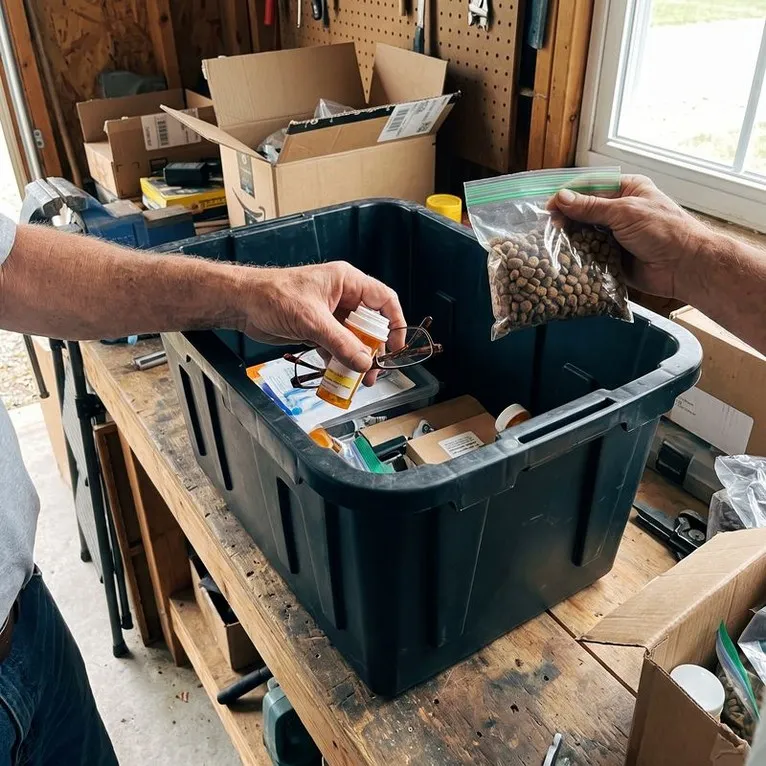
When the Handbook builds the 72-hour kit, step 2 of Project 68 adds what it calls the comfort layer people forget: a medications margin, spare glasses, children's items and the pet three-day set. For older adults, that comfort layer is often the most important part of the kit.
- Medicines. How much extra to keep is a decision for your doctor and pharmacist, not a website. The Handbook's first-aid project (Project 70) sets the margin together with the pharmacist and prescribers, and states plainly that nothing in the book is medical advice.
- Refrigerated medicines. Ready.gov says to talk to your medical provider about a power outage plan for refrigerated medicines.
- A written medicine list with names, doses, allergies and doctor contacts. That is the medical set in the Project 64 binder.
- Spare glasses, hearing aid batteries, chargers and any assistive items such as a cane.
Ready.gov adds a few steps that are easy to miss: set up direct deposit for benefits so a disruption in the mail doesn't hold up a check, keep a NOAA Weather Radio for alerts, and plan how you will communicate if hearing, speech or vision makes phone calls hard. A written card with key numbers, in large print, helps everyone.
Power outage checklist for seniors
An outage is the most common emergency, and it hits hardest when a household depends on power for health or warmth.
| Item | What to arrange |
|---|---|
| Power-dependent medical devices | A backup plan made with the provider (Ready.gov); batteries and chargers in the kit |
| Light | A flashlight for every person, kept by the bed; no candles |
| Carbon monoxide alarms | Battery backup, on every level of the home (Ready.gov) |
| Phone | A charged power bank and a written list of numbers |
| News | A battery or hand-crank radio |
| Food | Keep the fridge closed: about 4 hours cold, a full freezer about 48 (Ready.gov) |
| Warmth | One warm room, blankets, layers |
If someone uses a CPAP or oxygen concentrator, the backup plan deserves its own conversation with the provider. Our guide to a power station for CPAP covers the battery side. Many electric utilities also keep a list or program for customers who rely on medical equipment; call yours and ask what it offers.
An emergency plan for elderly parents
When a parent lives alone or far away, the plan has to work without you in the room. The Handbook's tools fit well:
- Roles (Project 62). Decide who calls Mom when the power goes out, and who is the deputy if that person can't. Every role has a deputy so the plan survives one absence.
- A neighbor who checks in (Project 67). The person next door can be there in minutes; you may be hours away.
- An out-of-area contact. Everyone reports to one person, who relays news. Our family communication plan guide sets this up.
- The binder (Project 64). Copies of IDs, insurance cards, the medicine list and doctor contacts in one grab-able binder. See the emergency binder checklist.
- Transportation. Ready.gov says to plan your transportation if you need help evacuating, and to plan for pets or service animals, since not all shelters accept pets.
Staying warm and safe without power
Older adults lose body heat faster, so winter outages need extra care. Our guide to keeping elderly people warm in winter covers the warm room, layers and nighttime warmth.
Two safety rules matter most. Never use a gas oven or stove to heat the house, and never bring a grill, camp stove or generator indoors or into a garage. Carbon monoxide symptoms look like the flu: headache, dizziness, weakness, nausea and confusion. If they appear, or a CO alarm sounds, get everyone outside to fresh air, then call 911. More in carbon monoxide poisoning symptoms.
Keep the kit ready and the plan current
The Handbook's Project 68 keeps the kit in two labeled, clear tubs in the shelter room closet, dates the perishables, and rotates them on the quarterly drill. One rule: it is never quietly raided for camping. The book's field note: the kit is 72 hours of not making decisions. The binder gets an annual refresh at tax season.
Start with what costs nothing: one call to a neighbor this week, and one appointment to ask the doctor about a medicine plan. Then add one piece of the kit each payday until the tubs are full. The full kit list is in our 72-hour kit checklist.
Frequently asked questions
How do seniors prepare for an emergency?
Build a support network of family, friends and neighbors who will check in, make a plan for medicines and medical devices with the doctor, keep copies of insurance cards and a medicine list, and stock a kit with flashlights, a radio, water, food and spare glasses.
How much medication should a senior keep for emergencies?
That is a question for the doctor and pharmacist, who can say what is possible for each prescription. The Off-Grid Handbook sets the margin together with prescribers, and Ready.gov advises a power outage plan for any refrigerated medicines.
What should be on a power outage checklist for seniors?
A backup plan for any power-dependent medical device, a flashlight for each person, battery-backed CO alarms on every level, a charged power bank, a battery or crank radio, a warm room with blankets, and a neighbor who will check in.
How can I help my elderly parent prepare for emergencies from far away?
Find a neighbor who will check on them first, decide who in the family calls and who is backup, set up an out-of-area contact, and help them build a binder with ID copies, insurance cards, a medicine list and doctor contacts.
Sources
- The Off-Grid Handbook, Garrett Dalton, Project 68
- Ready.gov: Older Adults
- Ready.gov: Power Outages
- American Red Cross: Disaster Preparedness for Older Adults
- Ready.gov: People with Disabilities
- CDC: Carbon Monoxide Poisoning Basics
Safety guidance changes. Check the agency pages above for the current version, and follow your local code and manufacturer instructions.