Can you drink rain water? What is in it and how to make it safe
Rain looks like the cleanest water there is. By the time it reaches a barrel, it has picked up the air, the roof and the birds.
In this article
- Is rain water safe to drink straight from the sky?
- What gets into rainwater on the way to your barrel
- How to make rainwater safe to drink in an emergency
- What filtering and boiling will not fix
- Is it safe to drink rainwater every day?
- Is it legal to collect rainwater?
- Can you drink rain water? The practical answer for most households
- Frequently asked questions
Can you drink rain water? Not as it comes off the roof. CDC says plainly that rainwater is not necessarily safe to drink without first removing germs and chemicals from it, even when it looks clean. In an emergency, rainwater can be made drinkable by settling, filtering and then disinfecting it. Drinking it every day takes a designed system and regular lab testing.
The Off-Grid Handbook says the same thing in its very first project. The safety box on Project 1, the gravity rain barrel, reads: rainwater from a roof is not drinking water as collected. Treat all harvested rain as non-potable until it has been filtered and disinfected.
Is rain water safe to drink straight from the sky?
Less than most people think. CDC notes that dust, smoke and other particles in the air can contaminate rain before it ever lands on a roof. The Texas Manual on Rainwater Harvesting adds that rain in farm country can carry fertilizer residue and pesticides from the air.
Rain also falls slightly acidic. The Texas manual puts its pH at about 5.7, compared with 7.0 for neutral water. That matters because acidic water dissolves metals, which is why the manual says lead solder must never be used in gutters for a drinking water system.
CDC lists the things that decide your risk: where you live, how often it rains, the season, how you collect and store the water, and how you use it. A cup caught in a clean bowl during a long storm is not the same as water that sat in a barrel for a month.
What gets into rainwater on the way to your barrel
The roof is where most of the trouble starts. The Handbook names the big three: roofing materials, bird droppings and airborne dust. CDC adds that chemicals such as asbestos, lead and copper can come from roofing, gutters, piping and storage containers.
- Droppings and debris. CDC warns that bird droppings wash into the barrel, especially when it rains after several dry days.
- Roofing. The Texas manual says composite and asphalt shingles are not appropriate for drinking water systems because compounds can leach out, though the water is fine for irrigation.
- Storage. A barrel that once held chemicals, or one that lets light in, adds problems of its own. The Texas manual calls for opaque tanks to keep algae from growing.
A first flush diverter and screened gutters cut down the dirt that reaches the barrel. They improve the water. They do not make it drinkable.
How to make rainwater safe to drink in an emergency
If the taps are dry and the barrel is full, rainwater can carry a household through. The order matters: clear water first, then kill the germs.
- Pick the cleanest water. Draw from a covered, screened barrel, not from an open bucket. EPA says not to use water with floating material, a dark color or a questionable odor.
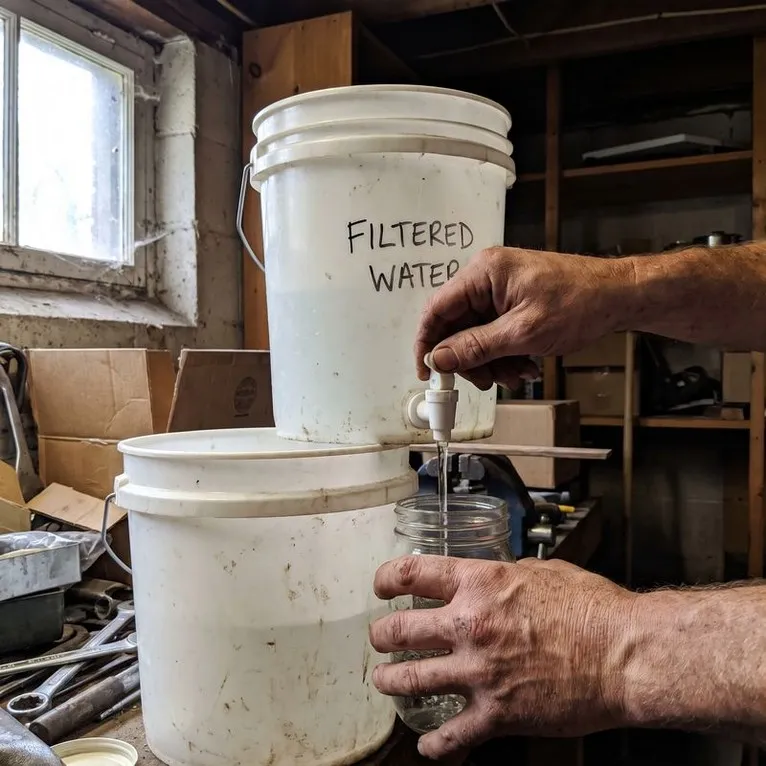
- Settle and filter. Let cloudy water stand, then pour it through a clean cloth or coffee filter, as EPA advises. A ceramic filter does far better. The Handbook's Project 3 builds a two-bucket gravity drip filter in about 40 minutes for about $55, per the book, and it delivers one to two gallons an hour.
- Disinfect. Boil the filtered water at a rolling boil for 1 minute, or 3 minutes at high altitude (CDC uses 6,500 feet as the line, EPA uses 5,000, so boil 3 minutes if you live above 5,000 feet). Or add 8 drops of 6% unscented bleach per gallon, or 6 drops of 8.25% bleach, stir and wait 30 minutes, per EPA. The full chart is in how to purify water with bleach.
- Store it clean. Keep treated water covered, in a clean container, and use it first.
The filter step is not optional. The book's safety box on Project 3 says a ceramic filter removes sediment, protozoa and most bacteria, but it does not reliably remove viruses, which is why disinfection always follows. Project 6 puts both methods on one laminated card so nobody is counting drops from memory.
What filtering and boiling will not fix
Boiling and bleach work on germs. They do nothing for chemicals. The Handbook's Project 6 is direct about it: these methods do not address fuel, pesticide or heavy-metal contamination, and chemically contaminated water should not be "disinfected" and drunk.
That rules out rain from a roof that was just treated with moss killer, water that ran over fresh tar or paint, and anything that smells of fuel. When in doubt, use stored water or bottled water, and follow your local authorities.
Two more cautions from CDC. First, do not mix rainwater into treated water: pouring rain into a jug of tap water can make the tap water less safe. Second, whenever possible, CDC suggests tap water from a public system or bottled water, not rainwater, for drinking, cooking, brushing teeth and rinsing produce. That matters most for anyone at higher risk of getting sick from germs in water, which is one of the factors CDC lists.
Is it safe to drink rainwater every day?
It can be, but only as a system you own and test, not as a barrel you dip into. CDC says that if you drink, cook or bathe with rainwater, you should test it regularly for germs and chemicals and ask your health department which ones to test for.
The Texas manual describes what most permanent drinking systems use: a suitable roof, opaque food-grade storage, then sediment filters and a disinfection step such as ultraviolet light, with NSF-certified equipment and filters changed on schedule. Our guide to a rainwater collection system for drinking water walks through each part, including the Handbook's Project 15, which ends in one labeled potable tap.
Testing is what turns "probably fine" into a number. Project 13 of the book pairs home strips for quick screening with a certified lab for decisions; see how to test water quality at home and, for the lab side, how to test well water.
Is it legal to collect rainwater?
In most places, yes, but rules differ by state. CDC notes that some states treat rainwater as state property and regulate how it is collected, and points readers to the Department of Energy's rainwater harvesting map and to state environmental or health departments. Check before you buy a large tank, and ask your health department before using rainwater for drinking.
Can you drink rain water? The practical answer for most households
Keep stored tap water for drinking, as in how to store water long term, and use the rain barrel for the garden, flushing and washing. Keep a filter and a bottle of fresh unscented bleach ready, and the barrel becomes a real backup if the stored water runs out.
Frequently asked questions
Is rain water safe to drink?
Not as collected. CDC says rainwater is not necessarily safe to drink without first removing germs and chemicals. Dust and smoke in the air, bird droppings on the roof, and metals from roofing, gutters and pipes can all end up in it, even when it looks clear.
How do you make rainwater drinkable in an emergency?
Let it settle, filter it through a ceramic filter or at least a clean cloth, then disinfect it. Boil it for 1 minute (3 minutes above 5,000 to 6,500 feet), or add 8 drops of 6% unscented bleach per gallon and wait 30 minutes, per EPA. This handles germs, not chemicals.
Can you drink rainwater straight from the sky?
It is cleaner than roof runoff, but CDC notes that dust, smoke and other airborne particles can contaminate rain before it lands. In farm areas it can also carry fertilizer and pesticide residue. Treat it the same way: filter, then disinfect.
Does boiling rainwater make it safe?
Boiling kills germs, including viruses, but it does not remove chemicals such as lead, fuel or pesticides. Do not drink rainwater from a roof recently treated with moss killer, or water that smells of fuel, even after boiling.
Sources
- The Off-Grid Handbook, Garrett Dalton, Project 3
- CDC: Collecting Rainwater and Your Health
- EPA: Emergency Disinfection of Drinking Water
- Texas Water Development Board: The Texas Manual on Rainwater Harvesting
- U.S. Department of Energy: Rainwater Harvesting Regulations Map
- CDC: Water Treatment for Hiking, Camping and Traveling
Safety guidance changes. Check the agency pages above for the current version, and follow your local code and manufacturer instructions.