Rainwater collection system for drinking water: parts, treatment and testing
A rain barrel and a drinking water system share a downspout and little else. The difference is treatment, testing and one clearly labeled tap.
In this article
- Can a rainwater collection system for drinking water be safe?
- The parts of an off grid drinking water system
- Choosing a roof, gutters and tank that are safe for drinking water
- Treatment: filter first, then disinfect
- Testing with a certified lab before anyone drinks
- Rain barrel for drinking water: what changes
- Keeping the system safe year round
- Frequently asked questions
A rainwater collection system for drinking water runs in a fixed order: a suitable roof, screened gutters, a first flush diverter, covered opaque storage, a filter, a disinfection step and one tap that is labeled as the only drinking water. Nobody drinks from it until a state-certified laboratory has tested the water from that tap. CDC adds that the system must never feed into pipes that carry treated tap water.
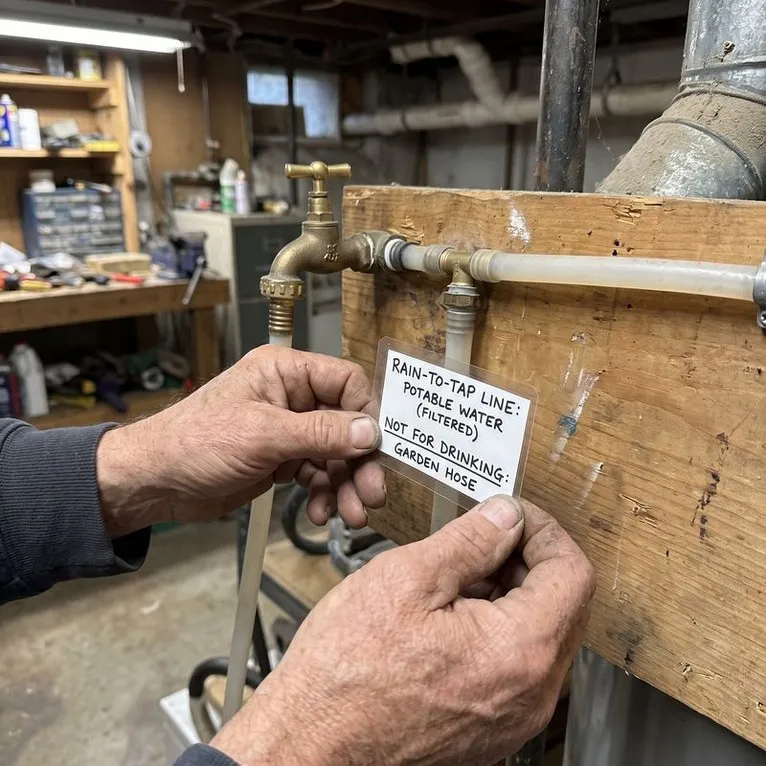
That is the shape of Project 15 in The Off-Grid Handbook, The Full Rain-to-Tap Line: a hard, weekend-long build that the book prices at $250 to $300 on top of the earlier water projects. Its safety box is short: one tap potable, everything else non-potable, and the labels say so.
Can a rainwater collection system for drinking water be safe?
It can, with the right equipment and upkeep. The Texas Manual on Rainwater Harvesting says that with minimal treatment and adequate care of the system, rainfall can be used as drinking water. The same manual says rainwater for household drinking use must be treated with appropriate filtration and disinfection.
CDC is more cautious. If you have access to a public water system or bottled water, it suggests using those for drinking, cooking and brushing teeth, and keeping rainwater for uses where you are less likely to swallow it. If you do drink rainwater, CDC says to test it regularly and ask your health department what to test for.
So a drinking system makes you, in the Texas manual's words, the owner of your own water supply: responsible for filters, testing, leaks and repairs. For the shorter emergency question, see can you drink rain water.
The parts of an off grid drinking water system
The book's first step happens on paper: catchment area, diversion volume, chain capacity, tank height, filter throughput and disinfection point, with the numbers from each project on one page. Our rainwater harvesting calculator covers the catchment math.
| Stage | What it does | In the Handbook |
|---|---|---|
| Roof and gutters | Catch the rain; screens keep out leaves | Project 8, gutter screening and roof prep |
| First flush diverter | Dumps the dirtiest first water of each storm | Project 2 |
| Barrel chain | Stores the water, linked at the base | Project 9 |
| Elevated tank | Gives gravity pressure, no pump needed | Project 14 |
| Filter | Removes sediment, protozoa and most bacteria | Project 3 |
| Disinfection | Kills what the filter misses, including viruses | Project 6 |
| Labeled tap and test | One potable outlet, tested before use | Projects 13 and 15 |
Build upstream to downstream, the book says: roof prep, diverter, chain, tank. Then insert the treatment pair between the tank and the tap.
Choosing a roof, gutters and tank that are safe for drinking water
Treatment starts with what the water touches. The Texas manual recommends a plain galvanized roof or a metal roof with epoxy or latex paint for drinking systems. It says composite and asphalt shingles are not advisable, because compounds can leach into the water. Most American houses have shingles, so this one fact decides whether your main roof can feed a drinking system at all.
- Gutters: no lead solder, which older metal gutters sometimes have.
- Storage: food-grade, opaque so algae cannot grow, covered, with screened vents against mosquitoes, and never used for toxic materials.
- Access: tanks must be reachable for cleaning.
- Certified materials: some states set rules too. The Texas manual notes that Ohio requires plastic and fiberglass tank materials, joints and sealants to meet NSF/ANSI Standard 61 for drinking water system components.
Clean gutters matter more than any filter, because the cleaner the roof, the less the treatment has to do. The book's Project 8 safety note applies to every gutter job: use a ladder stabilizer, keep three points of contact, and never work a roof edge alone or in wind. Our guide to how to clean gutters covers it.
Treatment: filter first, then disinfect
Every source agrees on the order. Filtration clears the water; disinfection makes it safe. Disinfection works poorly on cloudy water, so the filter always comes first.
The Handbook's line uses a two-bucket ceramic drip filter rated 0.2 to 0.5 micron feeding a disinfection station that uses boiling or measured unscented bleach, as in how to purify water with bleach. It is slow, about one to two gallons an hour, and needs no power.
The Texas manual describes the most common setup in permanent homes: a 5-micron sediment cartridge, then a 3-micron activated carbon cartridge, then an ultraviolet light, all NSF-certified. It warns that cartridge filters must be replaced regularly, or they can harbor bacteria, and that UV lamps need replacing after a maximum of 10,000 hours.
Neither approach removes every chemical. If a lab test shows metals, nitrates or anything else above the limit, ask your health department before you choose equipment.
Testing with a certified lab before anyone drinks
Project 15 says to run a full storm cycle, then test the tap output with Project 13 before anyone drinks a drop, and to test again after any change to the system. Home strips are screening tools; the decision belongs to a state-certified laboratory.
The Texas manual lists the microbes of greatest concern for drinking rainwater: E. coli, Cryptosporidium, Giardia, total and fecal coliforms, Legionella and viruses. Ask your health department which tests to order where you live, and how often to repeat them. How to test well water explains how to work with a lab, and how to test water quality at home covers the strips in between.
Rain barrel for drinking water: what changes
A garden barrel and a drinking water barrel can look the same. The drinking one is food-grade and has never held chemicals, it is opaque and tightly covered, and it sits after a first flush diverter. Its water still goes through the filter and disinfection before the tap.
Keep the line separate from household plumbing. CDC warns that rainwater must not be able to enter pipes carrying safe tap water, so any connection to the house is a question for your health department and a licensed plumber. Rules on collecting rainwater also vary by state; the Department of Energy keeps a state map.
Keeping the system safe year round
The book posts a laminated system map at the tap: what is potable, what is not, and who maintains what. Then it schedules the work: screens each fall, filter service by flow rate, disinfection stock by date, and winterization by first frost. A line that is maintained on a calendar stays safe; one maintained from memory drifts.
Frequently asked questions
Can a rainwater collection system provide safe drinking water?
Yes, if it is built and run as a drinking water system: a suitable roof, opaque food-grade storage, filtration followed by disinfection, regular testing by a certified lab, and steady maintenance. Rainwater for drinking must be treated; collection alone does not make it safe.
Can you use an asphalt shingle roof for drinking water?
The Texas Manual on Rainwater Harvesting says composite and asphalt shingles are not advisable for drinking water systems, because compounds can leach into the water. It recommends a plain galvanized metal roof or metal with epoxy or latex paint. Shingle runoff is fine for irrigation.
What filter do I need for drinking rainwater?
A filter alone is not enough. Common setups use a 5-micron sediment cartridge, a 3-micron carbon cartridge and an ultraviolet light, or a gravity ceramic filter followed by boiling or bleach. Use NSF-certified equipment and replace cartridges on schedule.
How often should I test drinking rainwater?
Test the tap output with a state-certified lab before first use and after any change to the system, then on the schedule your health department recommends. CDC says to test regularly if you drink, cook or bathe with rainwater. Home strips help spot changes in between.
Sources
- The Off-Grid Handbook, Garrett Dalton, Project 15
- CDC: Collecting Rainwater and Your Health
- Texas Water Development Board: The Texas Manual on Rainwater Harvesting
- EPA: Emergency Disinfection of Drinking Water
- EPA: Protect Your Home's Water (certified laboratories)
- U.S. Department of Energy: Rainwater Harvesting Regulations Map
Safety guidance changes. Check the agency pages above for the current version, and follow your local code and manufacturer instructions.