How much does a rain barrel cost to build, and what else you will pay for
A working rain barrel is more than a barrel. The base, the diverter and the screens make it useful, and the whole setup costs about $60 to build.
In this article
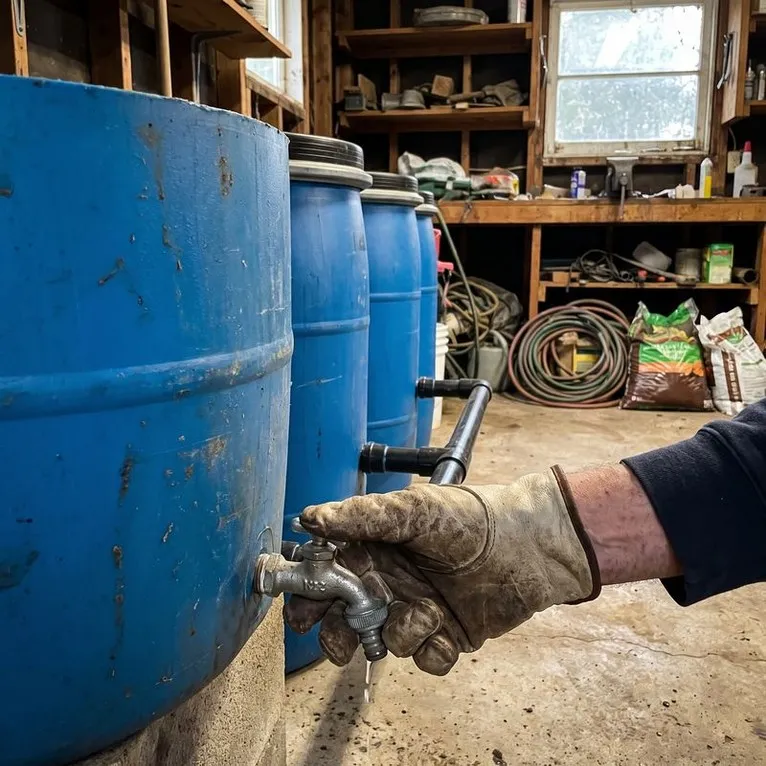
How much does a rain barrel cost? Built yourself, about $60 in materials for a complete working setup, according to The Off-Grid Handbook: a 55-gallon food-grade barrel, a brass spigot, a downspout diverter kit, two concrete blocks and fine mesh screen. Linking two more barrels into a 165-gallon chain adds about $120. The book's prices are 2026 typical retail, and your region will vary.
So how much does it cost to make a rain barrel yourself? That $60 is Project 1, the gravity rain barrel: an easy, 45-minute build. Ready-made barrels and kits are sold too, and EPA notes that many cities and towns distribute rain barrels to residents through annual sales, so check with your town before buying.
How much does a rain barrel cost to build?
The parts list for Project 1 is short. Here is what each piece does and why it is worth paying for.
| Part | What it does |
|---|---|
| 55-gallon food-grade barrel | The storage; never one that held chemicals |
| 3/4-inch brass spigot, locknut and washers | The tap; washers inside and out stop leaks |
| Downspout diverter kit | Fills the barrel and sends overflow back down the spout |
| Two concrete blocks | Height, which is your water pressure |
| Fine mesh screen | Keeps out leaves, grit and mosquitoes |
| Total, per the Handbook | About $60 |
Tools are a drill with a hole saw matched to the spigot, a hacksaw, an adjustable wrench and a level, which many households already own. The build itself is in how to set up a rain barrel.
Where the money actually goes
A used food-grade drum keeps the cost down, but it needs care. Rutgers Cooperative Extension says a used barrel should be scrubbed with soap and water and triple-rinsed before use, and the Handbook is firm that it must never have held chemicals.
The parts people try to skip are the ones that make the system work. The blocks are not optional: the book's field note says the most common first-build mistake is putting the barrel on the ground, where it cannot fill a watering can. Each foot of height adds roughly 0.43 psi.
The screen is not optional either. CDC says that without a screen where the water enters, a barrel needs emptying at least every 10 days to stop mosquitoes breeding. A few dollars of mesh saves that chore. The diverter handles overflow, which matters because one inch of rain on 1,000 square feet of roof yields roughly 600 gallons, per the book.
Rain barrel kit or DIY: what to compare
Ready-made barrels and kits save drilling and fitting time. When you compare one against the $60 DIY list, check what is included:
- Is the barrel food-grade and opaque? Opaque plastic limits algae; the Texas Manual on Rainwater Harvesting calls for opaque storage.
- Is there a diverter or an overflow fitting? Without one, you still need to buy it.
- Are all openings screened?
- Does it include a stand? If not, add blocks or a stand; see DIY rain barrel stand.
- Is the spigot placed a few inches up the side, as the book specifies at 3 to 4 inches?
A cheap barrel that needs every accessory added is not a bargain. A town sale barrel plus your own blocks and screen often is.
How much does it cost to add more barrels?
Once one barrel works, most people want more storage. The Handbook's Project 9 links two additional food-grade barrels to the first with 3/4-inch bulkhead fittings and short links near the base, plus an overflow kit for the last barrel. It is a medium, two-hour job at about $120, per the book.
| Setup | Storage | Cost in the Handbook | Cost per gallon stored |
|---|---|---|---|
| One barrel (Project 1) | 55 gallons | ~$60 | about $1.10 |
| Three-barrel chain (Projects 1 + 9) | 165 gallons | ~$180 | about $1.10 |
The cost per gallon stays about the same, so storage grows in step with your budget. Linking them at the base matters: the book notes that top-linked chains strand the bottom half of every barrel. Full instructions are in how to connect rain barrels together.
Add-ons worth budgeting for
Three small projects in the Handbook protect the barrel and the water in it. Each is listed at its book price.
- First flush diverter, ~$25, 30 minutes (Project 2). Dumps the dirtiest first water off the roof; see first flush diverter.
- Gutter screening and roof prep, ~$30, 1 hour (Project 8). Mesh for every run that feeds the barrel and a downspout leaf strainer. The book's safety note: use a ladder stabilizer, keep three points of contact, and never work a roof edge alone or in wind.
- Winterizing, ~$30, 2 hours (Project 12). Insulating wrap and covers, plus draining to one-quarter or empty before the first hard freeze; see how to winterize a rain barrel.
The book groups its projects into build tiers. A Starter tier runs about $40 to $80 and a Core tier about $120 to $180, so a barrel and its add-ons fit a Starter budget, and a three-barrel chain lands in Core.
Ways to keep the cost down
- Ask your town first. EPA notes that many cities and towns sell rain barrels to residents through annual sales. Your water utility or conservation district may know about one.
- Use what you have. Concrete blocks, a level and a drill are often already in the garage.
- Start with one barrel. Add more later as Project 9 shows, without throwing anything away.
- Spend on the spigot. A brass spigot with washers on both sides is the part most likely to leak if you cut corners.
What a rain barrel does not cost
Once it is built, a gravity barrel has no running costs: no pump, no power, no filters to replace for garden use. The yearly upkeep is cleaning gutters, checking screens, rinsing the barrel once a year, and draining it before winter.
One thing the price does not buy is drinking water. The Handbook says rainwater from a roof is not drinking water as collected. Turning it into drinking water takes filtering, disinfection and testing, which is a different budget; see can you drink rain water.
Frequently asked questions
How much does it cost to make a rain barrel?
About $60 in materials for a complete setup, according to the Off-Grid Handbook: a 55-gallon food-grade barrel, a 3/4-inch brass spigot with washers, a downspout diverter kit, two concrete blocks and fine mesh screen. Prices are 2026 typical retail and vary by region.
Is it cheaper to buy or build a rain barrel?
It depends on what the kit includes. Compare any kit with the DIY list: food-grade opaque barrel, spigot, diverter or overflow, screens and a stand or blocks. Many towns sell rain barrels to residents through annual sales, which can be the cheapest start.
How much does it cost to connect three rain barrels?
The Off-Grid Handbook prices two extra barrels, bulkhead fittings, links and an overflow kit at about $120, a two-hour job. Together with the first barrel, a 165-gallon chain costs about $180, roughly $1.10 per gallon of storage.
Does a rain barrel have ongoing costs?
Very few. A gravity barrel needs no power or pump. Plan on cleaning gutters, checking screens, rinsing the barrel yearly and draining it before the first hard freeze. A winterizing kit of wraps and covers runs about $30, per the Handbook.
Sources
- The Off-Grid Handbook, Garrett Dalton, Project 1
- EPA: Soak Up the Rain, Rain Barrels
- Rutgers Cooperative Extension: Rain Barrels Part II, Installation and Use (FS1118)
- CDC: Collecting Rainwater and Your Health
- Texas Water Development Board: The Texas Manual on Rainwater Harvesting
- Alabama Cooperative Extension System: Rain Barrel Maintenance
Safety guidance changes. Check the agency pages above for the current version, and follow your local code and manufacturer instructions.